
The Midwit Manifesto
the judgment that clapped through a "stroke"

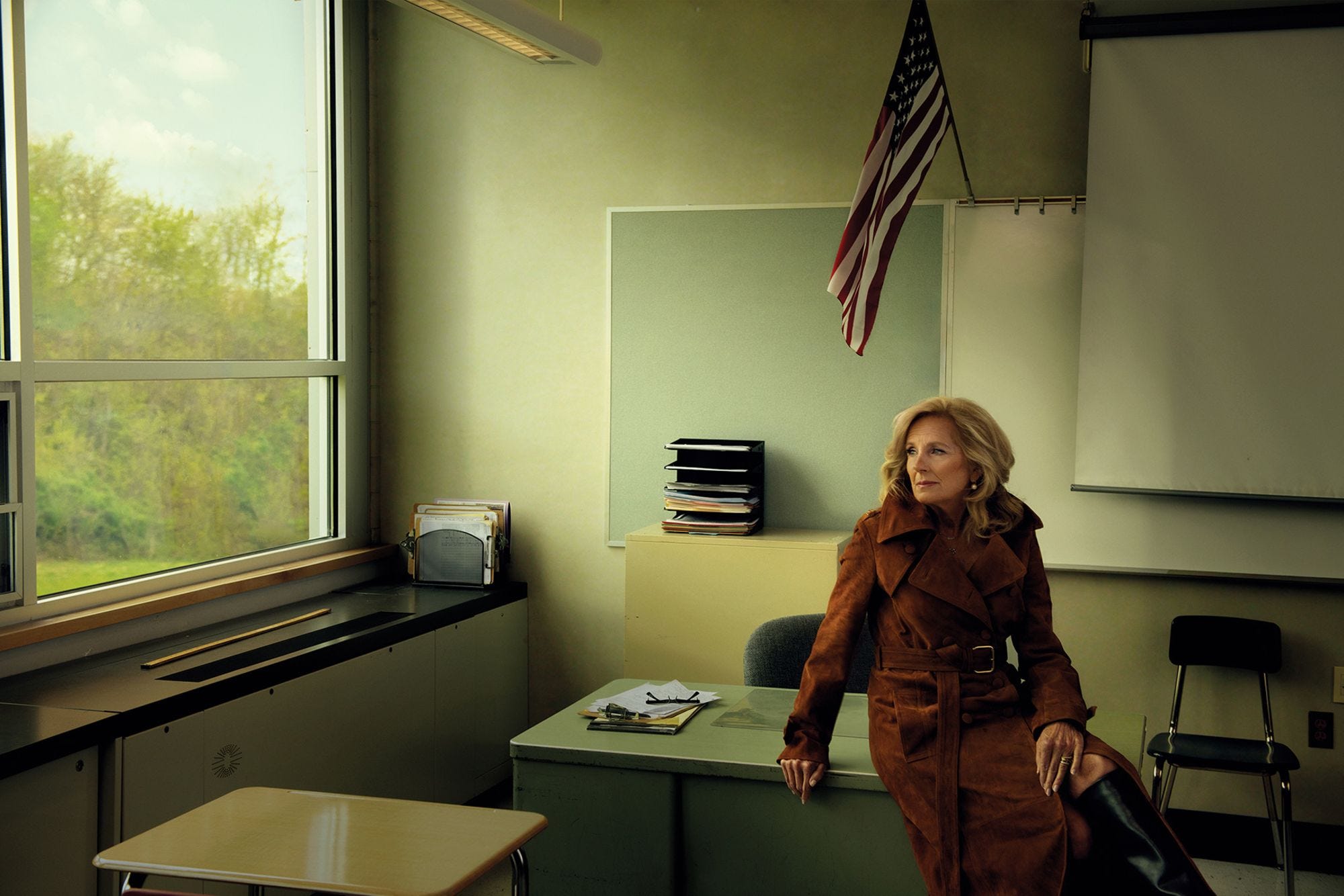
This is a close reading, mockery, and dissection of Jill Biden’s dissertation, which earned her a doctorate of education degree.
I wrote this in July 2024, a few days before the assassination attempt in Butler and the candidate switch that followed. I am republishing it unedited — so it still reads as though Joe Biden is both President and running for reelection — because Jill Biden’s memoir, View from the East Wing, comes out Tuesday, and I intend to review it.
The book makes republishing this feel less like nostalgia and more like vindication. Its entire purpose, by the read of nearly everyone who has seen an advance copy, is to dispel the accusation that Jill was the hidden hand covering for her husband’s decline and keeping him in power past the point his mind could sustain it. Her chosen method of dispelling it is to deny the premise: she now insists Joe was merely “slowing down,” not in cognitive decline, even as he ran for a second term. And here is where the book hands me the exact argument I make below — that whatever Jill Biden is, a person whose judgment about her husband’s mental fitness can be trusted is not it.
Because in the same memoir, describing that debate, she writes that she watched the opening and thought: Is he short-circuiting? Is this a stroke? She compares the man on stage to “an AI hologram” that was “glitching.” She wondered, in real time, whether he’d been drugged or was having a medical emergency. Then she walked him offstage, took him to a Waffle House, flew to North Carolina for a rally — and kept campaigning.
You’ll remember what she did at that rally. The infamous summer-camp-counselor routine, the “you did such a good job, Joe! You answered every single question!“ — the tone one uses on a kindergartner who sat still through circle time.
This was in stark contrast to what a sane person who honestly believed her husband was having a stroke on live television would have done:

We were told at the time this was loyalty, or stagecraft, or denial.
Without irony or self-awareness, the book claims (according to reports, anyway) that it was something stranger and worse: she did the kindergarten voice while privately believing her elderly husband may have just had a stroke on live television. That is not a woman managing optics. That is a woman whose response to suspecting a medical catastrophe in the person she loves most was to clap and praise his participation. I spend the next eleventy-nine paragraphs documenting that this is precisely the judgment on display in her doctoral dissertation — the inability to recognize when a number is wrong, when a confidence shouldn’t be published, when the obvious thing in front of her is the thing that matters. Eighteen years apart, same mind, same blind spots, same cheerful refusal to notice the load-bearing fact in the room.
A full review of View from the East Wing is coming, and it will join my reviews of the recent books by Kamala Harris, Karine Jean-Pierre, Jake Tapper, Michelle Obama, and Gavin Newsom, and my recent autopsy of the DNC’s autopsy of the 2024 election. As regular readers know, my reviews are long, thorough, and detailed enough that you will come away knowing everything that actually matters in the book without having read a page of it. So rather than giving Jill Biden your money, consider putting that money toward something more useful to the republic: reducing my student loan balance.
Upgrade to paid, and I’ll do the reading so you don’t have to.
What follows is the original piece, exactly as it ran in July 2024.
Special thanks to my friends J. Daniel Sawyer and Josh Slocum for their editorial assistance and encouragement as I worked on this epic-length post.
Why Jill Biden’s Dissertation Matters
During the debate of June 27, 2024, Americans got sufficient evidence to accept that our country is in the situation that many of us suspected: Joe Biden is non compos mentis, suffering from cognitive decline too severe to allow him to serve as President in anything other name.
The 25th amendment is typically invoked, and power transferred to the Vice President, when the President of the United States has a colonoscopy and thus will be under anesthesia for an hour. That the President is suffering from dementia and power has not transferred to the Vice President means that the country is in the midst of an ongoing coup.
No, that’s not melodramatic. Who is running the country? We don’t know for sure. But now we know that it’s definitely not the person we elected. By definition, that is a coup.
It may be that a diffuse group is carrying out the duties of the President, but it is still likely that one person is putting paper and pen in Joe Biden’s hands and telling him where to sign. That’s the person who is acting President for my purposes. The most likely candidate for acting President is First Lady Jill Biden. I may be wrong; it may be someone else entirely. But there is good reason to suspect her, and she’s the only named candidate of which I am aware. In the absence of contradictory evidence, it is a reasonable working assumption.
With that context in mind, I carefully and closely read her dissertation to get an idea of her intellectual capabilities and worldview. I skimmed it a few years ago during the “call her doctor!” controversy, but this time I read it quite closely.
I wanted to understand what sort of mind will be making the decisions if the President has to be woken up to make nuclear decisions. How does she think? What kind of work ethic does she have? Is she intelligent and conscientious?
What I learned was more than a little bit startling.
Her Dissertation in Context
Jill Biden was awarded her doctorate of education from the University of Delaware in January 2007, the capstone of an education that included a bachelor’s degree in English and master’s degrees in education and English. She also has longtime experience teaching English at the community college level.
A doctoral dissertation represents an original contribution to the body of knowledge in its field. It involves the extensive collection and rigorous analysis of substantial data. Beyond its scholarly significance, a dissertation serves as a showcase of one's mastery and academic prowess. If there is any work that merits meticulous attention, including enlisting others to painstakingly review it for errors, it is unquestionably the doctoral dissertation.
The title of the dissertation is: “Student Retention at the Community College: Meeting Students’ Needs”. Note that this seems to speak to a broad topic — the needs of community college students in general.
Summary of the Dissertation Itself
Y’all, I think I understand why the Biden family thinks it’s fine for Dementia Daddy to keep running the country. It may not, actually, be a sick desperation to hold onto power. Or at least, not fully.
It really and truly might just be that with Jill as Matriarch, their standard for intellectual capacity is so low that Joe seems to be just fine by comparison.
Her dissertation is so terrible, lazy, pathetic, and lacking in anything that’s even ambition-, originality-, or creativity- adjacent, that I wondered if clever conservatives wrote a parody and flooded the internet with it. But there is a lot of coverage of how bad it is, and the issues described match what I found, confirming that yes, I read her actual dissertation.
The university who gave her a doctorate for this travesty also issued a statement in support of her, which served as final proof, universities being what they are these days.
I had to choose what to mock and what to ignore, in order to prevent this post from being as long as the dissertation itself. Even so, this is very long. Some of the most revealing, jaw-dropping aspects are in the sections on Papers 2 and 3, so I hope at least some of you will read all the way to the end.
The document is 137 pages, of which the dissertation itself, from Abstract to Conclusion, is 80 pages. The majority of the 80 pages consists of putting the survey results into words, often with unforgivable mistakes of simple arithmetic. For example: “Of the 159 students surveyed, 55 receive financial aid; 41 pay their own tuition bills; 45 students’ parents pay; 3 spouses pay; 9 receive scholarships; and 9 others receive funds through the GI bill, vocational rehabilitation programs, or grants. Thus, only one-quarter of the students are able to finance their education themselves.”
First—yes, this doctoral dissertation surveyed only 159 students. Or was it 162? The breakdown subtotals add up to 162, not 159. This error is symptomatic of the lack of attention to detail in the whole project.
The rest of the page count is taken up by several appendices and transcripts of interviews.
The entire thing can be summarized in a few sentences: community college students often drop out, and this is bad for community colleges. Community college administrators can help fewer students drop out by asking themselves, “What would an overindulgent mommy who was terrified of having her adult children no longer need her do to make them as dependent as possible?” Then, after answering that question in full, start doing those things.
Midwit Manifesto: Abstract and Introduction
The final sentence of the one-paragraph Abstract provides the reader a taste of the insipidity to come: “Overall, problem areas are identified, and recommendations and solutions are offered and encouraged.” If you’re wondering how a solution can be encouraged, congratulations on speaking English, not bureaucratese. She means, of course, that she encourages people to offer potential solutions. The entire paper demonstrates one of the most powerful elements of that odious English dialect. In bureaucratese, qualifiers and transitional phrases get dropped in order to artificially basket non-similar items, which lends an air of disinterested authority to an otherwise stupid thought.
But it only does that effectively when the sentence doesn’t jump out at the reader as the kind of error likely to be made by an English language learner, who hasn’t mastered the language effectively enough yet to understand that only people can have courage and thus only people can be encouraged.
The abstract promises to focus on four types of student needs: academic, psychological, social, and physical. If you are anticipating reading about how the college can only effectively meet academic needs but can possibly provide some support to students and their families in meeting the other three types of needs themselves, well, prepare for disappointment.
The abstract also promises to discuss “the nature of the pre-tech (developmental) population”. It implies that the entire paper is about that particular population, but sets the tone for what is to come by not being clear on that point.
The introduction has an error in the second sentence: “The needs of the student population are often undeserved, resulting in a student drop-out rate of almost one third.” She meant “underserved,” which is the primary idea in her paper: community college students drop out because community colleges don’t do a good enough job of meeting their needs.
The introduction lays out the structure of what readers can expect. Paper I will provide a literature review in student retention, studying the promised four areas: academic, social, psychological, and physical. Paper II, the methodology section, includes interviews with faculty and students as well as an interview with Dr. Vincent Tinto, who is described as a “student retention expert,” and the results of what she calls “surveys.” It also looks at the student retention rates for Delaware Tech from 2002 to the present.
At the time she wrote this paper, 2006, that was a whole four years.
She studied four years worth of records of one set of statistics on one metric.
For her doctoral dissertation.
Finally, Paper III “discusses solutions and recommendations to the problem of student retention at Delaware Technical & Community College”. Compare this to the title, which promises insight into a broad topic, and note that we’ve already moved to a tiny, niche topic — the needs of one community college’s students, based on four years of statistics and her “surveys”.
It also moves back into English-language-learner territory with the sentence: “It offers a reflection of the information and statistics gathered.” Perhaps she meant that it reflects on these things, or perhaps she meant that this section reiterates these things and thus provides “reflection” in the sense of providing an angle of examination? We shall see!
Midwit Manifesto: Overview, Historical Background, and Pre-Tech
The overview kicks off one theme of this paper: innumeracy, lack of attention to detail, and inexcusably stupid word-count padding. She starts with describing the “face” of a community college classroom. “Three quarters of the class will be Caucasian; one quarter of the class will be African American; one seat will hold a Latino; and the remaining seats will be filled with students of Asian descent or non-resident aliens.”
Three quarters plus one quarter…plus some extra!

“Almost two-thirds will be part-time students, with the remaining one-third attending college on a full-time basis.” Really, Jill? With 2/3 being part-time, I thought the other third were tenured professors on sabbatical taking community classes for fun. Thanks for clearing that up!
Interestingly, she freely admits that diversity in classrooms often results in lower standards. I believe this is what the kids call “saying the quiet part out loud”: “Although there is strength in diversity as a classroom component, the lack of homogeneity in academic ability makes it difficult to teach to a single standard.”
The Overview goes into great detail about how Delaware Tech accepts everyone, regardless of how ill-prepared they are for college: “The open door policy at Delaware Tech ensures that all students can pursue the American Dream of attaining a college education. The placement test (CPT) places students into classes where they can achieve success – whether it is basic level, pre-tech level, or regular college credit level courses.” As all students must have a high school diploma or equivalent, this is a stunning admission — that some students, upon entrance, place into courses that are two levels below college credit.
Rather than comment on this, Biden immediately moves to a declaration that community colleges have a high dropout rate because the community college is not an attentive enough parent. She lists all the extra help available, including writing labs and tutoring in every academic department, but concludes: “Yet, with all these services offered, the needs of the student population are underserved.”
Historical Background
In the Historical Background section, she writes about the history of community colleges and betrays, through her citations, how deeply lazy she was in the preparation of this project. She cites many sources, and in nearly every case, the page number is something between page 1 and page 30. How convenient! In the sole case where she cites a page number above 30, the citations are all from three pages in a single source.
She summarizes a movement in the late 19th and early 20th centuries to have universities focus on the junior and senior years, relegating freshman and sophomore year work to “junior colleges,” as being the root source for the creation of community colleges. She also describes a “debate” between advocates of two ideas: whether community colleges should offer vocational and technical training, thus focusing on increasing student earning power, or focus on preparing students to move on to four-year colleges, thus prioritizing academic rigor.
This section is mostly error-free, but that’s because it’s largely not her writing. It mostly consists of simply stringing together and citing facts, usually as direct quotes: “Two major events influenced the positive direction of the community college: The Truman Commission on Higher Education ‘popularized the term community college, and its findings led to the massive expansion of comprehensive community college that took place in the 1950s and 1960s’ (Witt et al., 1995, p. 87), and the early proponents of the community college, ‘Koos, Cambell, Ellis, and Zook, pushed for comprehensive junior colleges that would meet the diverse needs of the American population’ (Witt et al., 1995, p. 87).”
After a detailed explanation of how the GI Bill expanded college access for the middle and working class, she describes the founding of Delaware Tech by the in-depth research of….quoting from page two of its catalog.
Pre-Tech Students
The next section introduces “pre-tech” students, the cohort of students whose needs she is mostly concerned with meeting.
Pre-Tech Students are described in admirably honest terms: “At Delaware Tech, the term “pre-tech” is synonymous with developmental learners. These learners are most often defined as lacking in basic educational skills, possessing low IQ levels, lacking study skills, and/or possibly learning disabled.”
Midwit Manifesto: This Woman Doesn’t Understand Percentages
In the pre-tech section, she cites a statistic that 74% of first-time community college students required a developmental education and claims, “At Delaware Tech, the numbers of students in pre-tech classes substantiate the increasing percentages.” Then she lays out the specific numbers of developmental and college-level course sections at Delaware Tech, which she manages to add correctly. There are 102 developmental sections and 177 college level sections. She then concludes, “The percentage of developmental classes mirrors the general research at 71.3 percent of total classes offered.”
I have no idea how she made this ludicrous mistake. I am an experienced mathematics tutor and can usually figure out what someone was thinking and where they went wrong. In this case, I am mystified.
She calculated that there were 102 developmental sections and 177 college level sections. There are significantly more college level sections, yet she concluded that the developmental sections were 71.3% of the total sections offered.
102 + 177 = 279.
102 is 36.6% of 279.
Where did 71.3% come from?
She didn’t just reverse the figures, as the college level courses were 63.4% of the total. 102 is 57.6% of 177, so that’s not the mistake she made, either. I have no idea how or where 71.3% was found out of these numbers.
I went over this several times, and had several friends go over it as well. In the spirit of charity, I tried to think of how she could possibly have arrived at this number. All I could come up with for an idea was this: perhaps 71.3% is a statistic regarding developmental learners elsewhere in the Delaware Tech statistics she examined, and was cited here out of disorganization. Then perhaps it made its way into the final draft because she didn’t have the mathematical intuition to recognize that 102 is less than 177 and thus could not be a majority of the course sections.
A bright sixth-grader with a calculator was definitely called for to check her work in this doctoral dissertation.
This is more significant than it may at first appear. This isn’t just a math nerd being snobbish about someone being sloppy with numbers.
Her entire paper is written from the premise that Delaware Tech offers an appropriate model for commenting on broad issues of student retention in community colleges. But according to her own offered numbers, Delaware Tech’s percentage of developmental sections is 36.6%, less than half the cited statistic for community colleges in general.
The entire rest of the paper is based on the false premise that Delaware Tech offers a good proxy for community colleges in general and thus her “survey” of Delaware Tech students is meaningful to larger issues in education.
This should have taken her paper in an entirely different direction! She should have been examining Delaware Tech from the lens of “why does a community college whose population is radically different from normal community college populations still have a retention problem?”
And you know what? That would have been an interesting and worthwhile project, in competent hands. One possibly even worthy of a doctoral dissertation.
End of Overview
Here she finally comments on the lack of preparation that Delaware high schools are providing, but her sole suggestion is just silly. Many community college students come from a vocational school program, which uses the Modern Language Association (MLA) format. Instead, they should use the American Psychological Association (APA) format. The two citation styles have minimal differences for papers of the length that community college students would be writing, and this suggestion is ridiculous.
Because the switch from (Jones, p. 22) to (Jones, 1997, p. 22) is the real issue for students “lacking in basic educational skills, possessing low IQ levels, lacking study skills, and/or possibly learning disabled.”
Sure, lady.
The final noteworthy element of this section is the extent to which she infantilizes the adult students served by community colleges: “For example, adult students may not realize that they have physical problems such as ADHD, hearing problems, or visual problems. The teacher, in effect, is often the first one to notice that the student is inattentive or squinting or asking a question about material that has just been discussed. It then becomes the responsibility of the instructor to direct a student to the school psychologist or nurse.”
Yes, she really seems to think that community college students drop out because they need their community college instructors to do a better job of figuring out that they need glasses.
It’s something of a trope that every female on the left thinks the job of government is to be everyone’s mother. Like most tropes, it has large elements of truth but quickly becomes a strawman when applied across the board.
But damn if she doesn’t make the trope look reasonable!
My paid subscriptions go to paying off student loan debt and make a huge difference in my life. If you enjoyed this, please consider upgrading!
Midwit Manifesto: Paper I
Paper I is a literature review of student retention issues. Literature review is by definition reviewing things other people have written, but in a doctoral dissertation, it should still be compelling and offer original thoughts from the dissertation writer.
Hers is not compelling and not even her admirably thorough lack of originality is original. Instead, it offers nothing but banal, barely-competent recitation of profoundly obvious ideas from the literature, with few exceptions.
Paper I begins with a non sequitur. “Unfortunately, even before the school year begins, ‘institutions must be innovative, creative and clear in their approach to retain students, not to mention setting measurable goals’.” Why this is unfortunate, or why institutions wouldn’t want to be innovative, creative, and clear, or to set measurable goals, is never explained.
Advisement
Then there is a long section about the importance of advisers to student retention, which reads like an eighth-grade report—the kind of thing that teachers assign to give students practice in writing about known facts.
Students who feel connected to their advisors tend to feel connected to their campus and are less likely to drop out.
Really? WOW!
Mentoring
The section on mentoring has jaw-dropping insights sprinkled in, connecting citations from literature with pearls of wisdom such as: “The best mentors are the faculty or staff with whom a student seems to connect.”
But there is one citation on mentoring that is noteworthy both for mentioning men and for being from page 72 of a book: “In one study, Yale psychiatrist Daniel J. Levinson found that men who were successful in life all had three aspects in common: they had a vision of what they wanted to achieve, they made friendships with people who could emotionally support them, and they sought a mentor to help guide them to success (Gardner & Jewler, 2004, p. 72).”
Ethnic Groups
After blaming a “lack of diversity” for various problems faced by ethnic groups in community colleges, there is some admirable honesty to be found in her connecting ideas: “Moreover, many minority students lack basic skills such as identifying the main idea and supporting statements, identifying parts of speech or using punctuation correctly; thus, they are placed in remedial courses.”
Study and Writing Skills
These sections report on the dire state of American education fairly effectively. “Many of the first year college students are lacking basic skills and effective learning strategies. Often, students are placed into study skills courses, but they have difficulty in transferring their knowledge to subject area courses. For example, students may be taught how to find a main idea, but when reading a psychology textbook, they fail to grasp the main ideas of paragraphs or chapters.”
American college students cannot find the main idea of a paragraph.
I bet they know about the gender spectrum!
Social
The section on how social factors can increase student retention is likewise a recitation of entirely obvious notions from the literature, connected by deep insights from Biden such as: “A more compelling reason for students to form friendships is to find ways to engage in learning. Colleges and universities need to find ways to promote student involvement in learning.”
Psychological Issues
In this section, the mommy mindset returns, and in such a way that it indicates she has no idea she’s voicing something even potentially controversial.
To be fair, the writing is so awkward that it may not fully communicate what she intended: “The community college is not only responsible for the academic well-being of a student, it is responsible for the emotional well-being as well. Such an approach to caring about the whole individual is often referred to as the holistic approach to educating an individual.”
Later, she adds (sic): “The emotional stability of student cannot be discounted. Unlike most students at four year colleges, community college students handle more responsibilities such as work and children and often feel more stress.”
Students at community colleges having jobs and children would seem to indicate they are more and not less capable of assuming responsibility for their own well-being, but what do I know? Despite my awareness that 102 is less than 177, I don’t even have a doctorate in education.
She cites a survey that indicates students at 2-year colleges report a greater receptivity to counseling, but I only know that the results matter because I ran statistical significance testing myself; she does no such thing.
After blaming the problems of “minority, international, first-generation, or immigrant students” on “new forms of discrimination,” she offers the following:
“A chain-reaction is likely to occur. Students must work to pay for school and also to support themselves and their families. At the same time, they must strive to do well in their classes to make more money to support their living styles. Stress, anxiety, and depression set in when the student succumbs to feeling overwhelmed. The first sacrifice has to be school; hence, student retention rates skyrocket if there are no safeguards in place to help students cope with all they are trying to handle.”
Yes, somehow she uses “skyrocket” to mean “something that goes down quickly.”
Physical Health Issues
Before I quote from this section, imagine you are the parent of an eleven-year-old girl doing a report for school. She wants you to read a paper she has written in favor of her middle school adding a Student Wellness Center. She hands it to you, and you read: “Physical well-being ties in closely with mental well-being. Needing a band aid or a few aspirin is not the only reason for a Wellness Center on campus. Many students are dealing with problems such as drug and alcohol related issues, pregnancy, STDs, obesity, smoking, and HIV/AIDS to name a few. Students need a place on campus to address these problems and find solutions.”
Aside from being alarmed that your middle schooler has classmates dealing with pregnancy or STDs, would you have a problem with this paragraph? Probably not. It’s pretty good writing for an 11-year-old.
It’s the first paragraph from this section of Biden’s doctoral dissertation.
The rest of it doesn’t get any better.
Conclusion
The conclusion is a summary of the literature review. I suppose it’s good that she drops her focus on being mommy long enough to admit “Because community colleges are educational institutions, the most important focus must center on the academic success of the students.”
Ah! I spoke too soon. (Emphasis mine.) “Physical well-being, created through the existence of a Wellness Center, is the final piece in providing services to students.”
Physical well-being, created through the existence of a Wellness Center.
Midwit Manifesto: Paper II
Biden’s methodology for gathering data was as follows:
She surveyed a total of either 159 or 162 (see earlier identification of the arithmetic error) pre-tech students, in pre-tech writing and pre-tech reading classes. She says “Two surveys” in this section, and it’s only by scrolling back and forth between the later reporting and this section that I was able to determine what the second survey given to students referred to.
She gave a survey on retention to all teaching faculty.
She gave a “slightly different” survey to counselors.
She held a group discussion of her colleagues: English faculty of pre-tech students.
Eleven full-time English faculty held a discussion on the ongoing development of the campus Writing Center.
Two (yes, two) pre-tech students who had dropped out talked to her about their views on retention.
She sought retention statistics from Delaware Tech to two other community colleges. (Note: she did not actually get these statistics.)
She examined the beginning and end of semester student numbers for English classes taught by full-time faculty for the past four years.
She interviewed a “noted retention specialist,” Dr. Vincent Tinto.
The First Student Survey
The basic information part of the survey is pretty typical, with the exception of question 9:
Your technology 85% or undeclared 15%
Possibly this should have been “you’re,” asking if the student was a technology major or an undeclared major? There is no way to be sure.
After reporting survey results in numbers, she pads her word-count for six pages by reporting the results again, in words: “Almost 38 percent of the students sought help at the Writing Center, whereas 62 percent had never taken advantage of the help offered.”
This section offers almost nothing beyond reporting, except making excuses for students not using the library in their courses: “Three quarters of the surveyed students had never used library services. This statistic may be somewhat misleading as students are capable of doing research on the internet and may not feel a need to check out books, videos, or other reference materials.”
The Second Student Survey
After reporting the survey results in words, she discusses an “Academic Advising Survey” that’s apparently the second survey mentioned in the beginning of this paper.
107 students (out of 167 surveyed) had met with their academic advisor. Because 30 of the 107 students were first-generation students, she analyzed their results separately, on the assumption that these students would be more invested in relationships with their advisors. She filled several pages reporting their results in words, as in (sic): “Over half the students (18/30) felt that advisors respected their rights to make decisions.”
The non-first-generation student section betrayed another basic arithmetic error. 30 first generation students plus 76 non-first-generation students equals 106, not 107. Again, she pads word-count for several pages reporting these results in words and full sentences when a table would have sufficed.
The very first thing that passes for an original idea is found in this section, though the tone is more appropriate for the worried mommy of an eighth grader than adults: “In future student retention studies, it would be interesting to note the students who consistently registered negative answers to questions. These students are the alienated students who could be addressed through early intervention.”
The Faculty Survey on Student Retention
A total of 69 faculty took the survey. The results go on for page after page of inexcusably banal word count and Mommy mindset: “Most of the faculty respondents (47/69) stated that they would be willing to mentor students. Many stated that they felt that mentoring was already an informal aspect of their jobs whether or not they were assigned as advisors. In many ways, the extended responsibility of any teacher is to be a good listener and offer help and guidance in many areas other than subject matter.”
The Counselor Survey on Student Retention
Six counselors took this survey, but she still managed most of a page reporting on the painfully insipid results. “Counselors validated that students need to feel connected to their institutions whether through participating in activities, mentoring, or providing for other student needs.”
Group Discussion of English Instructors of Pre-Tech Students
The errors and simplicity of thought in this section are what caused me to double-check that I wasn’t reading a very clever conservative parody. A few snippets (sic):
“When asked to read out loud, many refuse or stumble over work pronunciation. Because reading and writing are skills that are intertwined, instructors were asked the reading level of most of their students. Eric said that it was definitely below 12th grade level, while Carol said their reading levels were probably middle school level.”
“Instructors were then asked what one solution could be offered to increase student retention. Many felt that better advisement was needed. Mary felt that better advisement was needed.”
“The common theme that runs through what all faculty and pre-tech English faculty, in particular, are saying is that students are lacking study skills. This lack of how to study and organize hinders their success in all subject areas.”
Group Discussion about the Writing Center
This is a partial transcript of a discussion. It’s particularly funny that several people, particularly Elrod, are discussed but their roles, positions, etc., are never explained.
Jerry: Are you keeping track of who’s actually being coached?
Carol: Yes, we weren’t in the beginning, but now we’ve started marking the sign in sheet with an X, so we’ll be able to differ from who is coming to do word processing and who is coming to be tutored. That will be something new for the fall, and I would like to signify who is ESL out of that population. One thing that Bill found is that he is getting a lot of people needing ESL help, and we don’t really have the expertise to handle that.
Jill: Does Elrod?
Carol: A little, but whether or not they’d give him release time, I don’t know.
Is Elrod in a psychiatric ward? Is Elrod in prison? The world may never know!
The first two sentences of the “analysis” of this transcript, given that it’s a discussion of English professors, are so funny that I spewed Coke Zero onto the floor, barely missing my extra monitor:
“Full-time English faculty has worked hard this year to make the Writing Center an inviting place on campus where students feel comfortable coming for help. Instructors have had their classes visit the center, and Writing Center personnel has gone into classes to introduce themselves and to give information about the help students can receive.”
The Two Student Interviews (Both of Them!)
Biden interviewed two students who had dropped out of her pre-tech writing class, Ashley and Greg.
This section was jaw-dropping and likely represents a serious ethical breach.
Ashley had learning disabilities, which she didn’t seek the available help for. Then Biden reports: “At this point, Ashley motioned that she was wanted to talk to me, but unrecorded. She had been in the Rockford Center for a suicide attempt, and things were still not good at home. If Ashley had talked to a psychologist at Del Tech, or even to a counselor, she might have been made to see that Delaware Tech was not the right place for her. She did not have the academic skills to achieve beyond the pre-tech level. She just kept signing up for classes and then failing those classes for a myriad of reasons. She was emotionally fragile and could not possibly have handled the stress of attending school.”
In 2006, when she wrote this paper, Biden knew that her husband was planning a run for President. She couldn’t have predicted that she would be the Second Lady for eight years and later the First Lady, but she knew it was possible that her dissertation would one day be a subject of public scrutiny. To include that detail in this paper when a former student (who she describes as incapable of college work, which arguably can and should nullify any consent she gave to being interviewed for this paper) asked to be unrecorded is frankly disgusting.
It also, in my opinion, seriously calls into question whether her judgment can be trusted about her husband’s mental state. She proves in this dissertation, which she prepared 18 years ago, that she was incapable of sound judgment about when to withhold details of a sensitive nature about a troubled student in written work. (Hint: when she asked for a confidence to be unrecorded, that was also an implicit request for it to be unpublished). She says nothing about changing names or details, and other interviews are wholly unredacted, including the full names of Delaware Tech employees. The Rockford Center is a real mental health clinic near Delaware Tech, as well, so it is reasonable to assume that Ashley was the poor girl’s real name.
The other interview, with Greg, was unremarkable. Greg had medical problems and planned to return to school.
Comparison of Retention Statistics
She sought retention statistics from Cecil Community College in Maryland and Salem Community College in New Jersey, but was unable to get the data: “The retention data from both, however, was illusive and therefore could not be seriously considered.”
This section includes a transcript of a phone call in which an official from CCC says, “I really don’t know. I don’t have those numbers.”
English Department Retention Statistics
She doesn’t give the actual numbers, and frankly I don’t trust her ability to calculate them correctly, but her analysis says: “During that time span, the average drop-out rate in all English classes [not all reported] was 25 percent. In the pre-tech classes, 18.8 percent dropped out of Pre-Tech Reading, whereas 21 percent dropped out of Pre-Tech Writing.”
If accurate, this indicates that the developmental students are being better retained than the overall student body, which is a major point of interest in a dissertation on student retention, but it goes unnoticed.
Interview with Dr. Vincent Tinto
This section is hilarious for how pathetic it is.
Jill: “Through my surveys of faculty and students, the need for a psychologist seems crucial, yet the administration does not seem to support the idea. Do you have any thoughts or comments?”
Tinto: “No, I do not. I don’t know your institution, and I don’t know what its issues are.”
It ends with:
“Dr. Tinto expressed that he did not know of or about my institution, and he did not want any of his comments used in any policy dispute or taken out of context. I assured him that his comments would be used only for the purpose of my dissertation and that he would not be compromised in any way.”
Midwit Manifesto: Paper III
This paper begins with yet another tedious repetition of the survey results, and follows them up with the most mind-numbingly obvious recommendations imaginable as well as some utopian school-as-mommy bullshit. Here’s a snippet, displaying some hilariously awkward constructions:
“Orientation plays an important role in how students perceive their institution. Because Delaware Tech appeals to working men and women, it is imperative that orientation be held several times throughout the week.”
“The faculty in all technologies could work together in determining exactly what skills students need, from test-taking to determining the main idea.”
“Another innovative program that could be piloted is a faculty mentoring program. Many instructors expressed that mentoring was already an informal part of their jobs just by the nature of teaching in a community college.”
“But students at Delaware Tech need a more comprehensive center to deal with social problems and illness: teen pregnancy, AIDS, cancer prevention, and nutrition, among many others.”
Midwit Manifesto: The Questionnaires and Surveys
The appendices report the results (again) and there are more obvious errors of arithmetic. What follows is just one.
Question 6 of the Academic Advising Survey reports the following grades assigned to their advisers (by students) on the metric of (sic) “Knowledgeable about academic courses, program, and procedures”:
A) 50% B) 10% C) 20% D) 16.67% E) 10%.
That’s 106.67%.
Midwit Manifesto: The Interviews
Full (or at least, fuller) transcripts of the discussions Biden held are located in this section, and they’re as boring as you would expect.
One thing that jumps out is Biden’s repeated Mommy-like insistence that student needs are “underserved”, and that failure on the part of institutions to be attentive enough parents is the reason for retention failure. Her colleague Mary gets it right—there is nothing that an institution can do for many students.
“I always find on the first day of class, particularly pre-tech classes, I say to the students, ‘What other classes are you taking? How many hours a week are you working?’ Invariably they are taking a full time load, they have children, they are not prepared for college, and they are also working – 30, 40 sometimes more hours a week. It’s ridiculous. If they were better advised, I think, to take one class at a time, until they get used to the college atmosphere, and the workload, I think that would help them a lot. I think a lot of them get to half way through the semester where they just give up because they are so overwhelmed with everything they have to do.”
The interview with Ashley is here, presumably in full, and it’s a tragic story of a very troubled young woman. It should never have been included.
Conclusion
In his wonderful book, On Writing, Stephen King posits a pyramid of writing ability. Bad writers form the foundation, more numerous than any other group. Just above them are the competent writers, a much smaller group. Smaller still, the collection of good writers. At the very top are great writers, people he describes as having gifts from God—a group that God either grants you entrance to, or He does not. And if He does not, you have no hope of ever achieving it.
King’s point is that competent writers can work their way up one layer of the pyramid, from competent into good, with effort and timely help.
I think about this a lot, and it’s helped me enormously with how to think about my own writing. I enjoy writing, and I’m fortunate well beyond what I deserve that Substack has permitted me to turn something I enjoy into a well-paying side hustle. I think it’s a very helpful framing for thinking about these things.
I regard myself as a competent writer, who sometimes manages to produce pieces that stray into “good.” I hope to produce more and more of them, and to eventually work my way into “good” as a default position.
I say all that to make this point: I am not mocking Jill Biden for being a terrible writer.
Lots of good people are terrible writers.
And I’ve certainly, more than a few times, had the frustrating, painful experience of trying to do justice to a project or idea that was simply beyond my abilities at the time I was trying.
I am mocking her for something much more banal, and more easily overcome, than lacking in writing talent. I have skewered the hell out of this flimsy, pathetic excuse for a dissertation because it betrays total failure in areas at which someone with even average levels of conscientiousness could succeed. (Failing that, a woman of her means could have hired someone.)
Things like effort. Attention to detail. Reading source material all the way through. Frankly, if not making basic errors of arithmetic was beyond her capabilities, going for a doctorate was an act of deception as well as self-delusion. But if she was committed to going for it anyway, it was inexcusably lazy not to hire a 12-year-old with a smartphone calculator app to check the addition and percentages.
The laziness, non-existent conscientiousness, and preponderance of superficial jargon masquerading as thinking evidenced by this paper — designed to showcase Jill Biden at her very best — would be appalling in a middle school English teacher. It suggests a cynicism that is soulless, the work of someone who just wanted to force other people to call her “doctor” and didn’t care in the slightest about learning anything, contributing anything to her field, or otherwise deserving the credential she was attaining.
That it resides in the woman who is probably acting as President of the United States in all but name is a blood-chilling nightmare.
Twenty-fifth amendment.
Now.