The Cowardly Sound of Treasonous Silence
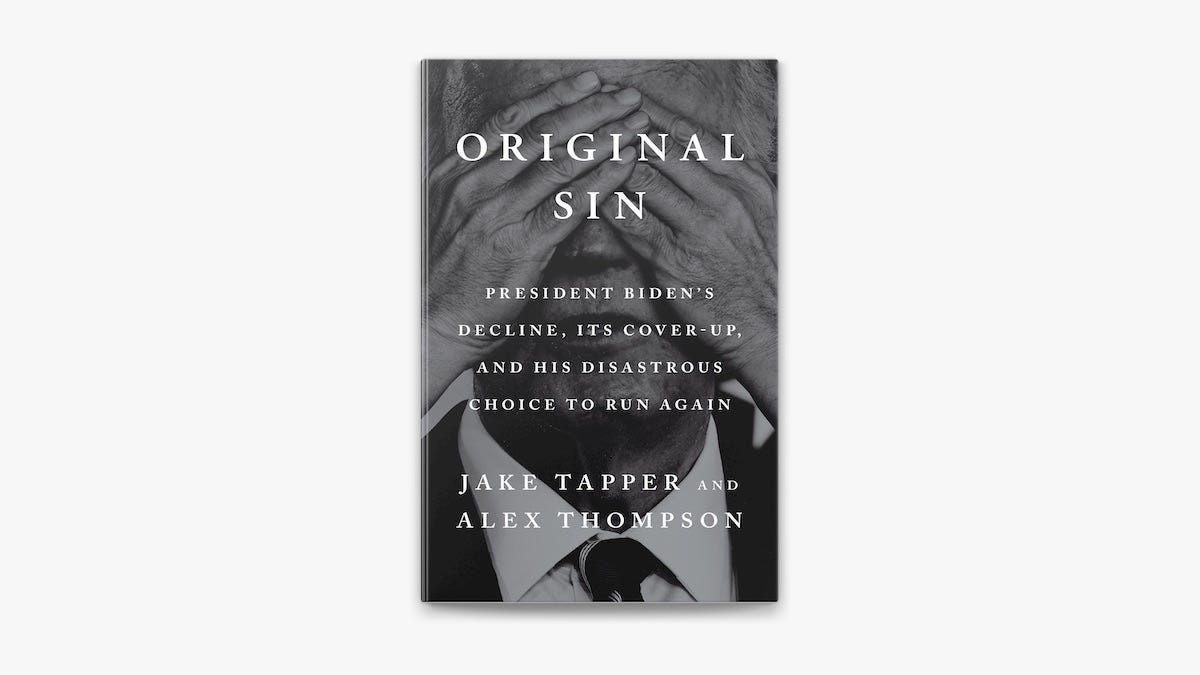
my review of Jake Tapper's book
“Fools, said I, you do not know; silence like a cancer grows.” — “The Sound of Silence”
Yes, I have already read it. Every word.
The Kindle version hit my iPad at midnight, and I woke up around 1am wide fucking awake, which happens semi-often, and started reading, taking notes as I went, and then I spent an hour and a half writing this over breakfast and am proofreading it over lunch to publish in the early afternoon.1
Yes, I read it skeptically. And before I review the book, I will lay out my priors and biases. Most reviewers do that implicitly, or else weave them in throughout, but I’m going to do what I always do: name them, up front.2
My Priors and Biases
This is a controversial book about a controversial moment, so I’m going to be unusually thorough. You may end up disagreeing with me, but you’ll understand exactly how I got where I landed.
I think nobody hates journalists enough—including Jake Tapper. But I don’t have any particular animus toward him personally. Until quite recently, I got all my news from Twitter, so I genuinely wasn’t sure if Tapper was on CNN or MSNBC. And if you lined up ten white men whose faces appear regularly in political Twitter discourse, I might struggle to pick him out. Also, I have no idea who Alex Thompson is. Nor do I care.
One of my grandmothers experienced serious cognitive decline before she died. I was very close to her, and I witnessed that decline up close. In 2020, I believed I saw some of the early signs in Biden. But to be fair to the position Tapper lays out in this book, I was ambivalent. I thought I saw early signs, emphasis on “early”.
Yes, I was aware that if what seemed like early signs were making it into news coverage, it was probably worse, but I was agnostic about how bad.
So no, I didn’t see Biden as a husk of his former self in 2020 the way many people did—or now claim to have done.
To be fair about my own lens: on bad PTSD days, I can lose my train of thought, snap at people, and find it difficult to finish spoken sentences without anxiety taking over. Biden lost his wife and daughter decades ago, and then his son in 2015. Both of his surviving children have had difficulties severe enough to make the possibility of losing them, too, be plausible. So if he has some form of PTSD, I wouldn’t be surprised.
Americans rarely recognize masculine emotion as emotion, but I do. So when I saw flashes of fury from Biden that struck others as off-putting, I may have over-identified with him. I may have been too generous.
I also have an unusually strong personal bias about elder abuse. I’m aware that this isn’t a virtue on my part, but I would vote to legalize cruel and unusual punishment for child and elder abusers.
And I believe Joe Biden was a victim of elder abuse—on camera, and at scale. So I may let him off the hook too much and be too hard on his family and insiders.
I have another bias that affected how I read this book: I’m drawn to what I call “butterfly moments,” the idea that some small, chance event can change the entire trajectory of a life. It was a total fluke that I spent one day in 2015 looking for a therapist instead of doing something else—and now, literally everything about my life is different. There’s a similar moment, which I will write about one day, that caused me to believe I could successfully major in mathematics and move into the middle class.
I love moments like that — little moments after which nothing is the same. I think life is full of them, usually only seen in retrospect.
I think the debate was one of them. If Biden hadn’t debated—and debated badly—I don’t think he would have dropped out. And if he hadn’t dropped out, I think there’s a decent chance he would have won.
The AP VoteCast survey, along with several other survey organizations, tracks voter motivation—not just who people voted for, but why. Were they voting against the other guy, or for their own candidate? Biden had a 38-point advantage on that metric. Harris had just 23.
His exit reshaped the election from “we’d get change, but it would be a change back to a lot of chaos, drama, and having to think about the POTUS every single goddamn day” to “I can vote for a devil I’ve met before, and while it wasn’t necessarily fun to dance with that devil, at least my bank account looked better. Or I can vote for a devil that scares the living shit out of me in new ways.”
That may not have decided the election. We will never know for sure. But it mattered. The assassination attempt was a big deal, but Americans have very short attention spans.
The election was an electoral college landslide, but only 230,000 votes in three states would have swung it the other way. So how much it mattered is a highly debatable question. And the debate was the linchpin.
So I opened the book hoping—desperately—to find the butterfly moment.
Who decided he should debate? Who prepped him? Who said yes?
The Cancer Diagnosis
The news of Biden’s cancer diagnosis changed how I read the book in two ways.
First, prostate cancer doesn’t metastasize overnight. If it had already spread, then this wasn’t new. This wasn’t a 2025 problem. It was a years-long problem, hidden from the public. That means Biden wasn’t just being shielded from the truth. The country was. He wasn’t just deployed past his limits—he was cynically used.
So I read this book with a secondary lens, knowing it’s about covering up the decline of a man who will die soon. While I’m not sentimental about death, I am sentimental about old people. And the diagnosis made me angrier. It made the elder abuse feel even more grotesque. So yes—my sympathy for Biden himself may have grown.
Not as a leader. Not as a politician. I don’t give a rat’s ass about politicians. There are days when I struggle to care at all about politics, which amounts to whether the team of narcissists I mostly agree with is winning or losing the current shouting match against the team of narcissists I mostly disagree with. That Biden is on the latter team, instead of the former team, is not a matter of consequence to me, or at least it wasn’t with regard to reading the book.
But I may have had more sympathy for Biden as a very old man who, no matter what he did or failed to do when he was younger, should have been protected.
And wasn’t.
The Grand Narrative of Tapper’s Take
The book sets up a paradigm so emblematic of the entire debacle that I’m laughing—meanly—as I write this.
Either Tapper had no editor, or his editor hates him. Despises him. Wants-to-see-him-publicly-humiliated, friends-don’t-let-friends-go-camping-alone-with-that-guy, loathes him.
I say this because the Author’s Note lays out a grand narrative: people believed what they wanted to believe, with good intentions but disastrous results. They fooled themselves. They doubted their own judgment—reasoning that if things were truly that bad, surely someone else would have said something. Or done something. Tapper name-drops the usual themes—cognitive dissonance, groupthink, courage, cowardice, patriotism—and quotes Orwell:
“...we are capable of believing things which we know to be untrue... to see what is in front of one’s nose needs a constant struggle.”
And then, somehow, the note also includes this line:
“Readers who are convinced that Joe Biden was little more than a husk from the very beginning of his presidency, barely capable of stringing two sentences together, will not find support for that view here.”
Oh, but they will.
Because despite this framing, the book proceeds to build a striking, damning, and frankly overwhelming case for exactly and precisely that view.
What it reveals about Biden’s condition as far back as 2019 is so alarming that if I were a district attorney, I’d be filing elder abuse charges against nearly every named insider in this book who was close to him during the 2020 campaign.
And if I worked in the Trump administration, I’d be flipping through the U.S. Code looking for a statute that lets you charge campaign operatives with treason by omission. That’s how bad it is.
That Tapper frames his story so precisely opposite from the story he actually tells is…well, it’s oddly perfect. Not the word that first comes to mind, “glorious.” That word implies something good.
But it’s truly spectacular, in the way a building collapse is spectacular. The kind of spectacle you can't look away from because it reveals everything rotten in the structure.
The authors’ failure to recognize and respect the enormity of the story they’re telling removes what little charity I might have offered them—though in an ironic twist, that very failure is what made the story so convincing.
I came in skeptical. I read the book braced for spin. But the framing was so delusional, so fundamentally at odds with the facts being presented, that I ended up believing almost everything. Not because the authors were persuasive—they weren’t—but because they clearly didn’t realize just how damning their own reporting was.
They weren’t trying to sell a hit piece. They were trying to sell a tragedy with no villains.
Which only makes the villains easier to see.
This review is long and detailed. I did that partly so that anyone who wants to know what’s in it but doesn’t want to give Jake Tapper any money could just read my review.
But I also did it because the evidence for a vicious, ongoing crime committed against an elder in public is so massive and overwhelming.
That Tapper thinks his book tells a different story is a blessing.
It means he wasn’t lying to us—he was lying to himself. And that makes the book, ironically, more believable than if it had been written by someone with self-awareness and an agenda.
Journalists love to pretend they’re neutral arbiters. Most of the time, they’re just running interference for the powerful. But Tapper didn’t shape the narrative here. He framed it—and then filled it with evidence that obliterates his own frame.
He thought he was documenting a noble tragedy.
What he actually wrote was a damning case study in cowardice, delusion, and systemic abuse.
And because he doesn’t know that—that’s how you know it’s real.
The 2020 Campaign
Biden insiders and aides knew, as far back as December 2019, that he was suffering cognitive decline. He struggled to remember details that should have been second nature—including the name of his longtime aide, Mike Donilon.
Mike Donilon had worked with Biden since 1981.
They ran an old man for President who couldn’t remember the name of someone he worked with almost daily for thirty-eight years.
By January 2020—just one month later—staff were already commenting that he was “noticeably diminished” from the already alarming December version.
From the man who couldn’t recall the name of his most trusted adviser.
A relationship so long-standing that, if it were a person, it would have been old enough to run for president itself.
And here’s some more dark irony: the first person who should be on trial for elder abuse—aside from Jill Biden—is Mike Donilon.
Why?
“The president valued Mike Donilon’s advice so much that aides would later joke that if he wanted, he could get Biden to start a war.”
With COVID as the convenient excuse, the 2020 Democratic National Convention was mostly conducted over Zoom. And the video footage that came back was damning.
“The videos were horrible,” one top Democrat said. “He couldn’t follow the conversation at all.”
Do you know why the racial justice conversation on night one was just five minutes long, and the healthcare panel on night two clocked in under four?
Because that was all the usable footage they had. After recording hours of Biden on camera, that was all they could salvage. He could not follow along. He could not act like someone capable of being President.
There is no excuse for the silence that followed. None. Every person involved facilitated elder abuse.
The 2020 DNC should have opened with Biden gracefully stepping aside and closed with the delegates choosing a new nominee after two nights of real debate.
That it didn’t is one of the most shameful failures of political courage in American history.
2021: Already Obvious He Wasn’t Up To the Job
The book provides no detail about the August 2021 withdrawal from Afghanistan, other than to say that Biden would get angry at his own aides anytime it was brought up — so it was rarely brought up.
Biden’s cognitive decline was obvious in October 2021, when Pelosi invited him to Capitol Hill on two separate occasions to get him to rally the troops. This was during the debate over whether Biden’s infrastructure bill would be passed on its own, or whether the Progressives who wanted it tied to the overall “Build Back Better” agenda would get their way. Pelosi wanted the infrastructure deal passed on its own, to get the House Democrats a quick and obvious victory from which she planned to use the resulting momentum to work on the larger BBB agenda.
Both times, Biden rambled incomprehensibly and left without even mentioning the infrastructure deal.
2022: The Illusion of Control
In January 2022, Joe Biden gave a two-hour press conference. During it, James Rosen from Newsmax asked:
“Why do you suppose such large segments of the American electorate have come to harbor such profound concerns about your cognitive fitness?”
Biden replied:
“I have no idea.”
Afterward, Jill Biden berated the staff—for letting it happen. In front of the President. As if he were a child actor whose handlers had failed to protect him from a reporter on the red carpet.
Tapper tries—half-heartedly—to sell this as the act of a loyal spouse. But a loyal spouse who blames the staff would either do so in private or at least frame the objection in a way that acknowledged the President’s agency.
This wasn’t that. This was a tacit admission that her husband was their collective puppet—and she was furious that the other puppeteers weren’t doing their jobs.
During this time, aides like Bruce Reed, Mike Donilon, Steve Ricchetti, and Ron Klain—each of whom should be on trial for treason—were actively strategizing on how to navigate Biden’s fragile, easily-triggered anger (a hallmark of dementia). They made complex decisions binary. Then they’d time the “ask” to hit during the presidential daily briefing, when he was usually in a better mood and likely to say yes.
This wasn’t a matter of ego management. This wasn’t “King Baby syndrome” or the kind of soft manipulation Southern matriarchs deploy when choosing just the right moment to ask their husband a favor.
This was end-running around the elected president’s will and comprehension.
“Five people were running the country, and Joe Biden was at best a senior member of the board,” said one source familiar with the internal dynamic. A cabinet secretary echoed it:
“I’ve never seen a situation like this before, with so few people having so much power. They would make huge economic decisions without calling [Treasury] Secretary Yellen.”
Foreign Policy Gaffes and the Mask Slipping
Russia invaded Ukraine on February 24, 2022. In the months that followed, Biden made repeated, reckless public statements. His handlers labeled them “gaffes” and scrambled to walk them back—desperate to maintain the illusion that they weren’t committing elder abuse on an international stage by parading around a shell who was in no way up to actually doing the job.
These included breaking the doctrine of “strategic ambiguity” over Taiwan and making inflammatory remarks about Putin that implied U.S. military escalation no one was actually prepared for.
That spring, press conferences all but vanished. The official excuse was that legacy media “doesn’t reach Americans like it used to.” The real reason was blunt, and private:
“But foremost among the reasons was Biden’s dwindling capacity to communicate. And this was only 2022.”
He began doing something painfully familiar to anyone who’s watched an elder decline: narrating his own mental disorientation in real time.
“In Iowa, at an April 2022 event about ethanol, Biden plodded through a list of policy priorities but eventually admitted: ‘I’m starting to bore myself here. But this is important stuff, I think.’”
Cabinet of Silence
Tapper interviewed four anonymous cabinet secretaries—each of whom should be frog-marched to jail to await trial for treason. They admitted the President couldn’t even conduct private cabinet meetings. Every question, every discussion point had to be submitted in advance so he could be handed a notecard.
Even that was often too much.
“The cabinet meetings were terrible and at times uncomfortable—and they were from the beginning,” said one secretary.
Another added: “I hated the scripts. You want people to tell you the truth and have a real dialogue, and those meetings were not that.”
The Midterms and the Myth of a Mandate
When Dobbs v. Jackson overturned Roe v. Wade in the summer of 2022, it was obvious the GOP would suffer for it in the midterms. Americans are moderate on abortion. We believe in “safe, legal, rare”—not in forcing raped middle schoolers to give birth or making doctors google state law mid-miscarriage to decide which treatment option will enable them to avoid prosecution.
The only way for Republicans to avoid electoral blowback would’ve been to mean it when they said abortion should be a state issue.
They didn’t.
In September—two months before the election—Senator Lindsey Graham introduced a bill to ban abortion nationwide. It failed, but it didn’t have to pass. It just had to remind voters that the party of “small government” had been lying for decades.
Yes, other factors contributed to the Red Wave becoming a Red Trickle. But this was the butterfly moment. Dobbs led Graham to say the quiet part out loud. That gutted the GOP’s midterm hopes.
And that, in turn, convinced Biden’s inner circle that he should run again. That he could win. That the midterms were proof of his enduring magic — that their puppet could continue to perform and let them cling to power. So they pushed the narrative that this dottering, cognitively diminished man could not only campaign—but serve four more years as President of the United States.
“As the results became more promising, Biden himself walked into the room with a blue sweater and a ball cap on. He sat down and watched the TV with some staff. To people in the room, he didn’t look surprised—he looked vindicated…Biden and his aides felt he had a special relationship with everyday people that elites just didn’t get.”
The End of the Year
In December 2022, on the day Brittney Griner was released from Russian custody, Biden could not remember the names of his national security adviser or his communications director.
Jake Sullivan and Kate Bedingfield worked daily with a man who was too cognitively impaired to remember their names.
They said nothing.
They should be tried for treason.
2023 and the Smoking Gun of the Tapes
In January 2023, Robert Hur agreed to serve as special counsel investigating Biden’s mishandling of classified material. To take the role, he resigned from a lucrative private-sector position—requiring real sacrifice from both him and his family.
As part of the investigation, Hur obtained tapes from a ghostwriter who had worked on one of Biden’s earlier memoirs. These are not the same recordings released recently—those were taped by Hur in 2023. These were much older.
On those tapes, Biden is heard discussing classified material with the ghostwriter. He also, plainly and unambiguously, references “classified stuff downstairs” in conversation with his sister.
That should have been the moment the prosecution prep began.
But there was something else in those tapes—something that made prosecution impossible.
“Beyond how damning they were, the tapes revealed something else important to the case.
Biden sounds very old and quite diminished.
In 2017.
He grasped to remember things, he sometimes had difficulty speaking, and he frequently lost his train of thought.
Hur and his team wondered: What would a jury make of this man?”
Biden sounded so diminished, so feeble, in 2017, that Hur’s team concluded no jury would convict. They doubted a jury could unanimously believe he knew what he was doing—or that he intended to break the law.
He was inaugurated four years after those tapes were recorded. He served a full term. And those tapes are now eight years old.
“Given how Biden presented on these tapes, Hur and his team thought it would be tough to get a unanimous jury to conclude that he knew what he was doing was illegal and that he intended to break the law.”
That summer, Hunter Biden’s plea deal collapsed—and he spun a new narrative for his father: that it was all a conspiracy to make him relapse.
Imagine the evil required to look your elderly, grieving father in the eye—the man who already buried your sister and your brother—and tell him, if you don’t save me, I’ll use again and die.
The darkness in Hunter Biden’s soul is hard to fathom.
And the emotional toll of that manipulation, of course, didn’t help the President’s fragile health. Several insiders are quoted as remarking that Biden’s decline accelerated noticeably when Hunter’s legal issues became more perilous.
As Biden’s decline became harder to deny, the White House adopted a familiar strategy: bullying the press.
“When there were negative news stories about Biden’s age, both the campaign and White House reached out repeatedly and insistently urging me and others to go negative on the news outlets and reporters,” one Democratic operative explained. “They wanted us to shame them on social media…”
On September 20, 2023, Biden stumbled through prepared remarks at a private fundraiser—low-stakes, note cards in hand. He called January 6 “January 8.” Then he told the story about Charlottesville being his reason for running.
Twice. Within three minutes.
He told it once, completely forgot, and told it again.
When Karine Jean-Pierre was asked about it, she said, “The president was making it very clear why he decided to run.”
Not A Decent Man
This anecdote doesn’t speak to Biden’s cognitive decline. But it destroys the narrative that he was, at core, a decent man.
At Hunter’s request—because their crack-addicted, deadbeat son didn’t want to deal with the consequences of his actions—Joe and Jill Biden excluded their granddaughter, Navy Joan Roberts, from Christmas at the White House and the dedication of Jill’s children’s book.
She was four years old.
Old enough to know the President was her grandfather, the First Lady her grandmother—and both were pretending she didn’t exist.
So desperate not to claim her that they were lying in front of the whole world.
Because her father didn’t want her, and her grandparents were fine with that.
Sometimes I truly wish I believed in hell.
Hur’s Interview of Biden
Hur interviewed Biden on October 8, 2023. He offered to postpone, since Americans had just been taken hostage by Hamas the day before—but Biden declined.
Hur was polite and professional, doing his best to extract only the required information.
“The interview was alarming. Biden forgot words, trailed off mid-thought. His answers jumped around. Stories rambled and ended abruptly. He used ‘anyway’ and ‘all kidding aside’ to exit stories when he lost the thread.”
At first, Hur wondered if this was a stalling tactic—a way to run out the clock on their time-limited session. But it wasn’t.
It was an old man. A broken man. A man whose brain had become a jukebox of disconnected memories, spitting out moments from the past at random—each one playing through his mouth whether it was relevant or not.
At one point, Biden couldn’t remember when his son Beau was deployed. Or when he got sick. Or when he died. Or when Trump was elected. The topic of Beau’s death clearly activated him. He rambled at great length—about their closeness, their love, their bond.
“Hur was growing concerned for the president, who seemed confused and had landed on an emotional topic. He felt bad for him.”
He offered Biden a break.
Biden declined. He wanted to keep talking about his dead son.
I cried reading that passage.
And I’m crying writing this one.
Joseph Robinette Biden Jr. was never a great man. And I don’t believe he was a particularly good one. But no one deserves to spend their dotage being used like this.
He was cynically and viciously manipulated—turned into a puppet—by people who were perfectly willing to commit elder abuse to keep their grip on power.
Again: I wish I believed in hell.
2024: Everyone Knew, and They Kept Going Anyway
Minnesota Congressman Dean Phillips, grandson of “Dear Abby” Abigail Van Buren, told the White House he was going public with a call for an open primary.
Not only did nobody listen, his rare moment of courage—refreshing, even if not entirely honest, since he tiptoed around the reality of Biden’s decline—cost him his leadership role.
That’s how committed the Democratic Party was to its “cling to power by committing elder abuse” plan.
The January Ukraine Briefing
On January 17, 2024, the White House held a high-level meeting between President Biden, national security advisers, and House and Senate leadership to discuss Ukraine.
Afterward, Hakeem Jeffries claimed Biden was “incredibly strong, forceful, and decisive.”
That was not spin. That was a lie.
“For the first twenty minutes of the meeting, the president listlessly read bullet points out of a binder. For many at the table, he was difficult to hear. He stumbled over words; he started sentences and then stopped abruptly; he trailed off.”
Speaker Mike Johnson, who was present, said nothing. His excuse: anything he said would be dismissed as partisan sniping.
While true, that doesn’t let him off the hook. He should be ashamed. He should apologize.
And he should resign.
The Hur Report and the Fury of the Guilty
In February, Robert Hur’s report was released. It confirmed what anyone paying attention already knew: Biden had mishandled classified information.
But instead of mounting a defense against the substance of the report—that Biden admitted, on tape, to the exact same conduct Trump was being prosecuted for—the White House and its allies launched a scorched-earth campaign against the only part of the report that was honest: Hur’s assessment that no jury would convict a cognitively declining, well-meaning old man of a crime requiring intent.
Hunter Biden and the president’s sister, Valerie, were reportedly furious. Under their pressure, Biden gave the now-infamous speech where he lashed out, insisting he hadn’t forgotten the date of Beau’s death—“it wasn’t any of their damn business.”
But Hur had never brought up Beau.
He had simply asked about 2017–2018, the time period of the ghostwriter tapes. Biden’s answer, and his angry reaction, were both detached from the facts. Hur, by all accounts, had been professional, courteous, and restrained. His decision not to prosecute was legally sound. And his assessment of Biden’s cognitive state—clear-eyed and understated—was, if anything, generous.
That Hur was attacked for telling the truth is shameful. That he was accused of Woke sins like “ageism” is symbolic of just how far gone our political discourse really is.
Hur could have released transcripts to clear his name. He declined.
Others offered to defend him publicly. He refused.
He had done his job. The facts could speak for themselves.
More Decline, More Lies
By this point, things were so absurdly broken that even the President’s defenders couldn’t keep their stories straight. Biden not only falsely claimed that Hur had upset him by invoking Beau—he also stumbled again, this time about Gaza, confusing Mexico with Egypt during a speech meant to prove his fitness for office.
The same four anonymous Cabinet secretaries from earlier in the book now reported that Biden was being increasingly shielded—even from them.
“I think the people around him had their own agenda, and they didn’t want more people around him,” said Cabinet Secretary Number Two.
“At one rare meeting during that time, Cabinet Secretary Number Three was shocked by how the president was acting. He seemed ‘disoriented’ and ‘out of it,’ his mouth agape.”
And:
“Aides who had once seen the president regularly would now go months without seeing him. Others noticed that at some meetings, Biden would occasionally be mumbling and not making much sense.”
The State of the Union and the Performance Drug Hypothesis
The book mentions intense prep and multiple rehearsals ahead of Biden’s March 2024 State of the Union address. It does not mention medication.
Having experimented personally with Ritalin and other drugs to try to manage my focus and attention problems, I will remain convinced—unless presented with hard contradictory evidence—that the President was chemically enhanced with a combination of Ritalin and Leqembi, the mild-stage Alzheimer’s drug shown to temporarily reduce symptoms.
The book even supports this hypothesis in its description of what happened immediately after the speech:
“But the Biden who walked in wasn’t the man many had just seen on TV. Standing alone in the middle of the room and addressing the students, Biden launched into a confusing story about getting into politics. Before he finished that yarn, he launched into another. And then another. Biden had been borderline yelling during his State of the Union, and now people just feet away were straining to hear him.”
This is classic stimulant crash: the loss of focus, the energy drop, the cognitive fragmentation. It exactly tracks with how Ritalin wears off.
The Biden that viewers saw on television was not the real Biden. He was a performance. A pharmacologically boosted puppet doing his best imitation of the man he used to be.
And even that was only possible for a few tightly-managed hours.
Delusion As A Way of Life
As the campaign shaped up—dragging this frail, sad husk of the man he once was back onto the stage so that a circle of monsters could cling to power by abusing him a little longer—they needed a strategy.
Not a strategy for governance. Not even a strategy for winning, in any real moral sense. What they needed was a narrative—something they could sell. Something they could repeat often enough to believe.
So Mike Donilon and others landed on the obvious move: they would "convincingly tell the story of how the country was much better off than people thought it was.”
Not make the country better.
Not fix anything that was broken, or acknowledge how many Americans were still living paycheck to paycheck, hopelessly cynical, increasingly detached from every official narrative they were being fed.
Just: tell the story.
The story, not the truth, was the goal. And they believed—because they had to believe—that if they just told it well enough, people would buy it.
It was the campaign equivalent of smiling through a hostage video. A performance meant to reassure the audience that everything was fine. That the man on screen was in charge. That his voice was his own.
Delusion wasn’t just part of the strategy.
It was the strategy.
And they wore it like armor.
June: The Dominoes Start To Fall
June 2024 was the month of the infamous Trump–Biden debate.
It was the part I most looked forward to reading about. I’ve long seen the debate as one of those butterfly moments I try to track—tiny hinges on which the entire damn door turns.
There was real disagreement inside Biden’s camp. Ron Klain pushed for the debate. Internal polling kept showing cognitive fitness as the top voter concern. Deflecting didn’t work. Pointing out that Trump was only three years younger actually made the contrast worse.
A strong performance would fix it, Klain believed.
Steve Ricchetti disagreed—on the grounds of, well, Trump:
“A candidate just didn’t get a whole lot out of debating Trump,” Ricchetti said. “Even if you were beating his ass, you would lose part of your soul in that debate.”
Anita Dunn also pushed to skip the debates, partly as revenge against the Commission on Presidential Debates for not enforcing COVID precautions in 2020.
The tipping point was the Hur Report. That was when questions about Biden’s cognitive health finally hit the mainstream—no longer confined to podcast junkies and those of us who are Way Too Goddamn Online.
The debate was scheduled unusually early—June—allegedly for two reasons:
A strong performance would boost grassroots fundraising.
A disastrous one would give them time to recover.
But even as debate prep began, it was clear he had dramatically declined from his State of the Union just three months earlier.
Hunter’s Trial and the Collapse
June also brought another stressor: Hunter Biden’s felony trial.
One theme repeated by people who’ve known Biden for decades is that he was never the same after Beau died. The grief broke something in him that wasn’t fixable. That’s deeply human, understandable, and tragic.
But it happened during a stage of life when aging and cognitive decline were already accelerating—and it likely dredged up trauma from losing his first wife and daughter.
Hunter’s trial terrified Biden’s inner circle. Nothing made the President decline faster than stress involving his family.
Biden was so desperate to help his son that he offered to testify. A sitting President, ready to take the stand in a criminal trial for his addict son. That’s how far gone he was—mentally, emotionally, morally.
The trial confirmed that Hunter had, in fact, had an affair with his brother’s widow. The infamous laptop wasn’t Russian disinformation. It was real.
Hunter was convicted on three felony charges and faced a second trial in September. Biden was devastated. He feared for Hunter’s sobriety—and his life.
And the stress hit fast. That same week, at a fundraiser, Biden failed to recognize George Clooney—a man he had personally known for twenty years.
Maybe This Was The Plan
Chuck Schumer denies it, but the book reports him saying:
“If things go south at the debate, me, Barack, Nancy, and Hakeem have a plan B.”
That raises a possibility I’ve been considering since the moment the debate date was announced: maybe the point of scheduling it early wasn’t fundraising or narrative control.
Maybe it was a warning shot—fired quietly by someone who couldn’t stop the abuse outright, but who still had a sliver of conscience.
Someone too cowardly to say the truth out loud, but patriotic enough to try to get it out there another way.
I hoped the book would hint at that. But beyond Schumer’s (disputed) comment? Nothing.
If that person exists—if there really was someone who tried to blow the whistle by rigging the timeline—they remain unnamed.
Sad, but not surprising.
Debate Prep: The Mouth That Wouldn’t Close
Steven Spielberg—yes, that Steven Spielberg—video-called into the debate prep to help Biden look more human.
That’s how desperate they were.
The sessions were brutal. His performance ranged from “bad” to “passable.” His voice was hard to hear. His delivery was halting. His answers were incoherent.
Advisers had to remind him to close his mouth when he wasn’t speaking.
Let that sink in.
A man who had spent fifty years in public life had to be told—during prep for a live televised presidential debate—to close his mouth.
And still, the charade continued:
“Time and again, aides had seen Biden be bad in prep and then better onstage... Okay, well, our guy is a game-day performer.”
Debate Night: Tapper’s Role
Until now, I hadn’t thought much about Tapper himself. I made the case that the reporting is credible because he doesn’t seem to realize what he’s admitting. He thinks this is a story about groupthink and delusion—not an overt, years-long cover-up.
But Tapper moderated the debate. So here, his perspective suddenly matters.
He does his obligatory virtue-signaling—reminding us how bad the Bad Orange Man is—but to his credit, he doesn’t sugarcoat Biden’s collapse.
“Slack-jawed expressions and undetermined stare at the floor in front of him suggested that he wasn’t even aware that he was on camera for the entire ninety minutes.”
“The transcript doesn’t do justice to his difficulty finding the words, his facial expression as he closed his eyes to root around for what he was trying to say.”
“A cringe-inducing reference, at once tragic and bizarre, to the murder of Laken Riley.”
“The horror of rape... was certainly one of the abortion rights movement’s strongest arguments. That young women were being raped by their sisters was not.”
And then comes the gut-punch:
“Senior Democrats who had done work for Biden in 2024 later told us that they had watched the debate and wondered: Just who the hell is running the country?”
Debate Aftermath: the “Bad Times”
Quoting Biden insiders, the book refers to the post-debate period as The Bad Times.
Think about that.
It wasn’t “the bad times” when they hid a cognitively declining man behind a wall of handlers.
It wasn’t “the bad times” when they gaslit the American people, bullied reporters, smeared Robert Hur, or lied about the laptop.
The bad times began when the truth became undeniable.
Vice President Harris got angry when Anderson Cooper asked her the most obvious question in America.
“After the interview, Harris was visibly angry with Cooper. He had been asking the questions the nation had been wondering, but she took it personally.”
For.
Fuck’s.
Sake.
Everyone Knew
Hur’s friends were privately vindicated. He hadn’t lied. If anything, he’d held back.
“Hur told them all he felt was sad. How could anyone look at Joe Biden at that debate and not feel bad?”
What follows is a parade of Democrats—recognizable names—all performing shock. All claiming they had no idea.
It’s horseshit.
There’s plenty of evidence that they knew exactly how bad it was. They knew. They all knew. And they chose to keep going.
They chose power over truth. Strategy over dignity. Abuse over courage.
“At a post-debate fundraiser, Biden appeared flanked by conspicuously large teleprompters that worried attendees. He rambled, his voice barely audible. During a Q&A session, Biden would start answering and then lose the thread. He couldn’t finish his thoughts.”
That worried them.
Worried.
The President of the United States—after half a century in public life—needed massive teleprompters at a private event, and still couldn’t finish his sentences.
And these morally bankrupt people were worried.
Worried.
That this man was still running at this point is damning.
It’s no different than a child with visible bruises being dropped off by a drunk parent—and nobody doing a thing.
And the fact that this came from the party of compassion, the party of Woke, the party that never stops lecturing the rest of us on morality?
It makes me sick.
The First Lady was confronted by Senator Debbie Stabenow. After a gentle affirmation of how much everyone loved and supported Joe, she said:
“We don’t know if this was a one-time thing or if there’s something more going on with the president. But you know.”
The First Lady didn’t answer the senator’s implied question—but she later fumed about it to White House staffers.
She wasn’t alarmed that her husband might be unfit for office. She was angry that someone had the decency to ask.
Power Before Country
“The Bad Times” were spent in pathetic, backroom calculations—trying to game out who might call for a primary challenge and who wouldn’t. Most were far more concerned about how it would reflect on Vice President Harris than about the condition of the actual President.
There’s also plenty of reporting in this section about aides hiding real polling data and shielding Biden from calls to step aside—more elder abuse, just dressed up in strategic language.
This section of the book is boring. And disgraceful.
The fact that Harris had done nothing—said nothing—about Biden’s obvious, long-declining fitness for office made her clearly unfit for leadership. And someone—anyone—should have had the patriotism and spine to say so.
The Assassination Attempt
This part of the book speaks for itself, and in ways that Tapper surely never intended.
This is all it says:
“But soon the subject changed. At 6:11pm, at a campaign rally near Butler, Pennsylvania, Trump was nearly assassinated. One audience member was killed, two others were seriously wounded, and the gunman was shot dead by Secret Service countersnipers. The image of Trump bloodied but standing defiant, fist in the air, after a bullet grazed his ear would be one of the most memorable of the year.
“Looking at that photo, Biden campaign aides couldn’t help but think of how this would help Trump politically. ‘Fuck!’ more than a few said.”
It was, perhaps, the most honest moment in the book.
When the presidency is just a puppet show, even an attempted assassination is evaluated by its impact on audience perception.
The Withdrawal and Crowning of Harris
This section is also boring—fitting, given how little actual process there was.
After Biden, isolated in Delaware with a serious respiratory illness that had further incapacitated him, finally withdrew, Harris moved quickly and manipulatively:
“Harris raised the prospect that they call the other Democrats who might at that moment be contemplating running themselves. Phone each one, tell them she was running, tell them she intended to earn the nomination, and say she’d love to have their support. Put them on the spot.”
That was the “Democratic primary process”: about six strategic, pressure-filled phone calls.
And it worked.
The Campaign
The section on the Harris campaign is boring, too. The gaffes Biden committed during this period were sad—but predictable. The kind you’d expect from a confused, demented old man who didn’t understand how or why he’d been pushed aside, and was quietly furious about it.
The only part worth noting is this: when pressed, Harris’s insiders claim that even in private, she insisted Biden was strong.
So either they’re lying to protect her.
Or they’re telling the truth.
And if they’re telling the truth, then she’s either delusional beyond comprehension—or so committed to the lie that she lives inside it full-time.
Which is the kind of “stability” you get when gaslighting becomes a governing strategy.
The Lame Duck Period
The only remotely interesting part of this section is what it reveals about delayed outrage. Because Biden didn’t step down when it was clear he was no longer compos mentis, some Democratic insiders got accused of playing politics.
Many of them were also angry when Biden pardoned members of his family—not because he did it, but because he added that Hunter’s prosecution had been politically motivated.
Which was false. They knew it. He may have known it — it’s impossible to tell what he knew.
And they were angry not at the lie—but at how politically inconvenient the lie had become.
Tapper’s “Conclusions”
Tapper ends the book with a chapter titled “Conclusions,” and it is as mealy-mouthed, cowardly, and small as you’d expect.
He insists that Biden still had “moments of clarity,” even at the end, and wasn’t fully non compos mentis all the time—as if that mitigates what happened by even a millimeter.
Then, with the moral courage of a man trying not to offend his brunch friends, Tapper offers one solitary policy solution to ensure this never happens again:
Congress should pass a law requiring the President’s physician to certify, annually and under penalty of perjury, that the Commander-in-Chief is physically and cognitively fit for office.
That’s it.
After hundreds of pages laying out one of the most staggering institutional failures in American history—an open, televised crime of elder abuse perpetrated by a sitting President’s own staff—the best Jake Tapper can come up with is “maybe someone should sign a form.”
It’s not just weak.
It’s laughably, cosmically insufficient.
My Conclusion
The book is what it is.
I’ve already explained why I believe most of what it reports, and the few places where I remain skeptical. It’s certainly well-written—for whatever that’s worth.
But the truth is this: Jake Tapper is a bad journalist. Not because he got the facts wrong. But because he only managed to gather and publish the truth once it no longer mattered. Once the consequences were gone. Once the power had already shifted.
He was brave when it was safe.
And that’s not bravery.
If you’ve read this far, I hope you feel no need to put any money in his pocket.
That this book—this damning, detailed catalog of institutional cowardice—will not result in criminal charges for anyone is, to me, the blackest of black pills.
No elder abuse charges.
No conspiracy to defraud the public.
No dereliction of duty.
No treason.
Just polite book tours, Sunday shows, and the smug, unbroken silence of the ruling class.
That silence is the sound of impunity.
This post was intended to thoroughly review the book and ensure that those who wanted to know what it said without putting money in Jake Tapper’s pocket could do so. I have written a follow-up post that synthesizes my own thoughts about what it all means and the larger importance of how this happened. Link.
Because I read the Kindle version, I will not be giving you page numbers — they’re going to be different for everyone based on font size and chosen layout, so it’d be pointless. Sorry.
The title of this review is a play on “The Sound of Silence,” originally by Simon & Garfunkel but perfected by Disturbed. The song kept coming to mind as I read — an unusually appropriate piece of music to accompany this story, particularly in its emotional salience. That cover is masculine. Furious. And it’s the appropriate follow-up to the warning the original offered in its meandering, feminine way.


“He was cynically and viciously manipulated—turned into a puppet—by people who were perfectly willing to commit elder abuse to keep their grip on power.”
Yeah, it’s not just elder abuse, is it? All of DC is a Roman-Empire-worthy stew of back-stabbing, ruthless, corrupt grabs for power. The game is “Abuse or be abused”. And THIS is the real horror shown by books such as Tapper’s. Our system of government has gone down the road of all the previous corrupt empires, to a point where only the biggest psychopaths end up holding onto power. THIS is what we have to change if we want our Republic to endure, especially if we want it to resemble the ideals of our Founding Fathers. God help the Trump administration.
Thank you for reading that mess and sharing your thoughts and analysis. You did a real service here as I would not give Tapper a worn penny to pay Charon under any circumstances, but I should know what he and others did and did not do. I read your review twice and am amazed, appalled and angry. The people involved in this galactic level excrement show deserve, as you rightly stated, to be charged and tried for multiple crimes. If convicted, none of them should ever leave prison.