
The View From Nowhere
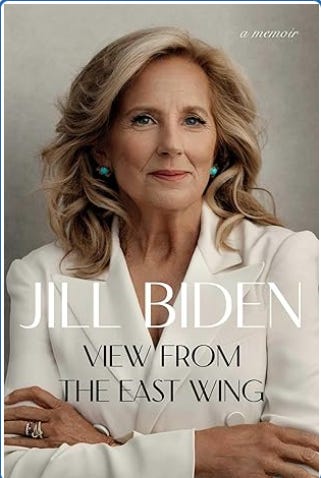
my review of Jill Biden's book, "View from the East Wing"

Last week I republished my autopsy of Jill Biden’s 2007 doctoral dissertation.
It is a remarkable document, ostensibly the pinnacle of achievement in the field of education.
What it actually is? An inexcusably lazy joke of a document that practically predicted her time as First Lady, since it clearly revealed a mind unable to notice the most important fact sitting in front of it. That 102 is less than 177. That a student who asked for a confidence to go unrecorded was also, implicitly, asking for it to go unpublished. That the central premise of her own paper had quietly collapsed two sections in, and she sailed right past it.
I timed that republication to this week, because View from the East Wing arrives with exactly one job: to deny that she was the hidden hand covering for her husband’s decline and keeping him in power past the point his mind could sustain it. And it fails in the most Jill Biden way imaginable — by proving the thing it set out to disprove.
Regular readers will also remember my review of Jake Tapper’s book, from last May — a book that describes a presidency where, by one insider’s account, five people were running the country and Joe Biden was at best a senior member of the board. Tapper never named who held the pen; I argued it was most likely Jill, the only named candidate I’m aware of and a reasonable working assumption until someone offers a better one.
The memoir was her chance to offer that better one. Instead she hands me the case for free: this is the woman who, by her own account, watched the June debate, wondered in real time whether her husband was having a stroke, compared him to a glitching hologram — and then took him for waffles, flew to a rally, and praised him like a kindergartner who’d sat still through circle time.
Eighteen years after the dissertation, the same mind is still cheerfully refusing to see the one thing that matters. What follows is my usual long, thorough, why-give-them-your-money-when-you-can-give-it-to-me-instead-and-hey-I-will-even-earn-it review. As always, I’ll lay out my priors first.
My Priors
I come to this book having already published a savage read of Jill Biden’s mind. I autopsied her doctoral dissertation and concluded she’s a midwit with a documented inability to see the most crucially weighty fact in front of her. So I’m primed — to be fully honest, likely over-primed — to find that same failure here, and you should weigh everything that follows against my obvious motive to find the dropped subtotal again.
I also came in expecting a cover story. I’d said before reading it that this memoir has one job: to deny she was the hidden hand. A book doing something more human than that would surprise me, and I should admit I wasn’t braced for the possibility.
Two lenses I can’t fully switch off. One of my grandmothers declined cognitively before she died and I watched it up close, so I know what the real thing looks like — and I trust my read of it. And on bad PTSD days, I can lose my train of thought, snap at people, have zero frustration tolerance, etc. And I believe Joe Biden to suffer from some form of PTSD, due to losing his first wife and daughter in a car wreck, then later losing a son to cancer, then having both his surviving children be screwed up to the point that reasonable fear of losing them has surely been a constant trigger. So it is not at all difficult for me to imagine a scenario where cognitive decline looks like PTSD and people close to him remain in blissful ignorance.
The first bias makes me harder on the people who hid Joe’s decline; the second once made me read his flashes of fury as grief rather than malfunction, even as I refuse to excuse the people around him who had a duty to the country to overcome their own biases and lenses. The two work against each other and, I hope, balance each other out enough that I can be fair. The reader will have to determine that for himself or herself.
So here is the rule I’m giving myself, precisely because I’m over-primed: I will believe her wherever the evidence lets me and give her every benefit of the doubt possible. Not as a courtesy. As a control against my own bias. If I’m going to claim she can’t see the fact in front of her, the honest version of that claim requires me to first credit every fact she does see clearly — to bank her true sentences at full value before I touch the false ones.
So let me make the first deposit now. She writes that during Beau’s illness she began thanking God, first thing every morning, for her own health and Joe’s. I believe her completely. It is exactly the kind of small, private, weighty habit that grief installs in a person, and there is nothing in it for her to invent. It is real, it is human, and it is the sort of thing I came in expecting not to find.
Noted. Credited. Held.
Which is what makes the very next move in the book worth slowing down for. Because the gap between the sentence I believe and the sentence I don’t is the whole argument.
The Prologue
The memoir opens on a thesis dressed as a confession: that losing Beau was so total a catastrophe that it freed them to run in 2020. The worst had already happened, she explains. There was nothing left for the campaign to take. Grief had been converted, somewhere in the alchemy of the Prologue, into a kind of armor — and that armor is offered as the reason they could step back onto the field.
I want to be careful here, because I just told you I’d believe her where I can, and the raw material of this claim is real. Beau’s death was real. The devastation was real. I don’t doubt for one second that it reordered every value in that household. That part I bank at full price.
But the inference — “the worst already happened, therefore we could run” — is not grief. It’s a frame. And it’s the kind of frame I learned to name in my review of Cory Booker’s book: the difference between vulnerability that’s a structural fact and vulnerability that’s ornamental. Structural vulnerability does explanatory work — it actually holds up the skeleton of the story. Ornamental vulnerability is hung on the wall to be admired, to soften you up, to make the next several hundred pages harder to argue with.
You put it in the Prologue for the same reason a defense attorney puts the dead son in the opening statement: so that everything after it arrives pre-forgiven.
And the giveaway that it’s ornamental is that it doesn’t survive the simplest, most basic arithmetic.
Run the actual subtraction. If the loss of a child is genuinely the worst thing that can happen to you — and I’ll stipulate that it is — then the rational posture toward your two surviving children is not “we’re free now.” It’s the opposite.
It’s protective to the point of paranoia. A parent for whom the worst already happened does not look at her two remaining, visibly fragile kids and conclude: therefore, let’s submit them to a national colonoscopy in prime time. Because that is what a presidential campaign is. It is a years-long, federally subsidized invitation for every journalist and opposition researcher in the country to go spelunking through Hunter’s addiction and Ashley’s worst private moments with a headlamp and a press pass.
So the math doesn’t reconcile. Either Beau’s loss was not the empowering reason they ran — in which case the Prologue is selling me a motive that isn’t the motive — or “the worst already happened” is doing exactly the work I think it’s doing: retrofitting a sympathetic logic onto a decision whose actual logic she’d rather I not examine.
You can have the grief as the explanation or you can have the exposure of the two kids you had left.
You cannot have both and call it coherent. 102 is still less than 177.
And notice — this is the same failure as the dissertation, eighteen years on. Not a new fact she can’t see. The single most important one, again, sitting in the exact center of her own opening pages: that a mother who has truly priced the loss of a child does not then place her two remaining children on the auction block and describe it as freedom. She walks right past it, into a Prologue she clearly believes is moving.
It is moving. It’s just not true. And the tell that it’s not true is that I tried to believe it, the same way I genuinely believe the morning prayer — and the prayer holds and this doesn’t. That’s the difference between a fact a person actually felt and a frame a person needed.
The Opening Beat: A Truly Sad “Marriage”
Let me start by giving Jill Biden her due, because the chapters that open this book are full of things I believe. I believe she sent Joe to the store and got him back three hours later, after two dozen selfies and a chorus of “Happy Birthday” to a stranger’s mother — it’s too specific and too fond to invent, and it’s the truest portrait of the man in the book. I believe she quietly alerted his male doctors that he’d been up seven times in the night, because a wife of nearly fifty years learns to route around her husband’s embarrassment. I believe the two years of menopausal insomnia she never mentioned to him, and the veil of discretion she says their marriage has always kept around the body.
I also find it tragic.
They have been married for nearly fifty years. People who’ve shared a bed for nearly fifty years but cannot discuss their health is so quietly heartbreaking that I cannot imagine anyone revealing it to the world if it were false.
These are real, unflattering, human things, and I bank every one of them at full value — partly because they’re so tragic and horrifying, and partly because I want it on the record that when this woman tells me something I can believe, I do.
Which is exactly why chapter one stops me where it does. She walks up to the central question of the whole illness — how a man wrapped in a twenty-four-hour medical team, a man who “couldn’t stub his toe without ten people running at him waving bales of gauze,” arrives at stage IV cancer metastasized to the bone — states plainly that it makes no sense, admits she was as stunned as the baffled stranger on the beach, and then writes the sentence that is this entire book in miniature: that she “didn’t want to waste too much energy looking back and asking how this could have happened.”
The most important fact in the chapter introduces itself, and she declines to look at it. And the proof of devotion she offers in the same breath — did he take his medicine, how much water, do I need to call the doctor — only deepens the hole, because that granular vigilance is precisely what makes a missed metastatic cancer impossible to explain honestly.
She has handed me the bubble wrap and the surprise and asked me to hold both. I believe her about the bubble wrap.
That’s the problem.
One Minute
The decision to run — the one that put everything in motion — gets transacted in under a minute. Chardonnay for her, Diet Coke for him, and before the menus arrive she asks if he’s running. Yes. “Okay,” she says, and orders the fish; he orders a hamburger, as he does even at seafood restaurants.
That’s it. That’s the whole conversation.
She tells us this is how they’ve always handled the important things: the more it matters, the more efficient they get.
She means it as intimacy. Read it straight and it’s the veil again — the same marriage that couldn’t discuss night sweats or a husband’s seven nightly trips to urinate now can’t spend ninety seconds on whether to seek the presidency. And the part she offers as devotion is the part that should stop you: she’d have said “okay” either way.
Not a partner weighing the most consequential choice of their lives.
A spectator, ordering fries, ratifying a decision she’s already decided isn’t hers to question.
Which becomes the operative trait of the section, because she keeps showing you the data and refusing to do anything with it. She arrives at early-state campaign events to find a handful of people. One time, two. She can see the campaign isn’t viable; she says so plainly.
And her response is that it “certainly wasn’t my job to second-guess the advisors, so I trusted the process.” Empty rooms in, trust the process out. The humble order-taker persona — fish not burger, okay-either-way, not-my-job — isn’t only personality. It’s the alibi. Every time the disqualifying fact appears, there’s a team or a process to defer to, so seeing it never obligates her to act on it.
You can call that humility. You can also call it the exact posture a person adopts to be in every room where the decisions happen and accountable for none of them.
She really, really wants us to believe she’s just a humble, order-taking little woman who masterminds nothing but goes along and gets along.
She’s trying so hard to convince us of that as fact that it’s conspicuous and the pretense is drawing attention to itself.
And she tells us how she does it. Compartmentalization, which she names in her own voice as her superpower: fully present in exercise class, fully a teacher, fully Joe’s spouse, each sealed in its own box, “without distraction.” She calls it a source of strength.
Then, pages later, the boxes do what boxes do — addiction was not a topic Joe and I talked about. I think we were partly in denial — as Hunter, unhinged by grief, stops answering their calls. The thing that lets her be undistracted at the gala is the same thing that lets a metastatic cancer and a son’s collapse run unexamined in the next room.
She isn’t failing to see.
She’s perfected not-looking and accepted awards for it.
For the record, the section isn’t all indictment. She can be genuinely disarming — the 2020 field so crowded that Bernie Sanders was the young, sexy candidate next to Joe is a real joke, and she lands it. The tough, money-tight childhood as the oldest of five girls, the lifelong faith in a sisterhood of women holding each other up, reads as sincere. Michelle Obama offering to come to her mother’s 2008 funeral, Jill asking her to stay away so it wouldn’t become a media circus, Michelle gracefully agreeing — kindness on both sides, and I’ll say so. None of that is the problem.
The problem is the empty room with two people in it, and a woman standing in it who could see exactly what it meant and had decided in advance that meaning it was somebody else’s job.
And then, for a moment, the not-looking cracks. Cleaning out a drawer, she finds one of Hunter’s lighters and is instantly back to watching him chain-smoke. I can barely say the words “My son was a drug addict.” Barely. She admits she never took on addiction as a cause as First Lady, that she has no answer for why, only the guilt — What did I not see? — and the closing confession that indicts the whole household at once: A lot of people knew how dire the situation had become, but they didn’t say anything, and I didn’t ask.
It is the truest sentence in the section, because it’s the pattern stated as a pattern. She even reconsiders the stoicism itself: I used to think my way was the healthier path. Now I’m not so sure. Credit it fully — it’s the first time she lets the wheels come off in public, and it costs her something to do it.
Then the world handed the campaign a gift that made not-looking a national strategy. COVID arrived, and a candidate nobody could draw two people to a room for suddenly didn’t need the room at all.
Campaigning During COVID
Through 2020, Joe ran on a promise that his administration would “look like the country” — a woman as his running mate, the first black woman on the Supreme Court. Both commitments were real; he made them in the same March debate against Sanders, and the record bears them out. Jill is proud of this, and the pride reads as sincere. Fine.1
Then COVID rewrote the campaign in her favor, though she doesn’t put it that way. The candidate who’d been drawing two people to a room suddenly didn’t need the room. The basement campaign — Zoom rallies, no rope lines, no scrum — meant the very weakness she’d watched in those empty early-state events was now invisible by design. A man who couldn’t fill a VFW hall never had to try.
She narrates the strangeness of it all without once noticing that the strangeness was doing her family a favor.
The Harris chapters are where she’s most revealing, because she can’t decide which Kamala she’s writing about. There’s the one Beau brought home in 2011 — “Mom, I met someone to watch” — warm, admired, woven into the family. And there’s the one who turned to Joe at the June 2019 debate and delivered that little girl was me, which Jill recalls with a thought bubble “full of expletives” she couldn’t let her face show.
She files it under hypocritical point-scoring and then — this is the tell — spends a full paragraph reciting Joe’s civil-rights résumé in rebuttal: sixty-three black judges, forty of them women, Juneteenth, the Emmett Till Act, the Court seat. Nobody litigates a five-year-old debate clip in a memoir unless it still draws blood. She’s answering a charge no one in the room made.
But the part that should stop you is the envelopes. With the VP pick looming, Joe proposes that he and Jill each write their top three names, seal them, and compare. They do it four times, once a week. The first three lists were completely different. Then — we never opened the last pair of envelopes. She offers this as a charming marital ritual, and it is the opposite. Weeks before the most consequential personnel decision a president makes, the two closest people to it could not produce a single overlapping name across three rounds, and then stopped playing rather than find out whether the fourth round agreed. Three differing lists is its own dropped subtotal, and she sets it down on the table without once asking what it means. The answer she does give is the one she always gives: I was Joe’s spouse. Of course he had to make the call on his own.
The order-taker, surfacing at the exact moment a vice president is chosen.
By the time the votes came in, nothing about the year had been normal and she knew it — thirty primary candidates, a campaign run from a basement, a result so slow that Election Day became Election Week. She gives us the houseful of grandkids in Wilmington, the kitchen dance party to bleed off the tension, and Steve Kornacki immortal at his whiteboard in the tan slacks — Had he slept? Was he human? — the one genuinely funny grace note in the stretch. Then the roar from the house, the grandkids sprinting down the lawn to the dock screaming we won, we won. Joe had won. After all that instability, she writes, he would help the country get back to normal.
And here she sets down the sentence she does not yet understand she’s written. Nothing that year had followed the normal pattern — not the primary, not the campaign, not the win. So they shouldn’t have been surprised, she says, when the inauguration wasn’t normal either.
She means the empty Mall, the troops, the pandemic staging. She thinks she’s describing the end of the strangeness.
She’s describing the beginning of it.
In the rest of it: the Afghanistan withdrawal, her role in the US response to October 7, her take on the events of 2024, including the debate, and a lot more.
I stayed up all night to read this book so you don’t have to, and to get the review out quickly. So this is paywalled until I get ten new paid subscribers, at which point I’ll remove the paywall for everyone.
Keep reading with a 7-day free trial
Subscribe to Holly’s Substack to keep reading this post and get 7 days of free access to the full post archives.