
To Boss Ourselves
on the approach of the 250th birthday of the United States

“She thought: Americans won’t obey any king on earth. Americans are free. That means they have to obey their own consciences. No king bosses Pa; he has to boss himself. Why (she thought), when I am a little older, Pa and Ma will stop telling me what to do, and there isn’t anyone else who has a right to give me orders. I will have to make myself be good. Her whole mind seemed to be lighted up by that thought.
“This is what it means to be free. It means, you have to be good.”
—from Little Town on the Prairie, by Laura Ingalls Wilder
Every once in a while, the reality of how lucky I am stops me in my Chuck Taylors.
Let’s start there: I own, at last count, a dozen pairs of Chucks, and one pair of winter boots. The Chucks are embroidered (by others) or painted (some by others, some by myself).
A total of thirteen pairs of shoes is on the low end of normal for American women, based on what data I can find — the average is around 20. But it seems, to me, almost impossibly luxurious. Sometimes I stare at the shoe rack and feel guilty. Other times I stare at it and feel like crying.
Fifteen-year-old me, spending babysitting money on her first pair of Chucks and falling in love, could never have imagined a life where even three pairs were on the table, much less a dozen.
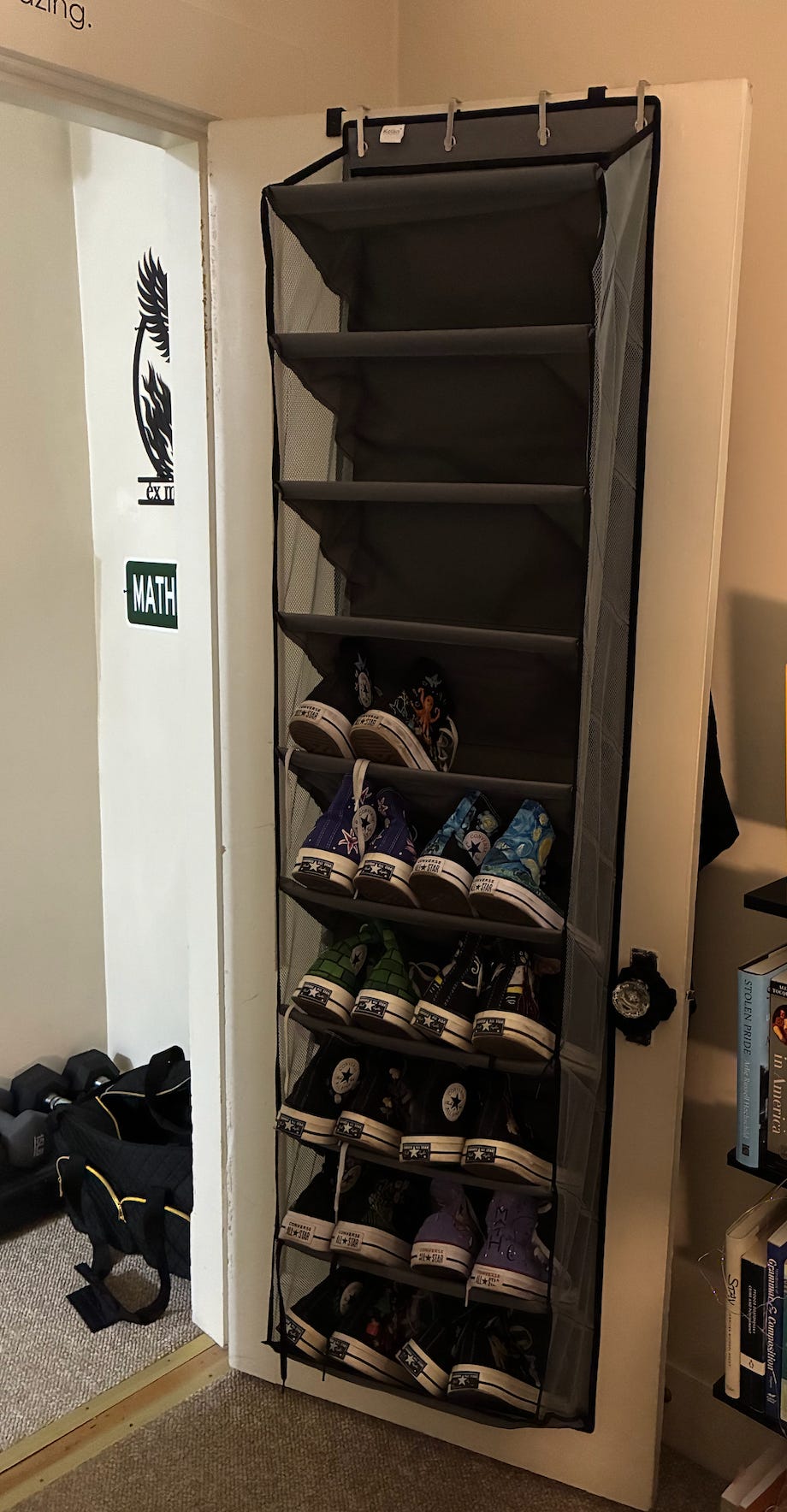
These are shoes for walking, and walking is most of what I do in them — the same route, most days, down the hill into town and back up again.
I live in what passes for a bad neighborhood in Washington County, Vermont. That phrase should tell you something all on its own, because here is what the bad part of town looks like.
It looks like flowers.
Owners and renters alike, almost every house I pass has them. Marigolds and petunias crowded into a terra-cotta pot. Geraniums in a window box. Poppies leaning red over a cracked sidewalk. A whole row of containers marching down a set of weathered deck stairs, because there was no flat ground to set them on. The houses are modest, and some of them are tired. The people behind these doors have some of the hardest lives in New England — real hardship, the serious kind, nothing I’d paper over with a nice sentence.
And yet. Flowers.
Nobody needs them. And that is the entire point.
A marigold feeds no one, pays no rent, settles no debt. It is pure surplus — beauty tended by people who could be forgiven for having nothing left to spend on beauty, and who grow it anyway, out by the mailbox, where a stranger passing in her painted shoes will see it. My Chucks have starry skies and sea creatures worked across canvas that only ever needed to keep the weather off my feet. The flowers are the same wager, made by my neighbors: that there is enough — of money, of time, of spirit — to put some of it toward something lovely and unnecessary.
That is the luck. Not that life here is easy; for a lot of these households, it isn’t. The luck is that even at the bottom of the hill, in the worst part of town, there is margin enough to bloom.
When I finish my first draft, I’m going to walk downtown.
Within two miles of my apartment — my apartment, a point we’ll come back to — there is both a standard and an ethnic grocery store, as well as about fifteen restaurants. There are two bookstores, a stationery shop, an art gallery, a laundromat, an art supply store, an old-fashioned hardware store where the men and women who work there can answer your questions without pulling out their phones and ask, in return, only that you don’t let the store’s indoor cats out.
The sheer bounty of what’s available to me with a short walk is far beyond what was available to royalty in most of human history.
A bit farther is the state capitol, with a gold dome that’s somehow both gaudy and glorious all at once.
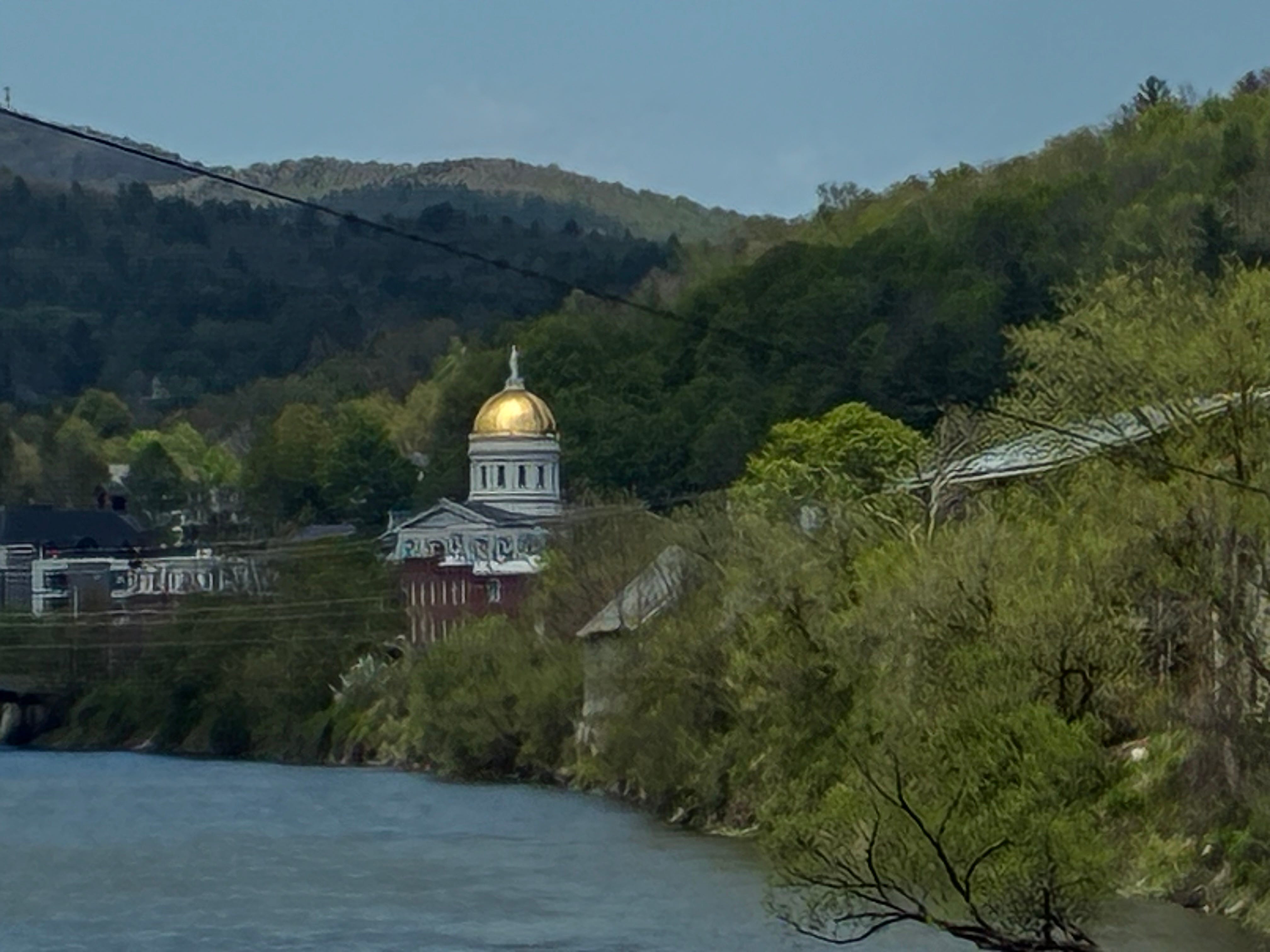
I can enter the state capitol anytime I like and watch the legislators debate. I can see how they vote. I can, with attention to the rules of order, ask to be heard — and I will, in fact, be heard, quite apart from my legally secured right to vote.
On Tuesday, I sat on a bench in front of the capitol and made the beginnings of a sketch. For me, whose drawing-from-life-not-photos skills are still developing, this means doing lots of math: holding up a ruler and making notes on proportions and angles.
I was there for hours, leaving only when the sun started going down, changing every shadow and every note I'd made about them.
There were no cops, no suspicious looks from government officials, no eyeballing from authorities.
I sat, for hours, outside the seat of government for 1/50th of the most powerful military-industrial complex in the history of humanity.
And the only interactions I had with other human beings were a few passing smiles.
While I’m spilling my guts: here’s a confession that you likely won’t hear from anyone else today.
I have no idea if my country is at war or not.
We went to war against Iran in late February. I’m scrupulous about how much political content I let into my life, which means that despite being Terminally Online, very little of my online time is spent on news.
Let’s pause here and think about that.
I’m an adult citizen of the United States of America, and I cannot tell you the status of a war my country has been engaged in for several months.
Far more amazing than that, I am a woman who cannot tell you the status of the war.
Historically, women have known war in a way different from the men who fought it. War is when the risks of disaster — rape, losing a child, having to flee a burning home in desperate search of shelter — all skyrocket.
Me? I have no idea if the war is even over or not. It may be impossible to exaggerate how lucky I am.
How did this happen?
Not by luck, though it feels like luck. Luck is the word you reach for before you’ve noticed the design underneath. There is a design underneath. Someone built it. Someone sat down, almost two hundred and fifty years ago, and wrote the thing down.
They wrote that the rights came first.
This is the part we forget, because it has been true our whole lives, and the truest things go invisible. The government did not give me my freedom. It couldn’t have. My freedom was already mine when the government arrived; its entire job, the only job it was ever assigned, was to keep what was already mine from being taken.
We hold these truths to be self-evident, that all men are created equal, that they are endowed by their Creator with certain unalienable Rights.
Endowed. Not granted. Not issued, the way a state issues a license or a permit — something it can revoke on a Tuesday, for cause. Endowed: handed down, built in, mine before any clerk had a form for it.
I was raised in a culture, if not a family, that taught me my dignity came from somewhere higher than any man, any ballot, any king.
I no longer believe a great many things I was taught as a child, but I’m still sure of that one.
And it turns out the founders staked the whole country on the same wager — that what makes a person sacred is not assigned by the powerful, and so cannot be unassigned by them. No election reaches it. No majority can vote it away. It was never theirs to give, which is precisely why it is not theirs to take.
And then — the phrase that still stops me — the pursuit of Happiness.
Not happiness. They were too honest for that; no government can hand you happiness, and they knew it.
The pursuit. The right to go looking. The right to spend your one and only life choosing how to live it — to paint your shoes, to plant marigolds you can’t quite afford, to sit on a bench for hours doing math in front of a building you are allowed to walk into, to be so untroubled by the powers of the earth that you lose track of the war.
Everything in the pages before this one — the flowers, the bounty, the smiling strangers, the blessed not-knowing — runs downstream of that single clause.
The luck I keep feeling is only this: a promise, kept.
And a promise can be kept or broken. That is what makes it a promise and not a fact. A promise that your rights come before the state matters least to the people the state was never tempted to trouble — and most, achingly most, to the ones history has always found easiest to make less than whole.
Which is the first reason I would live nowhere else.
It is the reason I want to talk about being a woman.
Let me go back to what I did on Tuesday, because it was nothing.
I walked downtown alone. I wore what I wanted. I sat on a public bench in front of the building where my state’s laws are made — by myself, a grown woman, with no one’s permission and no one’s arm — and I stayed until dark and walked home in it. I unlocked my own door. The door of my own apartment, the one I told you we’d come back to, the one whose lease carries my name and nobody else’s.
No one asked where my husband was. I don’t have one.
No one asked who had let me out or who my father is.
This is so ordinary that calling it freedom feels almost embarrassing, like thanking someone for the air.
So let me compare it to almost anything else.
Right now, this same Tuesday, while I sit here counting my shoes, there is a country where a girl is forbidden to learn. Afghanistan is the only nation on earth that bars girls from secondary and higher education — not by the accident of poverty, but on purpose, by law, by men who decided a girl’s mind was a hazard to be contained. A woman there cannot go out without a male guardian at her side. She has been shut out of the universities, the offices, the parks, the gyms. There are laws now reaching her very face and voice in public — the one to be covered, the other to be kept down.
She could not do the nothing I did on Tuesday. Not one piece of it.
She could not sit alone on that bench. She could not walk home in the dark.
She could not hold the lease, or the door, or the plain silence of a house that asks her nothing.
And she is not a woman of some vanished century. She is alive right now, exactly as alive as I am, breathing the same air on the same afternoon.
The only thing standing between her life and mine is the spot on the map where each of us happened to be set down at birth — which neither of us chose, or earned, or deserved.
That is the part I can’t walk past.
I am not going to tell you American women have it perfect. We don’t, and you would be right to stop trusting me if I said so. There are countries that outrank us on this measure or that one, depending on what metric you care about and who does the math, and we can have that argument another day.
But none of it touches the thing I mean, which is not the ceiling. It is the floor.
The floor is this. I am a person — whole, entire, on my own paper.
My name is mine. My money is mine.
My yes is mine to give and my no is mine to keep.
I can be schooled past the edge of any man’s comfort. I can stand up in a public room, say the thing I think, and be heard as a matter of law.
Underneath me there is a floor, and it holds — and it holds for the woman with the hardest life on my street exactly as it holds for me.
She has less of nearly everything. She does not have less of this.
That floor is what I would lose almost anywhere else, across almost all of history, and in more of the world right now than we like to picture from a bench at dusk.
I didn’t build it. I didn’t earn it. In a very real sense, I don’t deserve it.
I was simply born standing on it, in a country that had decided — long ago, and at a cost I did nothing to pay — that I would be a person and not a possession.
Most of the women who have ever lived would not recognize my ordinary Tuesday as a human life at all.
They would think they were looking at a queen.
So when I tell you there is nowhere else I would rather be, begin here. Not with the flag, not with the anthem.
With a woman on a bench in the failing light, unguarded and unafraid, free to make the smallest and most extravagant choice there is: to stay a few minutes longer, only because the light was good.
I have lived in two countries, and never left this one.
I was a girl in the rural South — Mississippi, Alabama — where the summer sits on you like a wet wool coat, where the church is the center of gravity, where a stranger will tell you her whole life at the gas pump.
I am a woman now in Vermont, where the winter is a kind of moral examination, where people leave you alone so politely it can take a year to make a friend, and where the stranger at the pump keeps her life to herself and thinks the better of you for keeping yours.
These are not two moods of one place. They are two worlds. The food is different, the faith is different, the jokes are different, the silences are different.
Set them side by side without telling me they were the same country, and I’d have called them two.
And they fly the same flag. They send their young people to the same army. On the few matters that reach that high, they answer to the same President and Supreme Court.
By every reasonable expectation, this should not hold. Places this unalike are meant to fly apart, or else grind on each other until one wins and the other vanishes. Ours, mostly, don’t.
I used to think that was luck, or habit, or leftover momentum. It isn’t. It’s the same answer as before. Someone built it this way.
They built the seam loose. On purpose.
The men who drew the thing up were afraid of precisely this — of a center grown strong enough to press Mississippi and Vermont into a single shape, which is only another way of saying strong enough to erase whichever one it cared for less.
So they kept the top small by design. Madison said it without flinching: the powers handed up to the federal government would be “few and defined,” and the powers left to the states “numerous and indefinite.”
The Tenth Amendment is that same thought set into law — whatever isn’t expressly handed up stays down here, with the states, with the towns, with us.
The country was meant to be thin at the top so that everywhere else it could be thick, and various, and stubborn. The marvel was never going to be that Vermont and Mississippi agree. The marvel is that they were built so they would never have to.
And there is a place you can still go to watch it run.
On the first Tuesday in March, the towns of Vermont hold Town Meeting Day. Neighbors gather in a room — a school gym, a grange hall, a church basement — and they govern themselves out loud.
They vote the town budget line by tedious line.
They argue the road grader, the library hours, whether the money should be spent on the thing at all.
Not representatives doing it on their behalf. Them.
It is the slowest, least glamorous, most gloriously boring exercise of power I have ever sat through, and it is the most real democracy left in this country.
A few weeks ago I ran into the governor of Vermont in line at that same hardware store, the one with the cats. No detail, no entourage, no black SUV idling at the curb — just a person waiting his turn like the rest of us, making small talk about the weather we were all going to complain about.
I have thought about that more than I expected to. In most of the world, and in most of the years the world has had, getting that close to the head of a government meant you were either very important or in very serious trouble.
Here it meant that my friend Josh Slocum needed to pick up paint, and I was along for teh errand.
Here is the part of Town Meeting Day that undoes me a little: it is older than the country. New England towns were gathering like this, deciding their own small fates in rooms, more than a century before there was a United States to belong to.
The founders did not invent the town meeting. They did something humbler and shrewder: they built a nation light enough at the top to leave it standing.
When Tocqueville came looking, two hundred years ago, for the place where American freedom actually lived, he didn’t find it in the Congress or the president’s house. He found it in the township — in the plain room where ordinary people practiced governing themselves the way children practice arithmetic, until it stopped being a lesson and became a thing they simply knew how to do. The town, he decided, was the school of liberty. Not the capital. The town.
I have sat in that school. A girl who grew up being told, in a hundred quiet ways, that the deciding happened somewhere else — to her, and not by her — that girl now sits in a room on the first Tuesday in March and raises her hand on the question of the road grader.
I have belonged to both of my countries. I can tell you the distance between them is real, and that the distance is not the defect. It is the design.
The union was made shallow on purpose, so that the parts could stay deep, and strange, and themselves.
I won’t pretend the seam has held perfectly. The top is far heavier now than Madison ever drew it; the federal government reaches into corners he never dreamed of, and “few and defined” reads, some days, like a line from a language we’ve stopped speaking.
Town Meeting Day is an ember, not the whole fire.
But it is a true ember. It still throws light. It still shows you what the thing was for.
Vermont has two hundred fifty-one towns, and there is a club — a real one, with a real membership — for people trying to set foot in all of them.
Not the postcard towns. All of them. The ones that are a white church, a closed store, and a dirt road. The ones whose whole population would fit on a school bus. You drive out to a place that holds nothing but its own stubborn name, you stand in it a minute, you mark it on the list, and you come home one town richer.
I am working my way through. I’ll likely be at it for years.
It is a deeply silly way to spend a Saturday, and I love it without apology, and somewhere around town number fifteen I understood that the silliness was the entire point.
You only get a hobby like this in a country built thin enough at the top to let two hundred fifty-one small places stay small, and separate, and worth the drive. The 251 Club is federalism turned into an afternoon — what love of locality looks like when a person finally has the leisure to indulge it: a whole free day spent going to look at a town that asked nothing of her and offered nothing in return but the fact of being itself.
And the list narrows, the way these things do, all the way down. Two hundred fifty-one towns, to the one I live in, to the street I walk every day, to the apartment that holds my name on its lease, to the living-room-turned-art-studio where I spend the quietest and best hours I have, to the desk in my office-bedroom where I’m writing this.
There are two shoes on that desk. Ceramic Chuck Taylors, the very image of the ones on my feet, made to hold pencils.
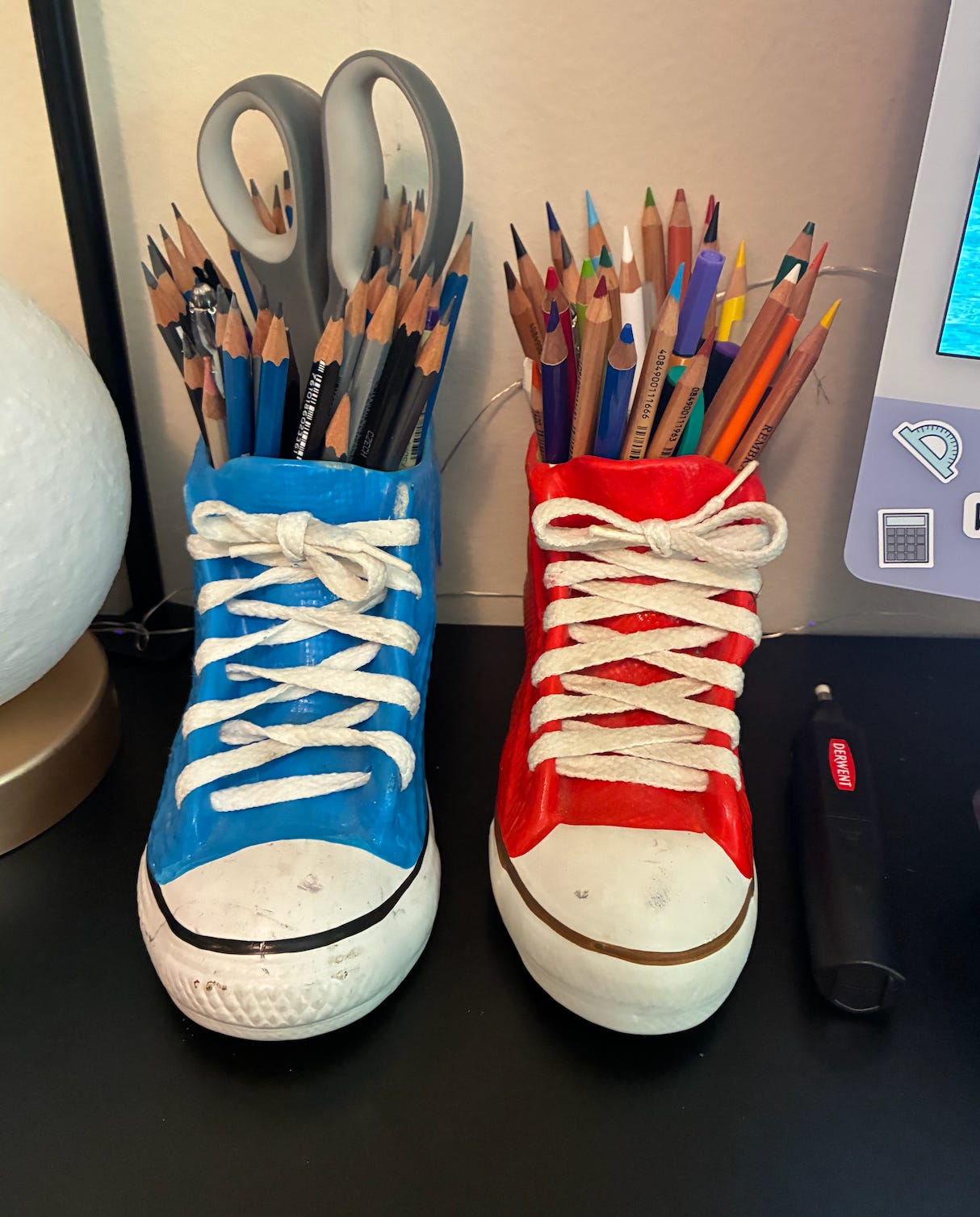
The blue one holds my graphite — the foundation, the realism, the long slow discipline of getting the values right, which is mostly, when you get down to it, a kind of math.
The red one holds my color: the newer work, the braver work, the part of me still finding out what it can do. Two shoes. Two sides of a person.
They sit there while I draw things nobody needs, in a country that has arranged, at staggering and unending cost, for me to be free to draw them.
That freedom is the whole reason the loud machine at the top exists. It’s also why the machine’s noise has never quite reached this desk.
A free country is, finally, a place where most of the governing is done by people governing themselves.
The great national fight floods every screen I own, and I still can’t reliably tell you who’s winning it — because almost nothing that touches my actual life is settled up there.
It’s settled down here: in the boring rooms, at the hardware store, on the lease, at the desk with the two ceramic shoes.
The fight at the top is vast, and it is deafening, and it was, by deliberate design, made survivable.
Which is what leaves the rest of us free to do the strangest and most wonderful things with all that quiet.
Every four years, give or take, my country has a nervous breakdown.
It is a whole-body event. The people who were exultant become inconsolable, the inconsolable become exultant, and both are certain — certain down to the marrow — that this time the republic is actually ending.
Then it doesn’t end. The new people govern more or less the way the old people did, around the edges of a center that barely moves.
The trash still gets picked up. The mail still runs. And in three or four years we do the whole thing over, roles reversed, conviction undimmed.
I have a name for this, because I am the kind of person who names things. American Political Borderline Personality Disorder. APBPD.
The term is borrowed from a real disorder from which real people suffer, but the shape is too apt to leave alone. A nation that cannot hold a steady picture of itslef. That swings, hard and fast, between adoration and contempt — sometimes for the same institution, sometimes in the same week, now and then in the same person. The last best hope of earth on Monday, beyond redemption by Thursday.
We idealize, we devalue, we cannot decide who we are, so we careen between who we might be and call each careen an emergency.
It took me an embarrassingly long time to see the obvious thing about this.
It is not the behavior of a country in danger. It is the exact opposite; the mathematical inverse.
A people with a real knife at its collective throat does not get to spend its strength relitigating its own soul on a four-year cycle.
Nations fighting to exist don’t have identity crises; they have wars, and famines, and the grim arithmetic of survival, and they would trade every one of our hysterias for a single boring Tuesday.
The freedom to not know who you are belongs only to those in no danger of being told. You get to have a personality disorder when your survival is not the question on the table.
The crack-up is the proof of the safety.
And the breakdown stays where it happens — up at the top, in the thin loud layer we built precisely so it could take the voltage. Down here, underneath it, almost nothing moves. The lease still has my name on it. The grader still runs. The governor still stands in line at the hardware store.
Whoever wins the contest, I will wake the next morning a person and not a possession, free to walk downtown in whatever shoes I please.
The swing rides on a floor that does not swing, and that is the only reason the swinging can be borne.
This is the same arrangement, seen from its other side, that lets me lose track of the war. The reversal that was going to end the world ends, instead, in my failing to notice.
We are free to treat every election as the apocalypse for the very same reason I am free to forget there’s a real one running: because the things that could actually finish us are being held off, just out of frame, by people and structures I have the unspeakable, almost obscene luxury of never thinking about.
I don’t want to be glib. The swinging costs something real — it wears people down, it frightens them, it eats the trust a country runs on, and not every lurch is small.
A thing can be a luxury and still do harm.
But it is the kind of bill you only run up if you’re rich, and we are rich in the one way that turns out to matter most: we are safe enough to be ridiculous.
Which leaves the question I’ve been stepping around all this time.
Safe because of what?
Held off by whom?
I grew up in a poor neighborhood — the serious kind of poor, the kind the comfortable parts of this country have trained themselves not to look at directly. The boys I grew up with had two roads out of there that I can remember, and only two. One of them ended in an orange jumpsuit. The other one ended in a uniform.
It was mostly boys then, and it is still mostly men. The actual defending of this country — the carrying of the rifle, the standing of the watch — has always fallen heaviest on the young and male, and heaviest of all on the young and male from places like the one that made me.
The freedom I’ve spent this whole essay marveling at, the bench and the shoes and the flowers and the blessed not-knowing, was not bought evenly.
It was bought, disproportionately, by the sons of the poor.
Some of the boys I knew took the road that wasn’t prison. And a few of them did not come back from it; they left their blood, their limbs, and their lives overseas.
I don’t know their names the way I should. I know them mostly as LaKeisha’s brother and LaTonya’s cousin and Nevaeh’s uncle.
That’s a small shame of my own, and I’ll carry it.
But I know they were real, and I know what they stood for, and I know that the arithmetic of my safe afternoon runs straight back through them.
I get to lose track of the war because someone I grew up with could not.
I get to forget there’s a watch being stood because a boy from my street stood it — and a boy from someone else’s street is standing it tonight, right now, while I sit here counting my shoes.
This is the bill, and I won’t pretend it’s fair. It isn’t.
A country that lets its comfortable forget the war while its poor go and fight it has not solved the oldest injustice; it has only moved it somewhere the comfortable don’t have to look.
I’ve been honest all the way through about the cracks — the federalism worn down to an ember, the swinging that costs more than I let on — and I’m not going to go soft at the finish and tell you the ledger balances.
Because it doesn’t. Someone always pays, and it is almost never the someone who benefits most.
And here is the thing I’ve been walking toward this whole time. Knowing all of that — having looked straight at the bill — I am grateful anyway.
More, not less. Gratitude that can’t survive the truth was never gratitude; it was just a good mood, and a good mood is no way to love a country.
I love mine the way you love anything once you’ve seen what it cost: clear-eyed, and a little bit on my knees.
So let me do the one thing all this not-knowing makes hard, and the one thing I plainly owe. Let me stop, on this ordinary afternoon, and think of the boys.
The ones who took the road that wasn’t prison.
The ones who came home changed, and the ones who didn’t come home at all.
The men — still mostly men — standing watches I will never see, in places I will never have to think about, so that I am free to never think about them.
They are the reason I get an ordinary Tuesday at all. They are the reason I can spend it forgetting them.
There is an American flag on a porch three blocks down from mine, on a house that has seen better decades, hung by people whose lives are hard in the ways I described at the beginning.
I used to read a flag like that as a kind of noise. I don’t anymore. I think it’s a receipt. Somebody on that street, or somebody they loved, paid toward the thing the rest of us take for granted, and the flag is them saying so — quietly, without an angle, the same way my neighbors put out marigolds.
Every once in a while, the reality of how lucky I am stops me in my Chuck Taylors.
Now you know everything that’s holding me up when it does: a promise someone wrote down, a seam left deliberately loose, a town that governs itself in a gym, a floor that makes me a person and not a possession, and a boy from a poor street who walked toward the war so that I would never have to learn its name.
I’m going to finish this draft, and then I’m going to walk downtown. I’ll wear the shoes. I’ll pass the flowers, and I’ll pass the flag, and I’ll remember what it’s a receipt for.
And somewhere out past the far edge of everything I let myself notice, the watch will go on being stood.
I still have no idea if the war is over.
That is the most extraordinary luck a human being has ever been handed.
And I am done pretending it’s ordinary.