
Dispatch From the Zoo
more on parasociality

Parasociality as a Mirror: Questions for Both Sides
I’ve written before about parasociality—the one-sided relationships that form between audiences and creators.
At its core, parasociality is the illusion of intimacy without the reality of reciprocity. The reader feels close, invested, even entitled; the creator remains largely a stranger, left to manage projections and expectations that don’t belong to them.
Why does this matter? Because when we confuse intimacy with access, or when we replay old emotional scripts onto public figures, the result corrodes both sides.
The creator loses peace, and the reader often loses perspective.
This post is an object lesson. The story is mine, but the questions are for both sides.
What Happened
After moving into a larger apartment and finally setting up a proper art studio, I felt happy and, stupidly forgetting everything I know about parasociality, posted a work-in-progress drawing on Substack Notes.
It was the first thing I started drawing in my new home.
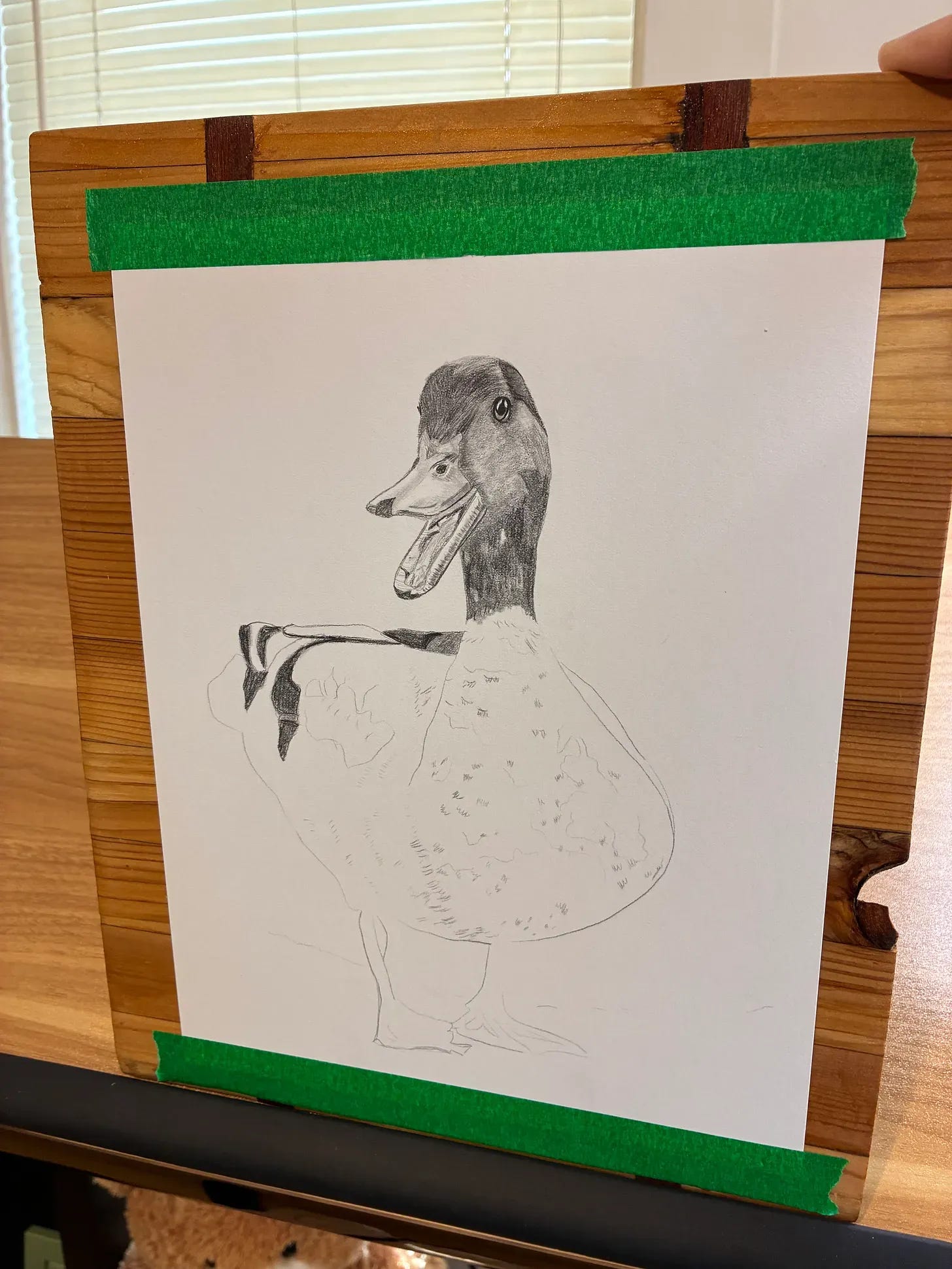
Someone replied that it looked like my “reboot of Alien.”
I was immediately annoyed. Drawing is serious work for me, one of the very few childhood wishes that I’ve been able to grant myself. It is also one of the ways I’m working to get out of debt.
In my annoyance, I shot back something like, “So it looks like an alien, not a duck. Great. What a beautiful start to a Monday. FFS.” Then I deleted the thread and moved on.
But the person followed up with a private message:
“It does look like a duck. Focus on the bill in isolation. Now remember the little alien head coming out of the big alien head. See? Sorry to make you mad, but it does amuse me I got a FFS out of you. Love ya, Holly.”
Here’s the full exchange.
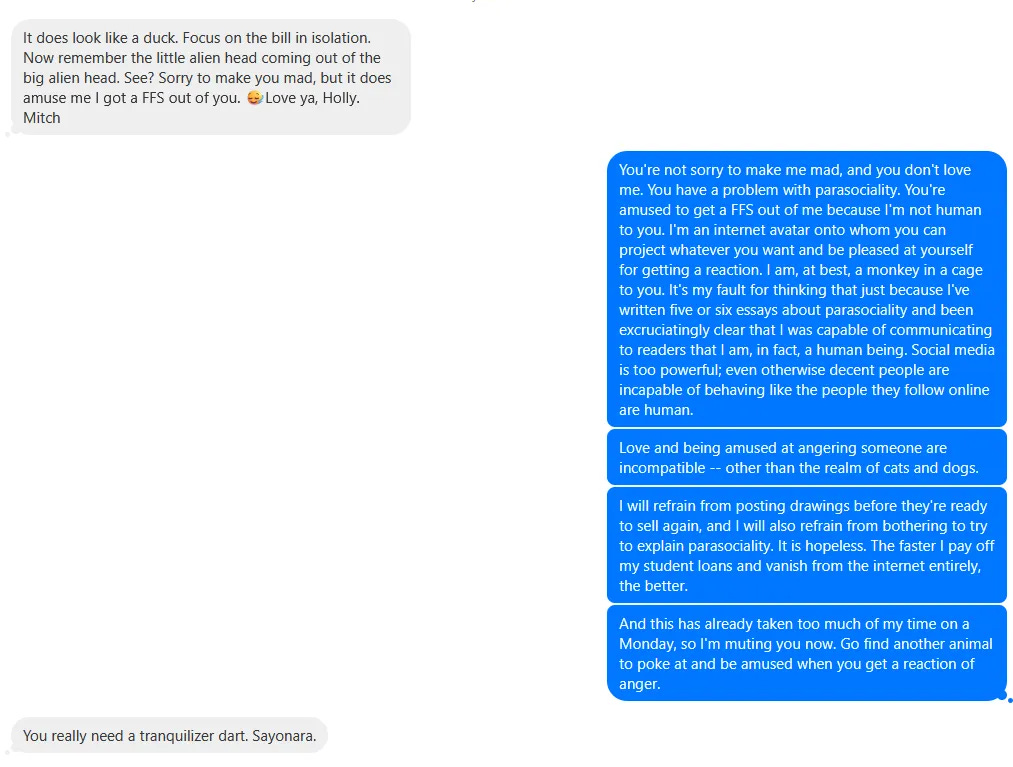
Pause there. Ask yourself: What was he hoping to get?
Was it simple attention?
Validation that he existed in my world?
The thrill of having provoked an emotional reaction?
And then ask: why does that matter so much to him, from me, a stranger?
What Creators Need to Ask Themselves
Now look at me. Why did I post a progress photo, knowing from years of experience that it would almost certainly draw parasocial responses?
Was I hoping for affirmation?
Was I seeking connection on a good morning?
Or was I, unconsciously, replaying my own childhood pattern of stepping into situations where I would be provoked and then tasked with managing the fallout?
If I’m willing to be honest—and I am—then the answer is yes to all of the above.
Yes, I was seeking affirmation. I’ve been practicing for a portrait that matters to me, and I wanted some assurance that the work was on track.
Yes, I was seeking connection. Since the retreat I’ve been far more self-sufficient than I used to be—I haven’t taken sleeping medication since the very first night of retreat—but this morning felt different. After a week of exhausting myself with both work and unpacking, I was about to begin my very first day in a fully set-up studio. It felt like a fresh beginning, and I wanted to share that good mood, to solidify it by moving it at least partially out of my head.
And yes, the reenactment is obvious. I grew up responsible for the moods of adults. Posting innocently online and then being forced to “handle” a stranger’s reaction feels uncomfortably familiar.
And yes, my response to him was more dramatic than it needed to be. I could have muted him instantly. Instead, I wrote a long reply spelling out everything I thought about parasociality, love, and the impossibility of “just ignoring it.” Was that overkill for one offhand message? Absolutely. But the intensity of my response is part of the point. Parasocial dynamics don’t just trigger irritation; they light up old circuitry.
When someone treats me as an avatar rather than a human being, I can feel myself slipping into childhood patterns of over-explaining, over-justifying, and trying to teach someone why their behavior is hurtful. And I’m particularly vulnerable to doing this because I’ve worked so hard in previous essays to explain parasociality (and what social media does to all of us more generally) and I believe that understanding it is key to being a responsible digital citizen—which, like it or not, we all are now.
So here is the question every creator can ask: Am I setting myself up to reenact the old roles—caretaker, scapegoat, entertainer—that once kept me safe?
What Readers Need to Ask Themselves
Back to the man who wrote me. He said it “amused” him to get a rise out of me. He ended with “love ya.”
Ask yourself: would you ever say to a friend, I’m amused that I made you angry?
Would you call that love?
If the friend is your cat and you provoked exasperation with a laser pointer, maybe.
Same thing if the friend is your dog and you provoked exasperation by offering and then withholding a toy.
But from a human, towards a human — is that love, in any sense at all?
Or is it something else—domination, ownership, a way of turning another person into a prop for your amusement?
And notice how quickly the shift happened. At first, when I gave him attention—even annoyed attention—he professed “love.”
But the moment the attention turned negative, he recast me as a zoo animal needing a tranquilizer dart.
That’s the classic idealization/devaluation swing familiar from Cluster B dynamics: adoration when you feed the need, contempt when you don’t.
So ask yourself: when you poke a creator, what are you really after? Attention? Connection? Control? Are you, too, replaying a childhood pattern in which provocation was the only reliable path to closeness?
Why “Just Ignore It” Doesn’t Work
When I posted about closing comments in perpetuity, several readers told me I should “just ignore” interactions like this. But ignoring doesn’t undo the dynamic. It lets it persist.
A better question is: What structure will stop the reenactment altogether? For me, the answer is closing comments. For another creator, it might be strict moderation, scheduled Q&As, or limited inbox access.
Ignoring is passive. Restructuring the terms of engagement is active.
Closing Reflections
Parasociality is not just rudeness — nor is it just kindness, when it comes from the other side of the idealization/devaluation spectrum.
It’s a structural distortion of the very idea of a human relationship. It creates false intimacy for the audience and extracts a kind of dishonest-by-necessity emotional labor from the creator.
Left unexamined, it invites reenactment of the ugliest family dynamics: caretaking, provocation, domination, appeasement.
And in its more volatile expressions, it even mimics Cluster B idealization/devaluation — “love” when you comply, contempt when you resist.
So the questions I leave you with are these:
If you are a reader: What do you want when you reach out to a creator? Attention? Validation? The pleasure of making them react? What childhood role might you be replaying when you do that?
If you are a creator: What are you seeking when you post? Affirmation? Connection? Are you, in turn, inviting reenactments of your own past?
I will keep writing and drawing. I will continue to produce for people who want to look and read without treating me as raw material for their amusement.
What I will not do is allow a part-time job to re-stage the ugliest dynamics of my childhood. I’d rather give up on ever getting out of debt and preserve my therapeutic progress.
This exhibit is closed.
Those seeking entertainment from provocation will have to find another zoo.