
The A+ Pupil
my review of JD Vance's new book


For A More Educated Take on J.D. Vance’s New Book
My friend Dan has a deep expertise in many of the issues that touch on this review, as well as a genuine historical context for many of the claims Vance is making. His review is here, and well worth your time.
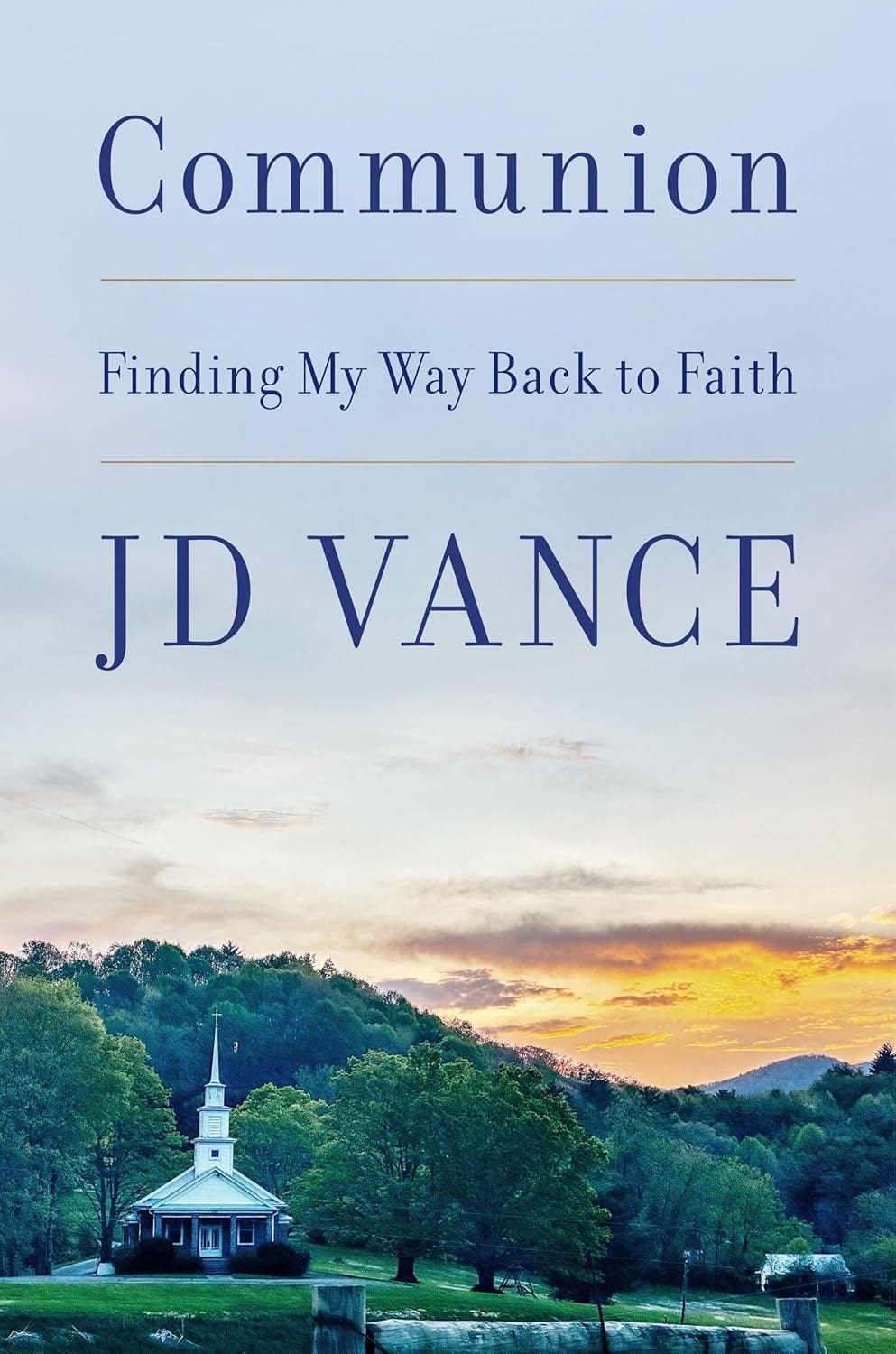
If anyone is going to inherit the mantle of MAGA, it’s J.D. Vance.
President Trump must either endorse him or implicitly admit that choosing him as vice president was a mistake, and we all know how readily President Trump admits mistakes.
Based on our national habit of pendulum-swinging (what I've called APBPD — American Political Borderline Personality Disorder), Democrats ought to be favored in 2028. But the party appears determined to keep doubling down on socialism and trans lunacy while also looking poised to recapture Congress this year and thus shifting the blame for our current messes onto their shoulders, creating a plausible path to a 2028 Republican victory.
So what the VP believes, and the kind of person he is, really matters. (To say nothing of Trump being both elderly and addicted to eating McDonald’s.)
This review is therefore long and detailed.
The upshot: this book shocked the hell out of me and made me profoundly scared about the possibility of this man becoming President, but it didn’t make me dislike him.
My Priors
As always, I will lay out my priors so you can judge for yourself how heavily to weigh my take on this book and its implications.
I grew up in a lunatic Christian sect. If you’ve seen the documentary “Jesus Camp,” you get most of it. As an adult, I deconstructed my childhood faith and became a reluctant atheist. I’ll go into what “atheist” means in the review, since J.D. Vance says he was one before his re-commitment to Christianity.
My only prior on J.D. Vance: I live in a cobalt blue state where my vote for President didn’t matter, so I wrote in a friend of mine. My intent there was twofold: one, I wanted a picture of my ballot to send him and brighten his day. Two, I think write-in votes send the message that “I am fully capable and willing of going to the trouble to vote, but not for these turkeys. Do better.” If I lived in a purple state where the outcome was in doubt, I’d have held my nose and voted for Trump/Vance.
Trump is a narcissistic blowhard who loves this country. His opponent was a narcissist who loved the performance of Woke virtue.
A deplorable choice, but not a particularly difficult one.
J.D. Vance Is A Walking Identity Crisis
If you’ve read Hillbilly Elegy, you know that J.D. Vance had a difficult childhood. Enormous instability, many types of abuse, and being surrounded by poverty, drug addiction, and psychological torture. His family drama included things like one grandparent setting another on fire, which was not enough to end their marriage. The overall theme of Hillbilly Elegy is the primacy of personal responsibility and the necessity of playing the hand one has been dealt as well as one can, not looking for government or others to bail oneself out.
The contrast between that theme and many things he says in this book is striking.
As a consequence of his childhood and the lasting damage, VP Vance is a walking identity crisis, and no, I am not talking about Vance having changed his mind. Changing one’s mind is good, laudable, and in the modern era even a little courageous.
I’m talking about something far scarier: Vance seems to have no deep understanding of himself or others, but rather grabs cultural labels without much regard for what they actually mean. He chooses labels that will resonate with voters and, it seems, that he hopes will resonate with himself. He reaches for the labels that will bring him the right vibes and weaves a self-concept out of them.
I see no indication that he does this consciously. I wish he did; it would make the possibility of a President Vance a lot less unsettling.
In Donald Trump, we have a predictably unpredictable President. By that I mean that we can confidently predict that he will do whatever the most recent person to either flatter or enrich him wants. I do not intend that as an indictment, just a description. In my view, it’s less horrifying than a President for whom a similarly reliable heuristic would be, “He/she will do whatever the leaders of the DSA want him/her to do.”
What makes it tolerable in Trump is twofold: one, the left is far too embroiled in Trump Derangement Syndrome to ever pull a Kim Kardashian and use this to their advantage to get what they want. (Lucky for us, since it would be exceptionally easy for them to do this if they had the brains.)
Two, everyone on earth sees this, even if they lack the language to describe it. So it’s right there out in the open.
To describe it more clearly: you want either a President being paid off or otherwise manipulated by nobody or a President who accepts bribes openly and in public. Because at least you know. It’s the in-between stuff that’s worst.
Reading this book convinced me that Vance would be as easily manipulated as Trump, but without the obvious, bombastic qualities that make this aspect of Trump’s character so much less threatening than they could be. He would be the in-between case.
Perhaps the best example of Vance operating on vibes: he calls the younger version of himself an “atheist.” I don’t think he was ever actually an atheist in the sense of lacking a belief in gods. I think “atheist” is a word he can apply to the misbehaving, cringe version of his younger self and the vibe will do most of the work.
I resisted this conclusion because I recognize my affinity for using words correctly, particularly words that apply to me, and my disgust at those who redefine such words for their own self-aggrandizement. (I get equally angry when people use “Christian” to mean “Not Jewish or Muslim.”)
Vance was never, in my judgment, an atheist at all. He speaks only of falling away from the church, and not even for deep or difficult reasons, mostly as part of a generalized “getting away” from his difficult past. There is no indication of anything other than wanting to fit in with his more worldly and cosmopolitan classmates. Nothing any deeper than that changed.
He went through no dark night of the soul where he wrestled with the notion of how alone and vulnerable each human really is if no gods exist. And while I don’t wish that on anyone — it’s excruciating — it is the doorway one must pass through to deconstruct faith and truly qualify, under the dictionary’s definition, as an atheist.
When Vance found out his wife was pregnant, suddenly “my faith” became important to him. “…and it also forced me to accelerate my religious journey. I knew I wanted to raise my kids in some church, but I didn’t know which one. As hypothetical children became a very real child arriving soon, I began thinking about my faith in a far more intentional way.”
Folks, this is not how I would expect someone who genuinely lacked belief in God to react to the news of impending parenthood.
An atheist would respond to impending parenthood with something closer to: Wow, this is tough. My religious upbringing gave me some good things — community; a sense that the universe has a plan and the corresponding feeling of ultimately not being alone; something I shared with my family, something important, and thus a type of identity. How can I give my kids the good parts of that without telling them lies about the existence of gods?
Why do I insist he is using the term inaccurately? What do I think “atheist” means?
Here’s an analogy: suppose you are walking downtown when you come across a stand that holds a sealed jar of marbles and a sign telling you the number inside is even. You can’t count them.
Do you believe the sign? Presumably not — you have been given no reason to.
But notice that declining to believe the sign is not the same as actively believing the number is odd.
You hold no position on the parity at all. If a bookie walked up and asked you to bet money that the count was odd, you’d decline that too. Your non-belief isn’t an active alternative claim. It’s the absence of one. That is the whole content of my atheism: a claim was made, no sufficient reason was offered, so I don’t hold it. I am not thereby asserting its opposite.
I am an atheist about Allah, Zeus, Gaia, and many other gods about which nearly all of you are also atheists. I’m just an atheist about one more god than you are.
What Vance describes is much closer to what evangelicals call “backsliding” than anything like the painful, difficult work of deconstructing into loss of belief.
I suppose using a definitionally inaccurate label to summarize one's adolescent mistakes is common enough. But this habit of reaching for vibes over definitions is something Vance does over and over again.
There are many points in this book that reveal him to have no real core. He has good intentions and a charming attempt at what he regards as healthy masculinity.
But he’s far, far too easily influenced to be, to my mind, good Presidential material.
For the reasons I’ve already explained, Vance’s story of “becoming an atheist” reads like narrative reconstruction, not a recounting of his actual journey.
His actual conversion — the experience that changed everything forever, turning his life onto a new path — was not his becoming Catholic.
It was marrying his wife.
Vance’s desire to be a good husband and father is the glue holding his entire life together. After his terrible childhood, it’s the most understandable and obvious of goals. Also the most laudable.
I’ve written many times about the importance of fathers and I truly believe that 90% of our social problems would vanish in two years if every (or nearly every) non-criminally-abusive American father was married to the mother and involved with their kids on a day-to-day basis.
So I am in no way condemning, criticizing, or critiquing Vance for this. It is the best possible response to a shitty childhood, and he sets an example that I hope many young men will follow.
But.
There is something profoundly tragic in the way he seems to have arrived there: “Ewan was such a big part of my past. That’s a strange thing to claim about a baby who had been in the world for only a few weeks. But it’s no exaggeration to say that the promise of this baby had gotten me through many hard moments in life.”
Vance’s son had a job in life — redeeming his father’s painful past — long before he was conceived. That’s tragic.
The tragedy is part of the broader-but-smaller tragedy of Vance’s whole life.
Reading Communion, I had the growing sense that Vance does not merely change his mind when persuasive people enter his life.
Rather, he seems to hand them the pen with which his identity is written, even in retrospect.
He does this to the wider culture and the memewars of 2003-2015 when he says he used to be an “atheist.”
He did it to the upper middle class notions of what it takes to be “elite” when he decided to go to law school for no real reason beyond it seemed like a good next step.
His wife, his priest, his mentors, his friends — they don’t simply influence his conclusions. They seem to become the authors of his self-concept.
The result is not intellectual humility, which is a virtue. It is the absence of an internal center of gravity.
That distinction is the thread tying together almost everything in this book. It explains his casual misuse of words like “atheist.” It explains why so many of his convictions seem to emerge from relationships rather than from sustained reflection.
And it explains why I found this book simultaneously heartbreaking and alarming. A person without a firmly authored sense of self is not necessarily dishonest or manipulative. Quite the opposite: he may be perfectly sincere.
But sincerity is no substitute for self-knowledge. Someone who is always looking to worthy people for guidance can easily end up looking to the wrong people instead.
That is a tragic way to live, and a dangerous trait in someone who may one day occupy the Oval Office.
From Hillbilly Elegy to Rerum Novarum
One of the things that most surprised me about Communion was Vance’s rejection of ambition as life’s highest good.
The younger Vance — the Vance of Hillbilly Elegy — believed that the only way out of a disastrous childhood was to seize responsibility with both hands. Yale. Law school. A prestigious career. Financial success. Whatever one thinks of that worldview, it was unmistakably centered on individual agency. How to maximize it. How to act from it even when your feelings are all over the place.
The Vance of Communion is a different man. Marriage matters more than career. Fatherhood matters more than status. A meaningful life matters more than an impressive résumé. That is real growth in some respects, and I found much of it admirable.
But it is not merely growth. It is a shift in first principles.
The man who once argued that the path out of chaos lay primarily through personal responsibility now increasingly sees the path through submission to a moral order larger than himself.
Whether that is ultimately an improvement is a harder question than the book seems to recognize — and one that became increasingly important as I kept reading. I suspect it could be, if the choice of moral order is made through reason and from a place of psychological wholeness and sobriety.
It cannot be if it’s made through the influence of others and in particular if it’s a kind of glue for a broken, fragmented sense of self — or a sense of self that never really formed stably at all.
Vance finds the glue in marriage and family. Then Vance discovers Catholic social teaching, especially Rerum Novarum, and for a while I thought I was simply watching a trying-to-be-thoughtful man wrestle with a body of ideas outside the usual American left-right divide.
In many ways, that’s exactly what Catholic social teaching, to the best of my understanding, is. I’ve always admired Catholics who are consistent on life being sacred — they oppose abortion and the death penalty. It defends private property while insisting upon a just wage. It condemns communism while criticizing forms of capitalism that reduce human beings to economic inputs. It is, as Vance writes, “neither conservative nor progressive; neither liberal nor authoritarian.”
And that’s when I started to get nervous. That line. The man who is defined by others has found an all-purpose philosophy to let him agree with everyone!
One reason I found this part of the book so weirdly, like-a-car-wreck-in-slow-motion compelling is that Vance is diagnosing a real problem. The American system is, in important ways, rigged. Not rigged so that no one can succeed; rigged so that class mobility is far, far harder than it needs to be. I recently wrote an entire essay arguing that our student loan system is a perfect example: the government quietly pushes people into repayment plans that often make responsible borrowers poorer over time, then acts surprised when they conclude capitalism itself has failed.
Why the hell would they not, when they owe $70K, pay for 11 years, and end up owing $60K? I got an email yesterday advising me, who pays extra every single month and has for years, of all my many options to pay less or not at all.
I majored in math. What do you think the sociology majors are doing?
Where I part company with Vance is over the remedy. The government’s job is to remove its thumb from the scale, not replace one thumb with another. A market that has been distorted should be repaired, not abandoned.
I think Rerum Novarum pushes Vance waaaaaay too far in the direction of government as moral architect, where Hillbilly Elegy better understood that the state’s first obligation is to stop making success artificially difficult and then get out of the way.
Vance’s infatuation with a papal encyclical from long ago does not make me nervous because I dislike Rerum Novarum. I disagree with much of it, but every serious person ought to read people who disagree with them, and every President should have a moral framework deeper than cable news and poll numbers.
A papal encyclical is just not a fucking founding document of the United States.
The President should learn from Rerum Novarum. He should not govern from it.
As I kept reading, I realized, again, that my concern wasn’t really about economics at all.
It was about the way Vance seems to form what passes for his deepest convictions.
Again and again and again, he introduces someone admirable, and then quietly begins seeing the world through that person’s eyes.
His Uncle Dan embodied Christianity and was an ideal husband and father.
His Catholic friends “saw something real in the Catholic Church,” and “through them I began to see it, too.” Notice the order there. Not, “they persuaded me.” Not, “their arguments convinced me.”
Rather, they saw something, and through them he learned to see it himself.
Then comes the most heartbreaking passage in the book.
A priest tells Vance something that struck me as both obvious and courageous, though by this point in the book it no longer seemed insightful: his entire life, J.D. Vance has alternated between complete dependence and complete independence, vacillating between two extremes. First his grandmother became his savior. Then other family members. Then his wife. The priest gently tells him that Usha cannot bear that weight. She is his wife, not his savior.
Reading that passage, I actually relaxed. Finally, I thought. Someone has diagnosed the central psychological wound running through this whole memoir.
But what happens next?
Vance describes realizing that “the Church will provide you a road map to God.” He calls this idea profound. And perhaps it is.
But I couldn’t shake the feeling that I was watching the same pattern continue under holier circumstances. The priest correctly diagnosed Vance’s lifelong tendency to let other people anchor his identity.
Yet Vance’s response, as he tells the story, seems to be finding a larger institution to carry that burden, so as not to ever potentially threaten his marriage with too much weight to carry (though he doesn’t seem to consciously realize this motivation).
Even Usha’s endorsement struck me this way. She doesn’t tell him Catholicism is true. She tells him, “It’s been good for you.”
I think she’s right. This book convinced me that Catholicism has been enormously good for J.D. Vance. It has almost certainly made him a better husband, a better father, and, I suspect, a happier man.
That isn’t my concern. I’m not his friend. I’m a citizen.
My concern is that Communion repeatedly reads less like the story of a man integrating new ideas into an already-formed self than of a man repeatedly finding new authorities to whom he can entrust the authorship of himself.
The saddest passage in the book has nothing to do with economics or politics. Vance writes that he fears occupying a grave his children never visit. He fears the emptiness of a beautiful church more than death itself.
Really think about this, y’all. Even Vance’s vision of death is defined by relationships outside himself: his children, his church, his community. Throughout this book he keeps searching, over and over, for permanence in people and institutions he loves.
I don’t blame him for that. After the childhood he survived, how could anyone?
I do this myself — it’s not hard to figure out how someone with a childhood just as awful as Vance’s, and in some ways worse, became a mathematician and artist. Mathematics is the branch of knowledge that provides permanence and certainty, and art is the human pursuit where you learn to take moments of beauty and make them permanent on a paper or canvas.
So I’m not judging him; I’m observing him.
But the President of the United States cannot afford to keep looking outside himself for the next person — or the next institution — to tell him how the world fits together.
That is where I part company with J.D. Vance.
The Wrong Kind of Person to Have A Mirror in the White House
I see myself in aspects of J.D. Vance, and that is a problem. I am the wrong kind of person to have a mirror in the White House. Candidates who remind me of me are, as the kids say, problematic.
There’s a long sequence where Vance narrates to his wife all the worst-case scenarios he imagines and prepares for. Not the premeditatio malorum of the Stoics, although it’s on that spectrum. Rather, he describes a neurotic series of intrusive thoughts about disaster and how he would save his family from them.
I get it, Mr. Vice President. I go to the movies with Josh and think through which direction I’ll dive to hit the floor if shooting starts.
It’s called neurosis, and it comes from trauma. Can you spell trauma, boys and girls?
To expand on how important this point is — J.D. Vance made me profoundly grateful for some of the most painful events in my life. Seeing the way he has used other people’s reactions to him as a foundation stone of his identity was horrifying, scary, ugly, and bone-marrow-deep sad.
When a little kid grows up without stability or healthy kinds of love, this is the lifelong temptation: letting other people define you. It can take a long time and a good therapist for you to even figure out you’re doing it, which is ironic and humiliating.
One of the most cutting episodes of my entire life involved someone I trusted breaking a promise. This was someone who, when I told him I was starting to trust him and that scared me, responded that he understood. I told him no, I don’t think you do. “One day I’m going to get annoying,” I said. “I’ll get annoying, or I’ll make a mistake, and every scrap of my experience in this world, every line of my mental code, tells me that’s the moment I get tossed out like garbage.”
He told me that would not happen. He said he already knew I was afraid of it — that he'd understood the responsibility he was taking on, and he would “bear it honorably.”
I made a mistake, and he did the exact thing he had explicitly, with confirmation ahead of time that he knew exactly what kind of damage it would do to me, promised never to do.
Reading J.D. Vance’s book, and seeing how he’s defined himself based on other people’s reactions — his wife, his priest, his friends, his mentors — made me burst into tears of gratitude for that broken promise. It sucked. It hurt. It cost me a friendship, the pain of my first experience losing all respect for someone who had once mattered to me, and what is almost certainly permanent damage to my ability to trust. But that price tag, high as it was, was absolutely worth it.
In destroying a significant portion of my ability to extend trust, my former friend gave me a kind of freedom I would never have known otherwise.
Far better to be myself, self-owned and self-defined, even if it leaves me wholly alone, than to be a J.D. Vance.
No, I am not claiming to have achieved this to a high degree, or even consistently, not even on my best days. But then, I’m not stupid enough to run for office, am I?
J.D. Vance is fit to be a major cultural influence on our young men, a role model for husbands and fathers, and an important voice in our country.
But I don’t think he’s fit to be President.
He is simply too eager to become the A+ pupil of the most recent teacher to inspire him.
That his current father substitute happens to be a document written by a dead Pope may reassure conservatives.
But it really, really shouldn’t.
A President may borrow ideas. He must never borrow his identity.