
Hostage Negotiation As Coalition Politics
what Gov. Shapiro's book reveals about the Harris campaign

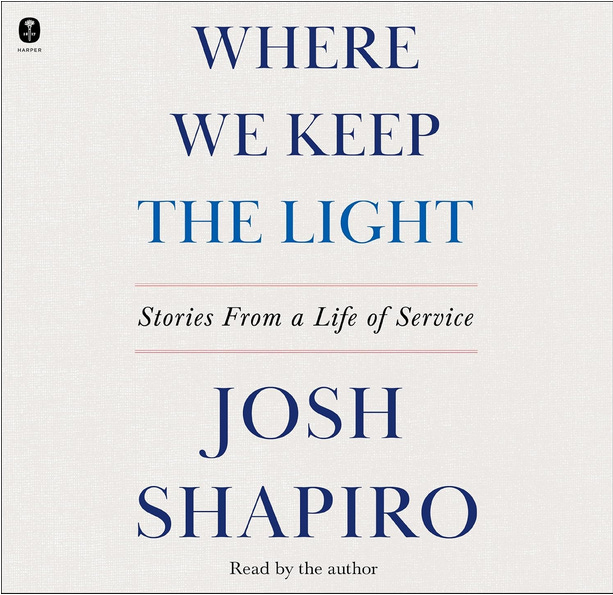
I read Pennsylvania Gov. Shapiro’s Where We Keep the Light for the same reason people slow down for a highway pileup: not because it’s healthy, but because you want to know what the hell happened in there.
On paper (er, Kindle) the book is a pretty classic modern political memoir: personal faith and family as the moral engine, public service as the proving ground, and a career arc narrated as a series of “show up, listen, execute” moments (county commissioner → attorney general → governor) with a few set-piece crises dropped in to establish character under pressure. Depending on which jacket copy you believe, it’s either “grounded and intimate” or “politically shrewd and deeply personal,” which is publishing’s way of saying: aspirational, carefully calibrated, and clearly aimed at people who do not enjoy being yelled at on cable news.
It’s also very explicitly a book about identity and threat — his Jewishness, antisemitism, and the way public life turns your home into a target. The memoir prominently features a harrowing account of the 2025 arson attack on the governor’s residence after a Passover Seder, which is the kind of thing no normal person writes as a “hook” unless it actually happened and is still living in their nervous system.
Now here’s the honest part: I’m not reviewing the whole book.
I’m reviewing the Harris-campaign portion — specifically the vice-presidential vetting story — because that’s what everyone actually cares about.
The rest of it is fine. Interesting enough, but unless/until he makes a serious run for President, nobody cares and I’m not wasting space on it. For what it’s worth, I suspect he will. The book is disarmingly authentic-sounding. It’s authentic in the way that’s either genuinely authentic or that is so perfectly crafted to sound authentic that nobody but his wife and his rabbi will ever be able to tell the difference.
When I say that’s the part everyone cares about, I don’t mean “everyone” in the lofty, civic-minded sense. Everyone in the group-chat reptile brain sense. The part where the curtain twitches and you glimpse the machine: who’s running it, what it rewards, what it fears, and what kind of questions it thinks are smart. (Spoiler: some of the questions, as described, are not smart.)
And before I get into any of it, I need to confess something up front: I am not a neutral reader here. This section of the book is a bias buffet for me. A dopamine delight!
Everything he says about the Harris operation is so perfectly aligned with what I already believe about Kamala Harris — her instincts, her brand, her political temperament, the kind of people who cluster around her — that it lands in my brain with the ease of a key sliding into a lock.
Which is precisely the problem.
When a narrative clicks that cleanly, it doesn’t feel like persuasion; it feels like confirmation.
And confirmation is the most addictive drug in the intellectual economy. Fentanyl has nothing on that shit.
So: yes, I’m going to take him seriously. But I’m also going to be very clear about why. Disbelieving him would require me to disbelieve my own prior judgment — not just about “Harris the candidate,” but about “Harris the machine,” the culture of risk management around her, and the way modern campaigns launder internal power struggles through language that sounds like principle. I’m not going to torch my own model of reality without a good reason. “It makes me uncomfortable” is not a good reason. “I don’t like the implications” is not a good reason. “My tribe would prefer I didn’t say this out loud” is not a good reason.
A good reason is evidence. A good reason is contradiction.
A good reason is an alternative explanation that accounts for more of the facts with fewer heroic assumptions.
So that’s the frame: I’m only reviewing the Harris-campaign section because it’s the only part of the book that matters to the current argument, and because it’s the only part where Shapiro isn’t just telling you who he is — he’s accidentally showing you how the Democratic party works when the stakes are high and the brand is fragile.
And I’m going to name, explicitly, the way my own priors make his account unusually easy for me to believe.
Okay. With that out of the way: let’s talk about what he claims happened in that vetting process — and what it reveals, whether every detail is true, half true, or “true in the way campaign people tell truths.”
If you’ve read my review of Kamala Harris’s book, 107 Days — entitled 107 Excuses, Evasions, and Pathologies — you already know the core diagnosis: a woman with no stable governing center, an almost pathological allergy to responsibility, and a campaign culture built around vibes, deference, and excuse-laundering rather than conviction or judgment.
What Shapiro gives us, unintentionally, is the other half of that x-ray.
Harris’s book shows you who she is from the inside.
Shapiro shows you what it’s like to encounter her from the outside — as someone who is serious, electorally useful, ideologically legible, and therefore threatening to the machine.
The first red flag comes before he even gets to Washington.
On the drive down, Dana Remus — who ran the vetting — calls with “one more question.”
“Have you ever been an agent of the Israeli government?”
Read that again. Not have you received money, not have you coordinated with, not have you been influenced by.
An agent.
When I read that, I found myself nodding, laughing, and then shaking my head.
The purple-haired “Queers for Palestine” freaks might not have been explicitly in charge of the Harris campaign, but there was ideological solidarity, and it went this deep.
Those freaks and their right-wing bullshit compatriots — the ones who think that Islamic terror attacks are false flags by Mossad to make Muslims look bad, that Israel controls the weather, and who probably asked their spouses why Mossad does this when they had to shovel snow last weekend — are far more powerful than we normies want to admit.
Shapiro is stunned. He pushes back, tells her the question is offensive, borderline insane. Remus replies, breezily:
“Well, we have to ask. We just wanted to check.”
This is not opposition research. Nor is it due diligence.
This is the revelation of a worldview in solidarity with the worst elements of our culture, terror of the left-wing version of those elements and unintentional agreement with the right-wing version.
Fear Is Not the Same Thing as Respect
What’s most striking about Shapiro’s account isn’t just the hostility to disagreement — it’s which disagreements trigger panic, and which constituencies are treated as volatile hazards rather than partners to be persuaded.
The Harris campaign did not misunderstand Jewish voters.
They feared a different constituency more.
This matters, because fear and respect produce radically different political behavior.
Respect says: These voters matter. We may disagree, but they’re part of the coalition and we should be able to argue in good faith.
Fear says: These people are dangerous. They can cost us the election. They must be managed, appeased, or neutralized.
Every signal in this chapter points to fear — not of Jewish voters, but of the activist wing of the left that has made Israel a moral tripwire and Jewish political identity presumptively suspect unless it performs sufficient self-denunciation.
That’s why the Mossad question isn’t just offensive; it’s diagnostic.
You don’t ask a popular swing-state governor whether he’s an “agent of the Israeli government” unless you are already operating in a mental universe where:
Jewish loyalty is conditional.
Zionism is treated as covert extremism, which is stupid in general but less than a year after October 7 is asinine. It means that Jewish trauma is the only trauma of which the party of Victim Olympics is unaware and towards which zero compassion is warranted. Almost as if Jews aren’t really human in their eyes.
Disagreement on Israel is read not as politics but as infiltration.
And you don’t do it because you think it will win Jewish voters.
You do it because you are trying to inoculate yourself against backlash from people you are more afraid of.
Shapiro makes this explicit later, when the vetting panel presses him repeatedly on Israel and campus protests (the radical notion that Jewish students should be able to walk to class without being harassed or having their dorm rooms vandalized) — not because his positions were unpopular in Pennsylvania (they weren’t), but because they might “play” badly elsewhere. Michigan. Activist circles. Online pressure campaigns. Donor-adjacent media ecosystems.
The same dynamic shows up around law enforcement. Shapiro’s strong, unapologetic support for cops — support that is popular with actual voters in Pennsylvania — is treated as another liability. Not wrong, not extreme, not electorally dangerous where it counts. Just “unpopular,” in the campaign’s estimation, because it risks angering the same activist class they are terrified of crossing.
Again, this wasn’t about persuading voters. It was about avoiding punishment.
Law enforcement wasn’t evaluated as a governing issue. It was evaluated as a vibes problem. And that tells you everything you need to know about how this campaign sorted priorities: not by reality, not by outcomes, not by who actually shows up on Election Day — but by who yells the loudest online and who can make life miserable for staffers and donors.
Jewish self-respect and public safety land in the same bucket here. Not “wrong,” just risky. Not disqualifying, just inconvenient.
This is the same instinct Harris reveals in her own book, over and over again:
The terror of upsetting protestors.
The refusal to confront antisemitism inside the coalition.
The instinct to blur, defer, and proceduralize instead of drawing lines.
The campaign wasn’t asking: How do we build a broader tent? Which is the question you ask if you’re trying to win.
It was asking: Who is most likely to punish us, and how do we avoid that punishment?
Hostage negotiation as coalition politics is both stupid and pathetic.
And it explains something that puzzled a lot of people after 2024: how a party that talks endlessly about inclusion managed to hemorrhage Jewish voters — not just in the margins, but in historically significant numbers.
The answer isn’t that Jews “moved right.”
It’s that they noticed, correctly, that they were being treated as bargaining chips.
Shapiro was electorally valuable. He was ideologically legible.
He was capable of expanding the map, and he was the literal popular governor of the most important state.
But he came with a cost: he would not pretend that Jewish self-respect was negotiable, or that law enforcement and campus safety were taboo subjects, or that disagreement itself was disloyalty.
From the campaign’s point of view, that wasn’t strength.
It was risk.
So they chose fear over respect — and then acted surprised when the people they treated as liabilities stopped behaving like a captive constituency.
This is the deeper continuity between Harris’s book and Shapiro’s chapter.
Harris shows you a candidate who cannot take responsibility because she is constantly managing threat vectors.
Shapiro shows you a campaign that has institutionalized that fear — one that confuses appeasement with strategy, compliance with unity, and silence with peace.
And that’s not just why they lost Jewish voters.
It’s why they keep shrinking the tent — and why they don’t seem to understand how it happened.
When Shapiro finally meets Harris at the Naval Observatory, the picture sharpens.
There’s no small talk. No curiosity. No sense of partnership. He describes a stripped-down room, aides silently taking notes, and Harris getting straight to logistics. She is confident. She believes she will win. She believes Pennsylvania matters.
Then comes the tell.
She explains what the vice presidency is.
“Your job was to serve the President,” she said. “That’s it.”
She elaborates:
“Your job is to make sure that you are not a problem for the President.”
Not help govern.
Not bring strengths the ticket lacks.
Not argue, advise, persuade.
Don’t be a problem.
That single phrase explains more about the Harris campaign — and the Harris presidency-that-never-was — than a thousand op-eds.
Shapiro tries, carefully, to describe how he governs. He talks about his relationship with his lieutenant governor — about wanting someone who can walk into his office unannounced, argue Door B, and then support Door A once the decision is made.
He makes it clear that he doesn’t need to be the decider — but he does need to be heard.
Full disclosure: I have come to believe, with the help of my (very old, very conservative, very male) therapist, that this is incredibly healthy. I have only two friendships that matter to me on a level where it would be soul-crushing to lose them, and this is the explicit agreement I have with both of them. “I don’t need you to agree. Your life is your life; your decisions are your decisions. But there are definitely times when I need you to hear me out.” And I don’t mean pretend to hear me out; I mean really hear me out. Ask whatever questions need to be asked for clarity. Actually hear me.
That’s all I need, and then when I have that, I can support whatever my friend decides, no matter what it is.
So I think Shapiro is right on the money here. That’s exactly what a Lieutenant Governor or a Vice President should want — to be heard — and should agree to do after being heard — support the ultimate decision.
Harris shuts it down.
“She was crystal clear that that was not what she was looking for.”
She tells him he would primarily work with her staff. She cannot promise access. She cannot promise influence. She cannot promise disagreement.
To her credit — and this matters — she is honest. Shapiro says so explicitly. She lays the cards on the table.
And what those cards reveal is not malice or incompetence, but something more damning: a governing philosophy built entirely around containment.
The VP’s role, as Harris understands it, is not to expand the universe. It is to shrink risk.
That aligns perfectly with what she tells us about herself elsewhere:
Why she couldn’t separate from Biden.
Why she froze on The View.
Why she passed on Buttigieg.
Why she preferred Walz.
The highest moral category in Harris-world is not right or wrong.
It is not disruptive. Agreement, or pretended agreement convincing enough to pass as actual agreement. And that’s all they really care about.
Is it any wonder that bullshit performance like pronouns in email signatures was the heyday of peak woke under these people?
The meeting ends. Shapiro is ushered not out, but sideways — to Eric Holder’s apartment — and told to wait. He waits for hours. He doesn’t know who’s listening. He doesn’t know what’s happening. He grows increasingly certain this is not what he wants.
Then Remus arrives with what may be the most revealing conversation in the chapter.
She lays out the “realities” of how the Shapiro family’s lives would change if he took the job and they won the election.
The financial strain.
The cost of clothes, hair, makeup.
The expectation that his wife Lori would have to perform, constantly.
The lack of money.
The burden.
Shapiro finally asks the obvious question:
“Are you trying to convince me not to do this?”
She’s taken aback.
She insists she just wants to be sure he understands.
But that exchange crystallizes the entire dynamic. This is not a campaign trying to recruit strength. It’s a campaign trying to avoid friction.
Strength is expensive. Conviction is risky. Independent standing is dangerous.
And Shapiro — a Jewish governor from the decisive swing state, with real relationships across constituencies and a record of winning — is all friction.
He goes home. He talks with his family. His teenage son cuts through everything with brutal clarity:
“Dad,” he said. “It doesn’t seem like you want to do it.”
That’s the knife.
Shapiro withdraws. Not because his son said that — it was clear all along he wasn’t comfortable with Harris’s allergy to responsibility, nor her priorities — but that’s a moment of beautiful clarity for him in the process of deciding.
He does it cleanly. He refuses to issue a statement. He insists it’s Harris’s process. He steps aside.
And when Remus hears, she’s stunned that he was worried about it.
“Are you insane?” she asks. “No one wanted you to do this. We are all thrilled.”
Thrilled.
Because the system worked. The risk removed itself.
Harris eventually calls to tell him she’s chosen Walz.
Shapiro supports the ticket. He campaigns. He gives the speech. He means it.
But the chapter ends not with triumph — it ends with relief.
Relief at stepping out of a machine that does not tolerate disagreement, does not reward conviction — actively fears conviction — and does not know what to do with people who are not content to “not be a problem.”
Here’s why this matters, and why it pairs so cleanly with Harris’s own book.
Harris shows us a woman who cannot take responsibility.
Shapiro shows us a system that is absolutely designed to prevent anyone from taking responsibility.
A system where:
Delegation of everything possible is identity, not strategy.
Process replaces trust, any reasoning process, or any possibility of dialectic.
Staff mediates everything. Ev-er-y-thing.
Moral language floats free of moral agency.
And dissent is treated as threat, not asset.
This is not about one candidate, though Harris is the avatar of all these issues with the modern Left. It’s about a party apparatus that has confused risk management with leadership and coalition with compliance.
Which is why they couldn’t tolerate Jews who didn’t hate themselves for being Jewish.
Which is why they lost so many Jewish voters in 2024.
Which is why they keep shrinking the tent and then acting surprised when fewer people fit inside.
Harris’s book is a diary of excuses.
Shapiro’s chapter is something far more useful: an accidental field report on how the machine actually works when the brand is fragile and the stakes are high.
And taken together, they answer the only question that really matters:
Not why Kamala Harris lost — but why she could never have governed effectively.