
What Survives
on adaptation, misinformation, and the stories we inherit

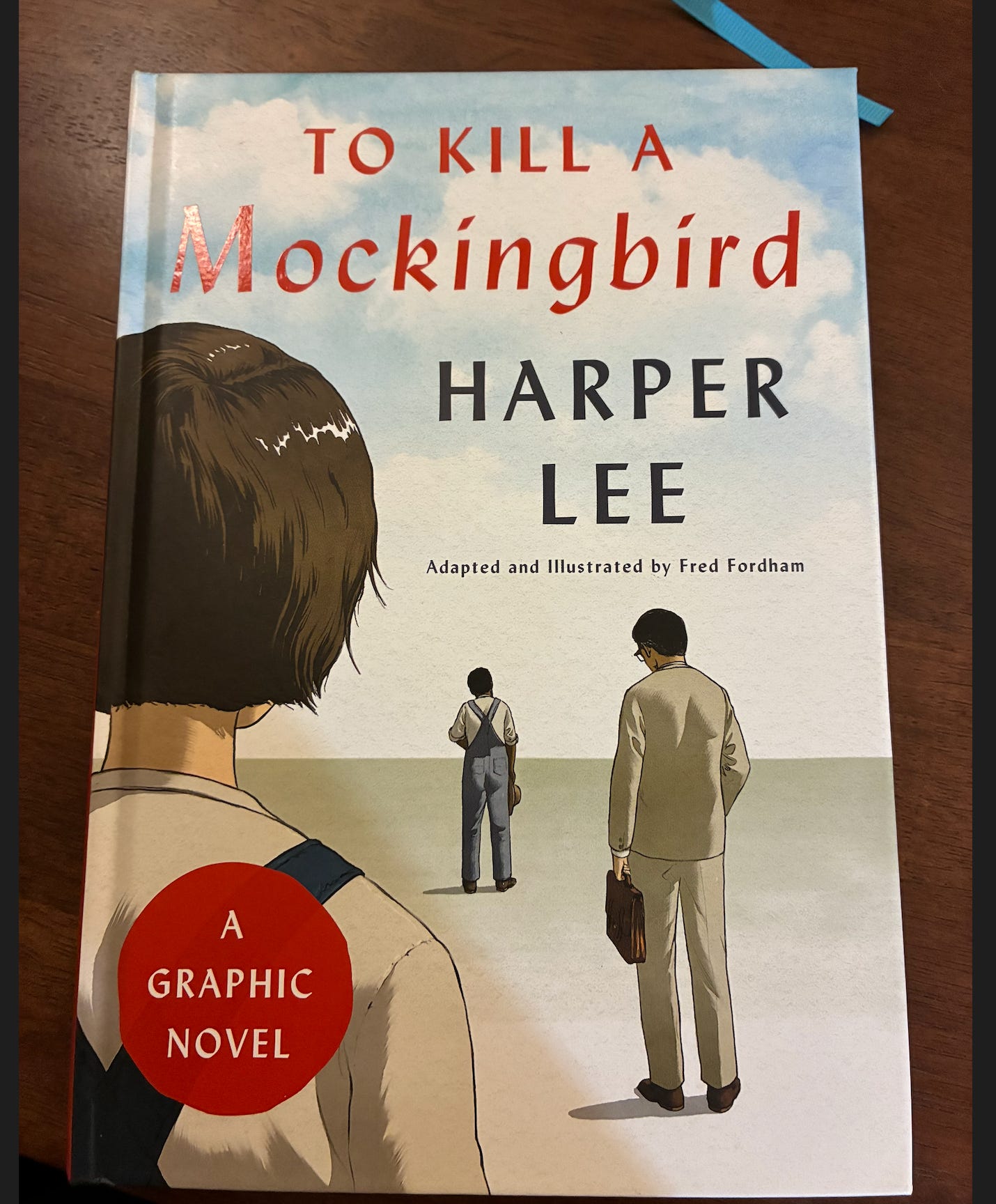
I was wandering around downtown Montpelier yesterday when I found and bought the graphic-novel adaptation of To Kill a Mockingbird. I didn’t put this together until I sat down this morning to write about it long enough to figure out my thoughts, but it’s likely no accident — one of those unconscious things my psychodynamic therapist is always pushing me to spot — that I spent a big chunk of Father’s Day with Atticus Finch.
I got it for research, which is the kind of thing I say now that I’m An Artist Drawing Comics. It sounds better than the truth, which is that I am an artist of ten years and roughly four months of those years have involved anything resembling sequential panels, and I wanted to see a long story in terms of how a professional does it before I inflict Dr. Vale Thorne on a paying audience.
It’s adapted and illustrated by Fred Fordham, and the cover tells you most of what the book is going to be before you open it: Scout’s back to the reader, Tom and Atticus small and far off across a flat dusty nowhere, the whole thing washed in pale sky and dirt.
If you need the story itself, I wrote at length about it a while back; the two-sentence version is that a principled small-town lawyer in Depression-era Alabama defends an innocent black man against a rape charge he cannot win, and his two children learn what their town actually is. The novel is narrated by his daughter, who is eight when the trial occurs and does not entirely understand what she is watching, which is the entire trick of the book.
I picked it up to study the craft. It ambushed me into thinking about lemmings.
The Craft
Here is everything I knew about comics technique before I opened this book: nothing. Here is what I can tell you now, having studied it the way an anxious person studies the thing they’ve publicly committed to doing twice a week starting in late summer.
Fordham works in what the people who know things call a clear line — even-weight ink, every edge decided, no frantic cross-hatching to hide behind. The form comes from flat shapes of color with a thin pass of shadow on top, and the palette stays muted the whole way through: dust, ochre, dishwater blue, the occasional bruised purple for night.
It is, I’ll note with the particular envy of someone who does it the hard way, almost the mathematical inverse of how I work. I spend hours layering pigment on paper tooth to coax light out of a surface. He blocks a local color and drops one shadow plane on it and the man is simply done, the monster.
What actually stopped me was the page architecture, because that’s the part I can’t fake my way through yet.
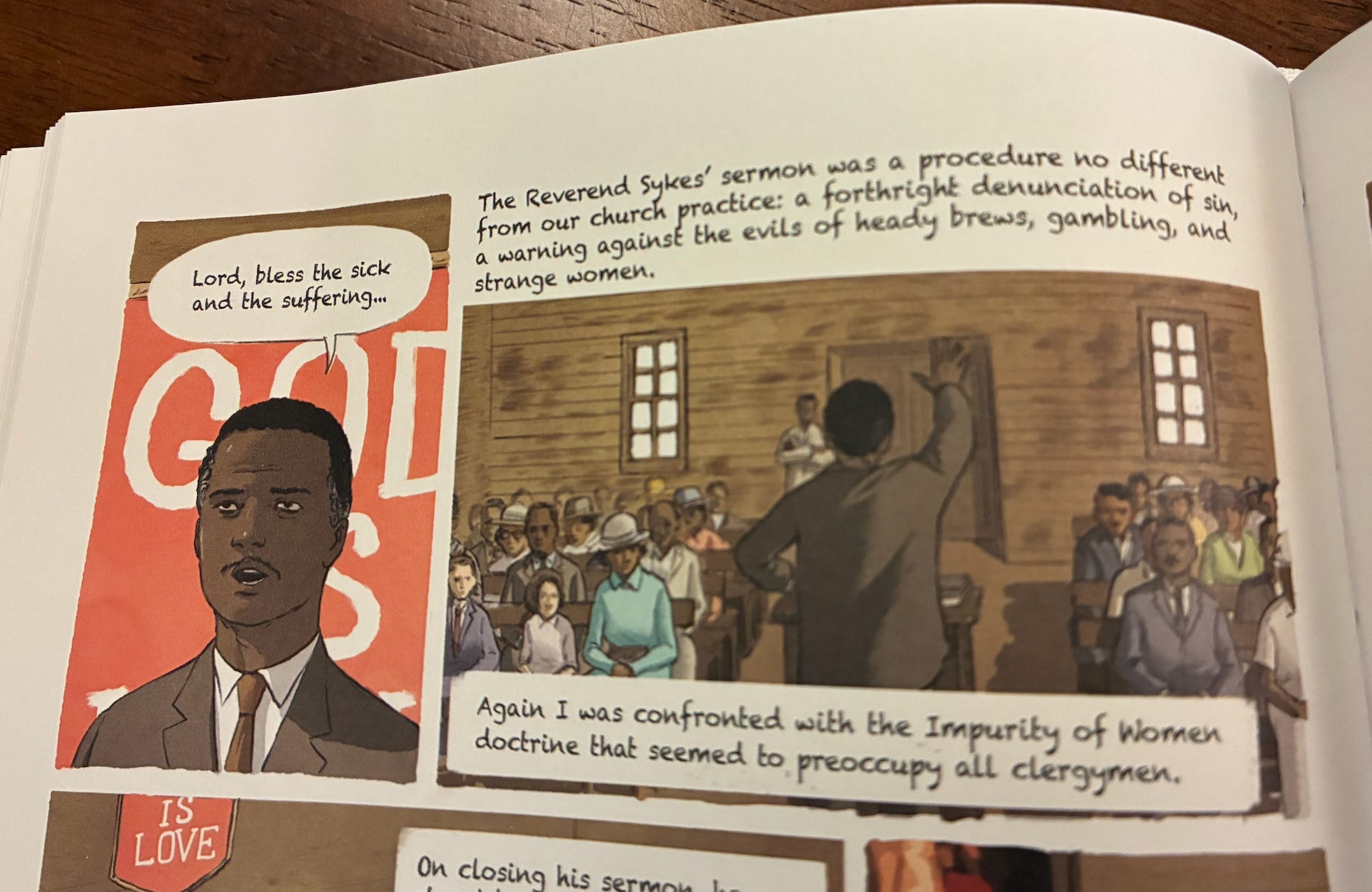
Watch what he does with a single page: a tall vertical panel of Reverend Sykes mid-prayer, the church banner cropped behind him so it reads GOD / IS LOVE in fragments, like set dressing he trusts you to assemble — and butted right against it, a wide establishing shot of the whole sweltering congregation. Face, then room. He spends panels the way you’d spend money, expansively, when the scene is spectacle.
And then he does the opposite, and that’s where I actually put the book down for a second. The confrontation between Sheriff Tate and Atticus — the moral hinge of the entire story — gets no background at all.
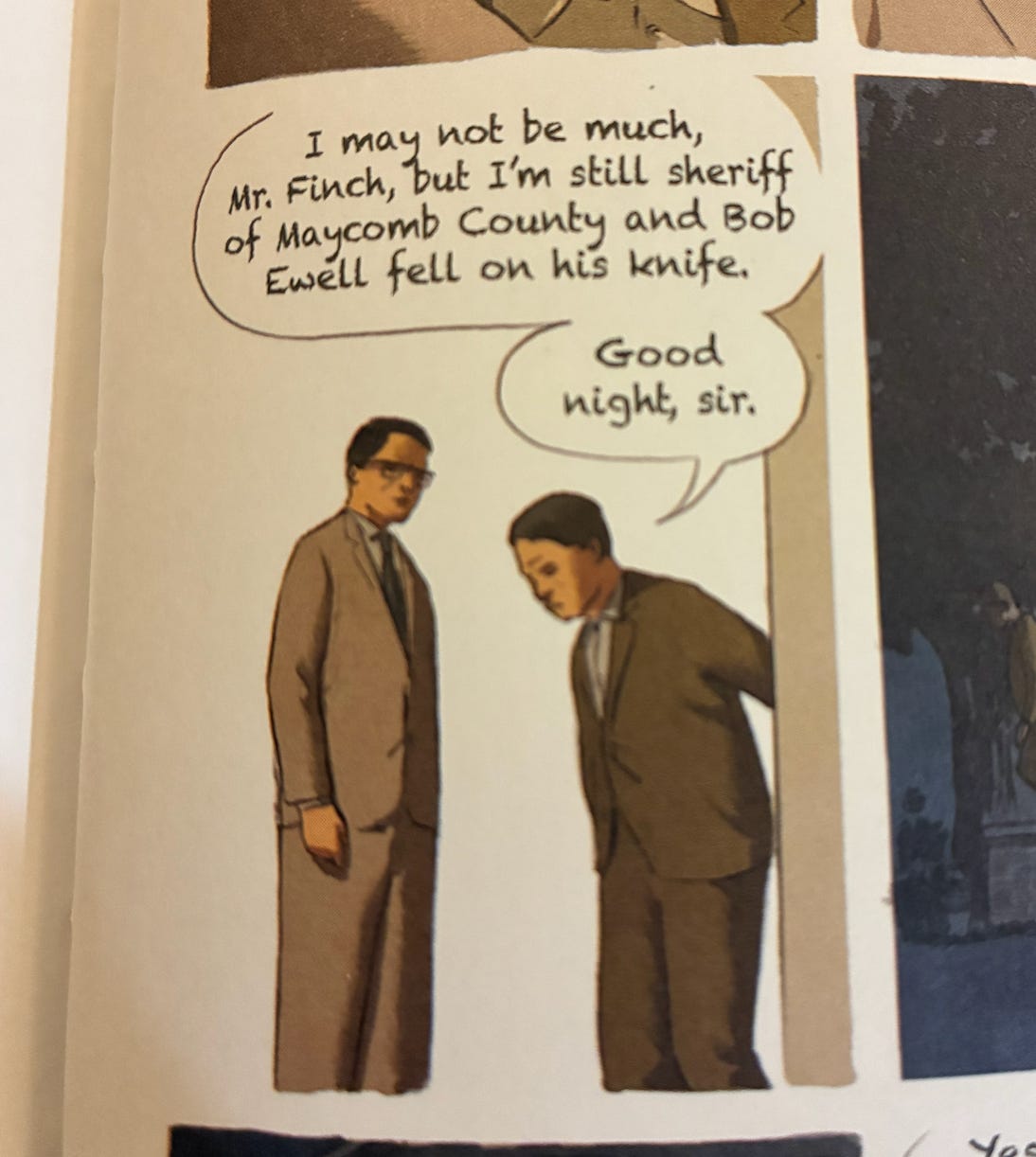
Two men. Empty space.
“Good night, sir” floating in white like a held breath.
When the words are carrying everything, he strips the world out from behind them and lets them carry it. That restraint is the thing I don’t have yet and badly want, the confidence to draw less.
But….
Well before that empty-background panel, the research started misbehaving.
Because what Fordham is doing — what any adapter does — is deciding what survives. He took a hundred thousand words and a dozen years of Maycomb and ran it through his own hand, and at every panel he made a call: this line stays, this scene goes, this gets a full page, this gets cut to a gutter.
An adaptation isn’t a copy. It’s a retransmission.
Somebody receives the story, and re-sends it through a narrower channel, and decides — sometimes on purpose, sometimes not — what makes it to the other end.
And the reader on the far side mostly can’t tell what’s missing. That’s the unsettling part. If you’d never read the novel, Fordham’s version simply is Mockingbird to you, complete and authoritative, and you’d never know there was a choice. You’d carry his edits around for the rest of your life as the thing itself.
Which is a fine and ordinary observation about adaptation, and I’d have left it there, except that once you start seeing the world this way you can’t stop.
Because that’s not just how comics work.
That’s how almost everything you know got to you.
What Survived
So I started keeping a ledger. As one does.
The big things survive, and survive well. Fordham keeps the full ugliness of the language — the n-word, the word the town actually used, unsoftened, every time. That’s the right call, and not an obvious one; it would have been so easy to flinch, and flinching would have been its own damnable lie about 1935.
A Mockingbird that cleans up its own mouth is a Mockingbird that lets the reader off the hook, and the entire point is that there is no hook to be let off of.
The best lines all made it through intact, which is most of what I came to check. “They did it tonight and they’ve done it before and they’ll do it again. And when they do it, seems that only children weep.”
And the one I’ve turned over on a thousand solitary walks — Tate planting his feet and taking the whole weight of the lie onto himself:
“I may not be much, Mr. Finch, but I’m still sheriff of Maycomb County, and Bob Ewell fell on his knife. Good night, sir.”
Those are the lines the whole story's morality rests on, and he got every one of them right.
Then there’s what got mangled in transmission, and reader, I must tell you about “yawl.” Fordham — or his letterer — renders y’all as “yawl,” repeatedly, throughout.
It’s y’all.
It is a contraction of you and all.
It has always been y’all.
It will always be y’all.
“Yawl” is a small boat. Period. World without end, amen.
This is what happens when a fiction is transmitted by someone who doesn’t speak the source dialect: a copy artifact creeps in, confident and wrong, and now it’s printed in hardcover forever.
I have feelings about this. I’m from Mississippi, goddamn it.
Moving on.
And then there’s the omission that actually made me stop, because it’s the interesting kind. There’s no real depiction of Scout’s Uncle Jack spanking her. In the book it’s minor — she swears despite being told not to, so he swats her, over her clothes, a few swats with his hand, the kind of thing that was wallpaper in 1935, when essentially every child alive got hit and nobody convened about it.
Fordham mostly waves it away. It’s unclear what happened — why Scout is angry at her uncle — and if you hadn’t read the actual book, you wouldn’t know.
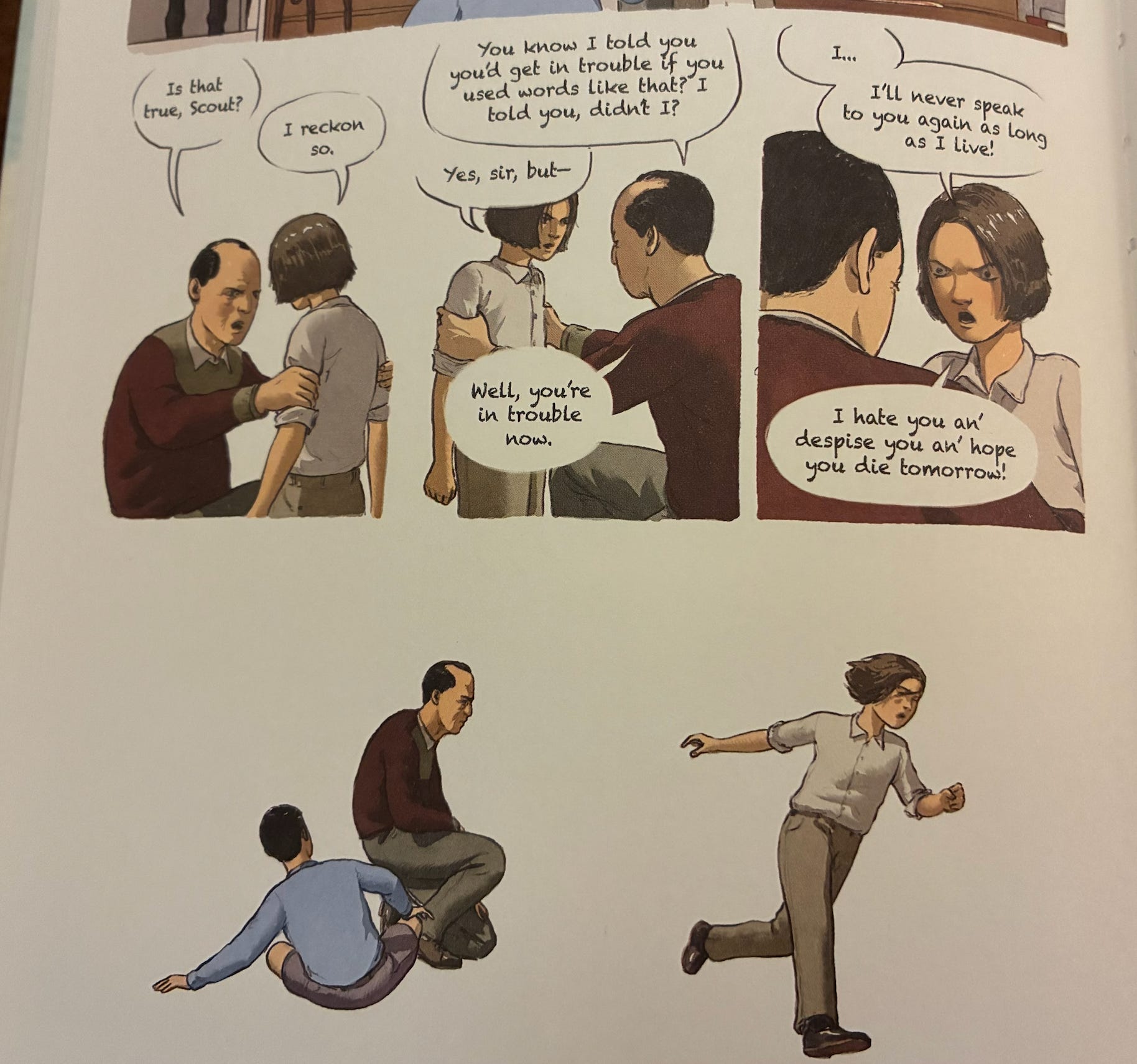
And I don’t think that’s an accident of pacing. I think it’s squeamishness — a present-day discomfort with drawing a child being struck, quietly smoothed out of a past that didn’t share the discomfort. Which is a small thing.
But it’s a small thing in a specific direction: the adapter editing history to spare the present’s feelings, and trusting that nobody will notice the past has been tidied.
Hold onto that one.
What Else Gets Tidied Up
Here’s the thing about that spanking. The reason it stuck with me isn’t that I care whether a fictional uncle swats a fictional child.
It’s that I recognized the tactic. Somebody received a true thing, found it mildly uncomfortable, and passed along a smoothed version — and the people on the other end will never know, and will go on believing the smoothed version is just how it was.
That’s not a comics problem. That’s the basic mechanism by which most of what you “know” arrived in your head.
We like to imagine our knowledge as a collection of facts we checked.
It mostly isn’t. It’s a collection of things somebody told us, who got it from somebody, who got it from a TV show, who got it from a 1958 nature documentary — a long game of telephone where the last person to hold the message is certain it’s true precisely because they can’t remember being handed it.
Nobody in the chain is lying, exactly. That’s what makes it so durable. A lie has a liar, and you can find him. A retransmitted error has only carriers, and the carriers are sincere.
Let me show you my favorites.
The Specimen Drawer
You probably believe swallowed gum sits in your stomach for seven years.
It doesn’t. It comes out on roughly the normal schedule, undignified but unbothered.
Nobody knows where this one came from, which is fitting — it’s the purest specimen, a fact with no birthplace, transmitted entirely on vibes.
You may believe you only use 10 percent of your brain.
You use all of it; some of it just isn’t busy at any given second, the way your whole kitchen isn’t on fire while you make toast. This one’s worse than the gum because people deploy it — to explain psychics, untapped potential, that one friend who did ecstasy once and came back with opinions. A wrong fact that does work is harder to dislodge than one that just sits there.
You almost certainly believe the Eskimos have a hundred words for snow.
They don’t. The whole thing is a decades-old misreading that smart people repeat specifically to sound thoughtful about language.
And you definitely believe lemmings hurl themselves off cliffs in a mass suicide.
This is my favorite, because it isn’t a fuzzy folk error — it was staged. Disney’s 1958 nature documentary White Wilderness needed the footage, so the crew herded the lemmings off a cliff and filmed it as natural behavior.
It won an Oscar.
Every person who has ever called a crowd “lemmings” is faithfully passing along a scene a trusted documentary presented as truth. Which is — and I want to be precise here — the exact thing Fred Fordham did with the spanking, just pointed the other way. A trusted adaptation edited reality, the audience took the edit as the real thing, and now they’ll carry it forever and feel informed doing it.
One that’s going around right now is that President Obama is uniquely egotistical because his is the first Presidential library to be called a “center.”
No.

The George W. Bush Presidential Center has been sitting in Dallas since 2013, open to anyone with a map and ten seconds. This is the laziest possible specimen — not buried in a 1958 documentary, not unverifiable by design, just one search away — and it travels anyway, because nobody who repeats it wants it to be false badly enough to type six words into a phone they're already holding. Here’s a 2013 press release calling it “Center” before someone emails me that Google just sanitized the results to protect Obama. (Yes, that is the sort of email I get.)
Looking deeper in our specimen drawer, now the stakes climb. You may believe a person isn’t officially missing until they’ve been gone 24 hours. There is no such rule. It’s a screenwriting convenience that became folk law. If someone you love is missing and your gut says something’s wrong, you call now — the first hours are when a description going out actually does something, not the twenty-fifth.
This is the first fiction on the list that can get someone killed, transmitted with the same shrug as the gum.
And at the top: nearly everyone knows someone whose brilliant, perfectly qualified white son didn’t get into his dream school and was told, to his face, by an admissions officer, that he lost his spot to DEI.
No he wasn’t.
And before the comments fill up: yes, the underlying thing happens. Race-conscious admissions were/are real, the thumb was/is on the scale, and somewhere out there is a kid with a 1570 who got passed over for a classmate with a 1290. I’m not litigating that. Believe what the data tells you about the practice.
What I’m telling you didn’t happen is the scene — the part where an actual named human being in an admissions office said it out loud, to a stranger, on purpose.
Because picture what that sentence is actually asking you to believe. A salaried professional, with a mortgage and a retirement account and a federal privacy statute hanging over every word, looks a rejected applicant’s father in the eye and volunteers a career-ending confession — knowingly breaks the law, on the record, to a stranger — for no reason except the warm dopamine hit of telling a man exactly what he came there aching to hear.
And she, trusting soul that she is, does it in a world where every single person she’s talking to carries a broadcasting company in their pocket, where that confession is one screen-record away from being her last day in the profession.
There’s no upside. There’s no version where that person keeps their job.
It is the single least likely sentence a human in that chair could say.
So it didn’t happen — not that part. What happened is that a real disappointment went looking for a shape, and “DEI” was lying right there, pre-cut to fit, and the I knew it arrived so warm and so fast that nobody stopped to ask whether the admissions officer in the story had ever actually opened her mouth.
But this one survives better than all the others combined, and not despite being unverifiable — because of it. It can’t be checked, and it tells the carrier exactly what he already wanted to hear, which turns out to be the ideal conditions for a fiction to thrive.
It isn’t a copy error anymore. It’s a comfort dressed up in a fact’s costume.
The Sheriff Knew
Now go back to that empty-background panel. Tate, planting his feet, telling Atticus that Bob Ewell fell on his knife.
That’s a fiction too. A flat lie, told by the man whose whole job is the truth, in front of a child, over a dead body. By the standard I’ve just spent a thousand words building, Sheriff Tate should be the villain of this essay.
He’s the opposite. And the difference is the only thing that matters.
Tate knows. He knows exactly what he’s doing, he knows it’s a lie, he knows what it costs, and he picks up the entire weight of it himself and carries it out the door. I may not be much, Mr. Finch, but I’m still sheriff of Maycomb County. That’s not a man passing along a smoothed version of the truth and hoping nobody checks. That’s a man looking the truth dead in the face, deciding to override it, and signing his name to the override. He’ll answer for it. He’s said so.
The gum and the lemmings and the white son who lost his seat to DEI are the photo negative of that. The carrier doesn’t know it’s a fiction. He pays nothing. He answers to no one, because as far as he knows there’s nothing to answer for — he’s just telling you how it is. He never even sees the choice Tate agonized over, because the choice was made upstream by someone he’ll never meet, and all he inherited was the certainty.
So it turns out there are two completely different things we call “believing something that isn’t true,” and we should stop using one word for them.
There’s Tate’s kind: you see the truth, you choose the fiction, you own the bill.
It’s still a lie. It can still be wrong. But it’s a moral act — a person standing behind a thing. And there’s the other kind: you never saw the truth, you didn’t choose anything, you pay nothing, and you walk around armed with a certainty you didn’t earn and can’t account for.
One is a man carrying a weight. The other is a man carrying a rumor and calling it knowledge.
The tragedy is that the second kind feels exactly like the first from the inside. The lemmings guy is as sure as Tate is. More sure, probably — Tate at least had the decency to look uncomfortable.
Which, finally, is what I think I’m doing with Dr. Vale Thorne.
Vale is an anthropologist from 2203 who comes back to take notes on us, and gets us wrong. Earnestly, confidently, with excellent posture. He is a professional observer who mistakes the smoothed copy for the thing itself — who sees a vending machine and files a report on our devotional shrines, and means every word of it. When I sat down to figure out what the strip was actually about, under the jokes, I couldn’t have told you. I think I can now.
He’s the sincere carrier. He’s the lemmings guy with a clipboard and a degree.
The whole strip is just the gap between confident transmission and truth, drawn twice a week.
I went into Fordham’s book to learn how to put two figures in an empty panel and let the silence do the work. I came out having been shown, by the book itself, the exact thing my own comic is supposed to be about.
The research ambushed the researcher, which is the most Vale Thorne outcome imaginable, and I’d be embarrassed if it weren’t so on-brand.
Here’s the part I can’t tidy up for you, because tidying it would be the whole crime: you are carrying fictions right now. So am I.
There’s no version of being a person where you’ve personally checked everything in your head — the channel’s too wide and life’s too short, and most of what’s in there got handed to you by someone sincere who got it from someone sincere.
You can’t stop carrying them.
What you can do is be Tate about it. Know which ones are choices. Look at the truth before you decide to override it. Sign your name.
Carry the weight instead of pretending there’s no weight to carry.
The lemmings guy and the sheriff believe untrue things with the same face. The difference is that one of them knows, and would tell you so, and would stand there in an empty panel and take the whole thing onto himself.
Good night, sir.
My new project is a comic strip called “Visitor Notes,” coming later this summer!