
What Art Is For
how a drawing reminded me that I exist

This post nerds out in two arenas: art and PTSD.
If you’re at all interested in how an artist creates a thing, you’ll get something out of it. If you’re at all interested in how someone with severe PTSD self-manages a major incident, you’ll get something out of it.
If you’re not interested in either, I’ll waste no more of your time. Have a good weekend.
The Artistic Impulse
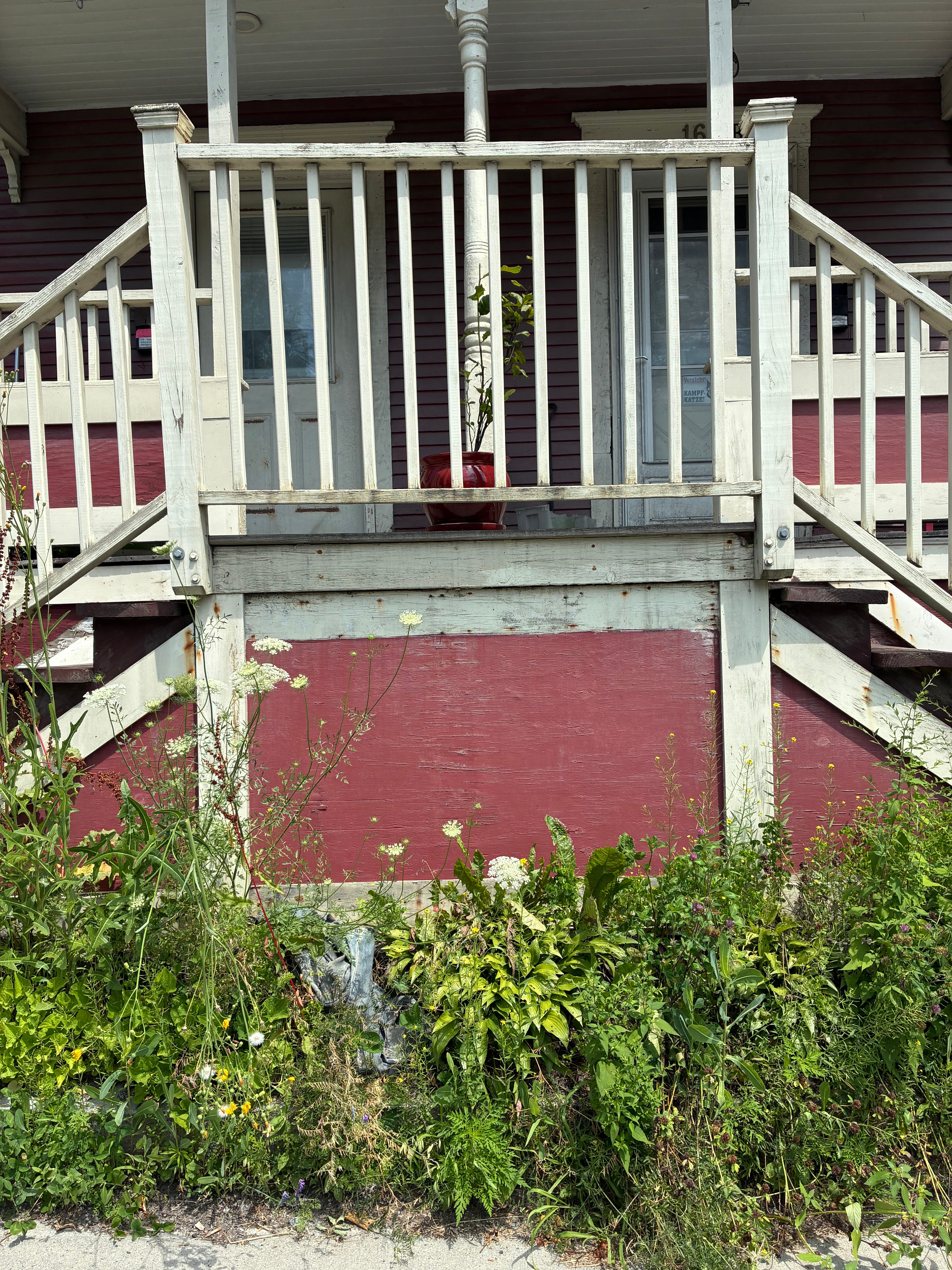
I took the photo above while taking a walk. What interested me wasn't the building. It was the pair of jeans tossed into the plants.
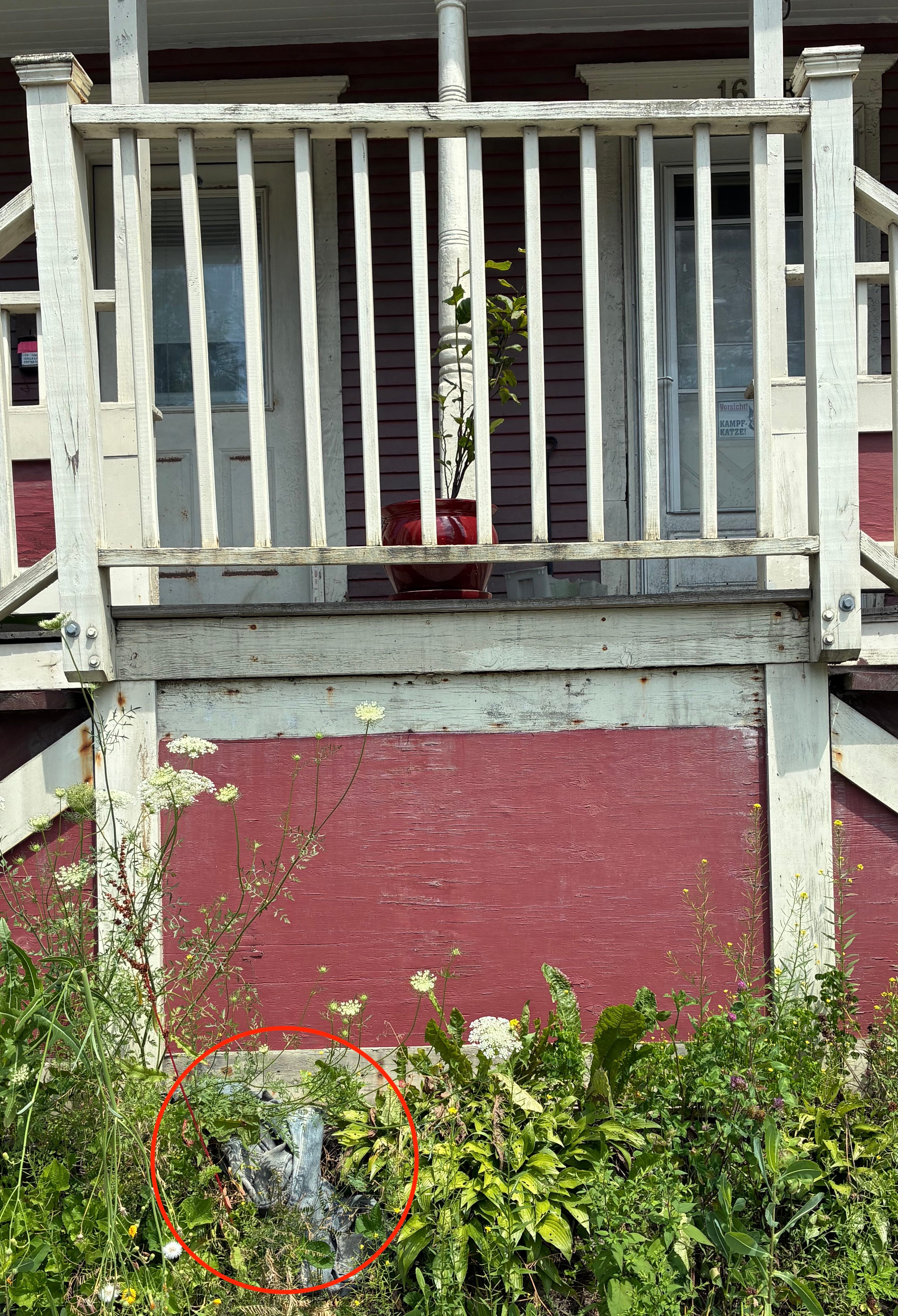
To me, the jeans told a story. What happened? Something happened.
Was it a domestic dispute — someone throwing the cheating bitch’s jeans out the window with the rest of her stuff, and she picked up everything else?
Was it more mundane than that — someone dropped them from a laundry basket on their way home from the laundromat and failed to notice?
Was it more dramatic than that — a teenager threw them out to be easily grabbed on his way when he initiated a plan to run away, got caught, and is now restricted to his room?
Was it more tragic than that — someone died by suicide, and their roommates have no idea how their dead friend’s jeans landed outside, but they cannot bear to pick them up yet?
When I took the picture, I realized the geometry provided nearly perfect composition, and I really wanted to draw it.
Specifically, I wanted to capture all the interesting angles while figuring out how to keep the jeans what they are in the picture: a delightful, intriguing little surprise for someone who pays close attention.
Several people had asked me for a post going into more detail than “YouTube, books, and practice” about how I got to my current skill level in art. They specifically were interested in the reference-photo-to-finished-piece decision pipeline. So I decided to use the picture and the process for a post. Then something happened.
The Triggering Incident
Something happened that forced me to confront a fear I had spent years trying to prove wrong. An experience unfolded that seemed to confirm one of the oldest beliefs my brain carries, something from my early childhood wiring. I'm not going to write about the particulars. What matters is what happened afterward, and that it was the kind of event that can make years of hard-won healing suddenly feel much more fragile than I thought it was.
The harder problem was that none of this could be allowed to undo years of agonizingly hard-won progress. My brain now had fresh evidence for the proposition it had held since childhood and that I had spent years arguing it out of.
The PTSD consequences were predictable: serious dissociation (the sense that I had ceased to be real and “I” no longer existed, but was watching my body perform certain actions) that vacillated with periods of cold rationality, evaluating the pattern of my life and just accepting that the original proposition was correct.
My sleep and appetite were both shot to hell, and both made everything, including the flashbacks from what happened as a little kid to make me terrified that the belief was true in the first place, much worse.
Making Choices, Making Art
The first decision I made was to simplify the top half of the photo. The second layer of railing — behind the front most railing, in front of the doors — had too much going on. I decided to remove the top half of that layer of railing. My first attempt was to try to get ChatGPT to edit it for me.
I spent two hours trying, and it simply never managed it, despite painstaking and careful prompts. I even went so far as to print out a photo and scribble out what I wanted removed and take a picture of that.
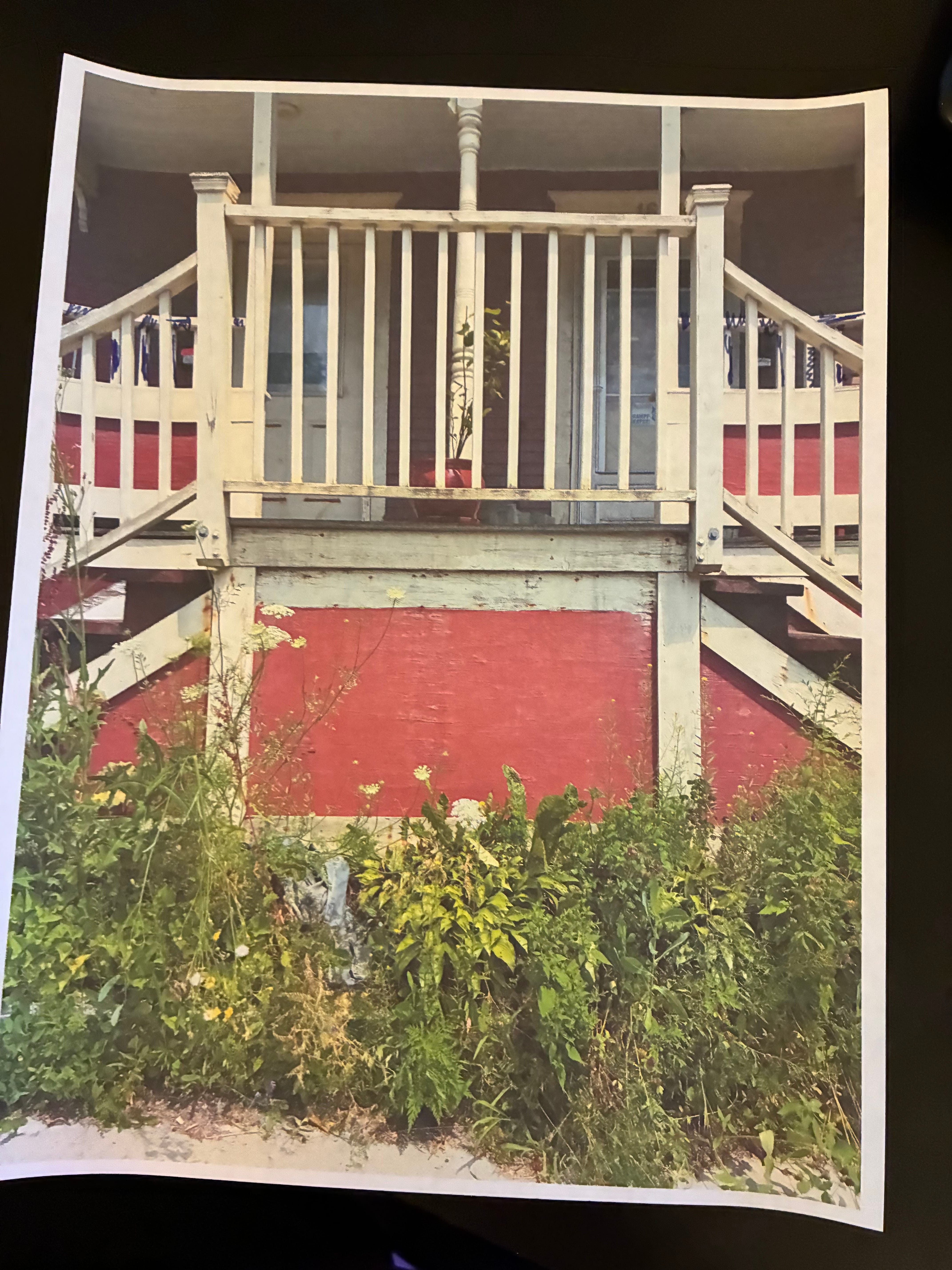
ChatGPT simply could not figure it out, so I just worked from this reference, which added a few layers of complexity to the underdrawing.
The underdrawing took hours with a ruler, about twice as long as normal, which would normally be beyond me, but given the state I was in, it was a blessing. My brain’s usual “This is torture” circuitry was offline, or perhaps busy managing other things.
Making Choices: Trigger Management
I work remotely and I love my job to the point that it’s always part of my thinking. The primary use of my work phone, in fact, is receiving texts from my personal phone with my ideas, thoughts, tweaks, etc. Very little makes me happier than tangible progress on a cool project, and since I work remotely this can happen anytime I’m capable of it. And my current project, while enormously challenging, is also really fun. So I grabbed any moment of clarity to make progress, and this helped more than anything else.
The rest of the time, I focused on the drawing.
A Mistake, Right on the Nose
Our brains are funny things, and mine did something hilarious.
The very first thing I did after finishing the graphite underdrawing was a dumb mistake. I reached for a warm grey instead of a cool grey and did the ceiling in the wrong color.
I was reaching for the tape to pull it off the drawing board when I realized what I was doing: I was about to treat the drawing, in which I had invested a lot of time and emotional energy, as a worthless piece of garbage and cut it off entirely due to one mistake that was made in good faith and from positive motives.
My drawing process had been ruptured, and I was about to decide it was unworthy of even an attempt at repair.
This was so reminiscent of past triggering events in my life, including this one, that it actually made me laugh, and I decided to accept that the ceiling would be the worst part of the drawing and just live with it. I covered it with a layer of a much darker cool gray, which didn’t quite work.
I also made another mistake — I filled in missing pieces near the posts with vertical strokes, instead of taking the time to fully reach it with horizontal ones, which made the ceiling look like it was anything other than a solid plane.
I promised myself I would finish the drawing and write this post no matter what, and I kept going.
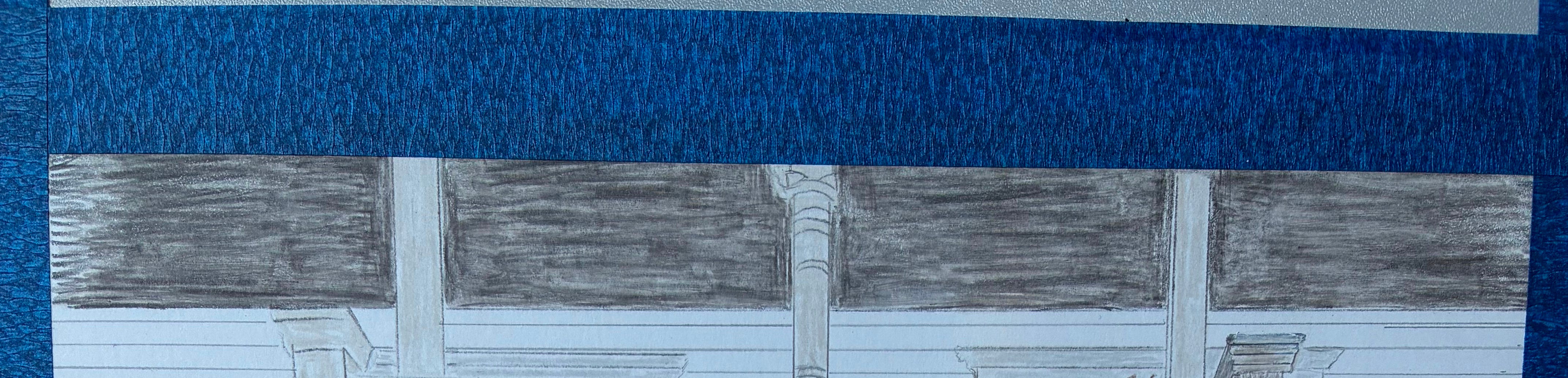
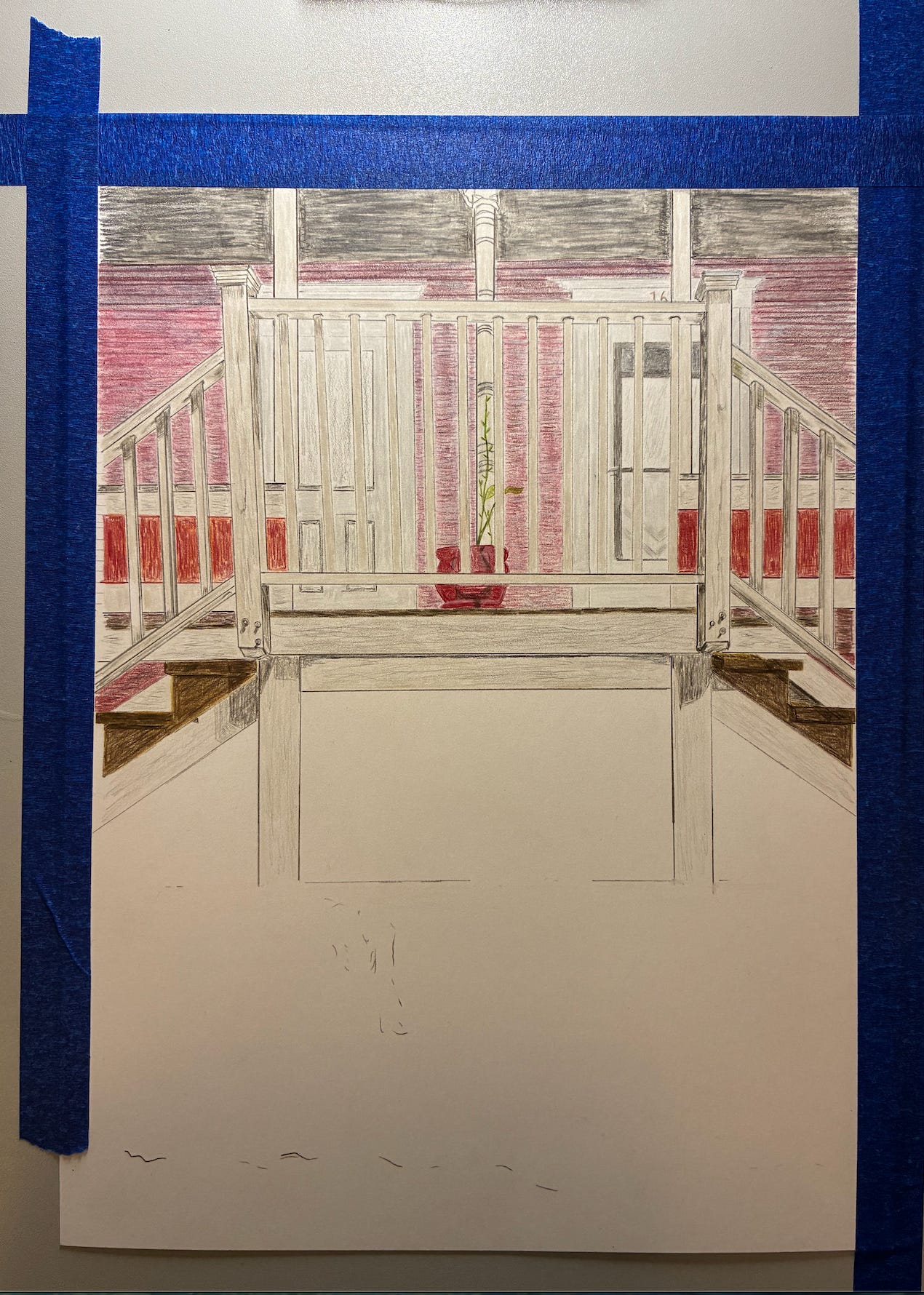
Then I shaded in a bit of the first layer in the combination I’d come up with to match the paint color on the middle layer of railing, to help me differentiate things more easily, and used a ruler to put in the siding.
I also took my first real risk — I over-emphasized the lines of the wood in the front most railing. This has the potential of making the railing look more sturdy and stable than it really is, but I thought it would pay off when I had the full shadows added by really making the railing pop and feel very three-dimensional, so I went ahead.
Here is a picture when I was well into that part of the process on the right side. You can also see a bit of the storm door in the unit on the right (the patterned part behind the bottom part of the door), which works.
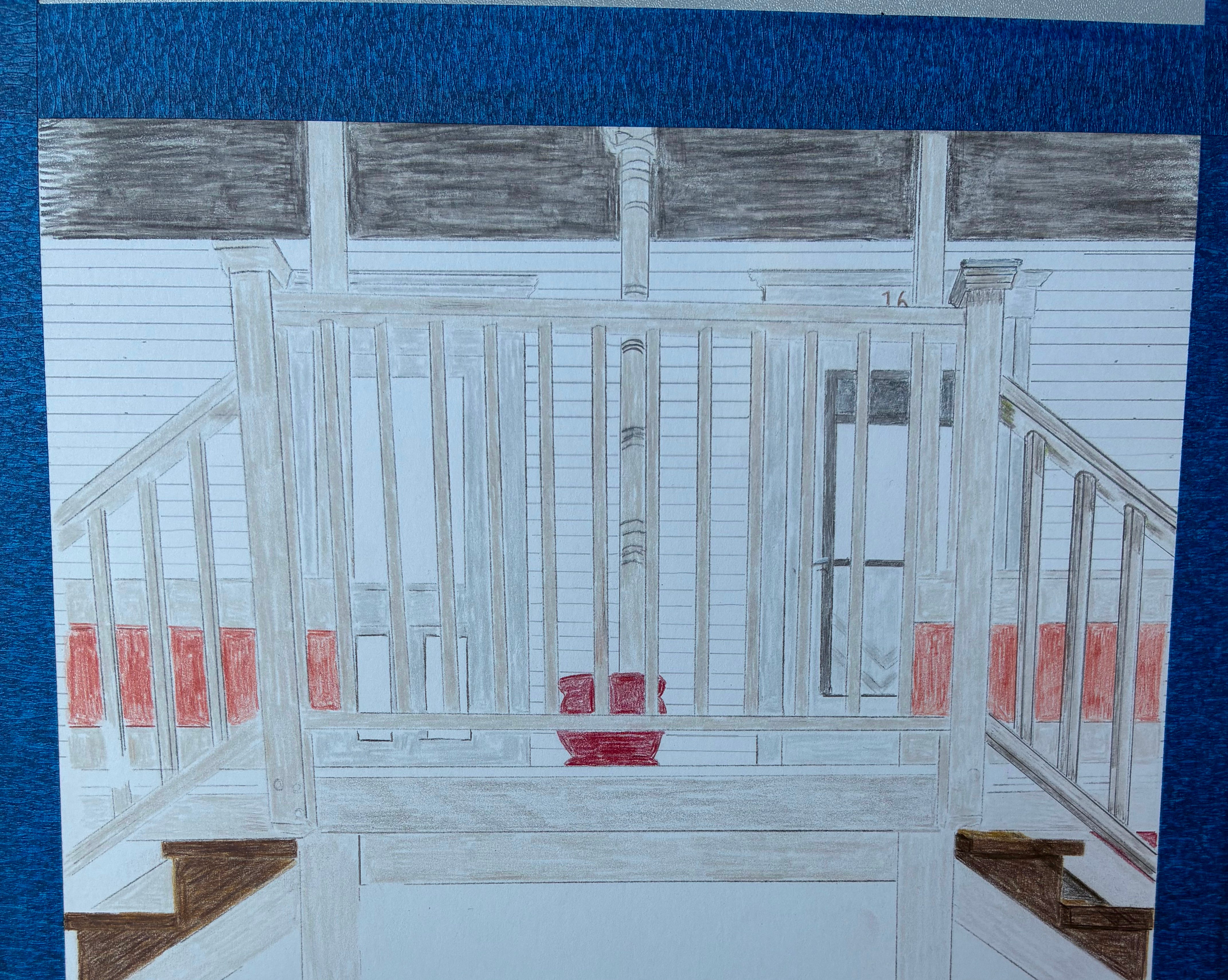
And a picture when that process was farther along:
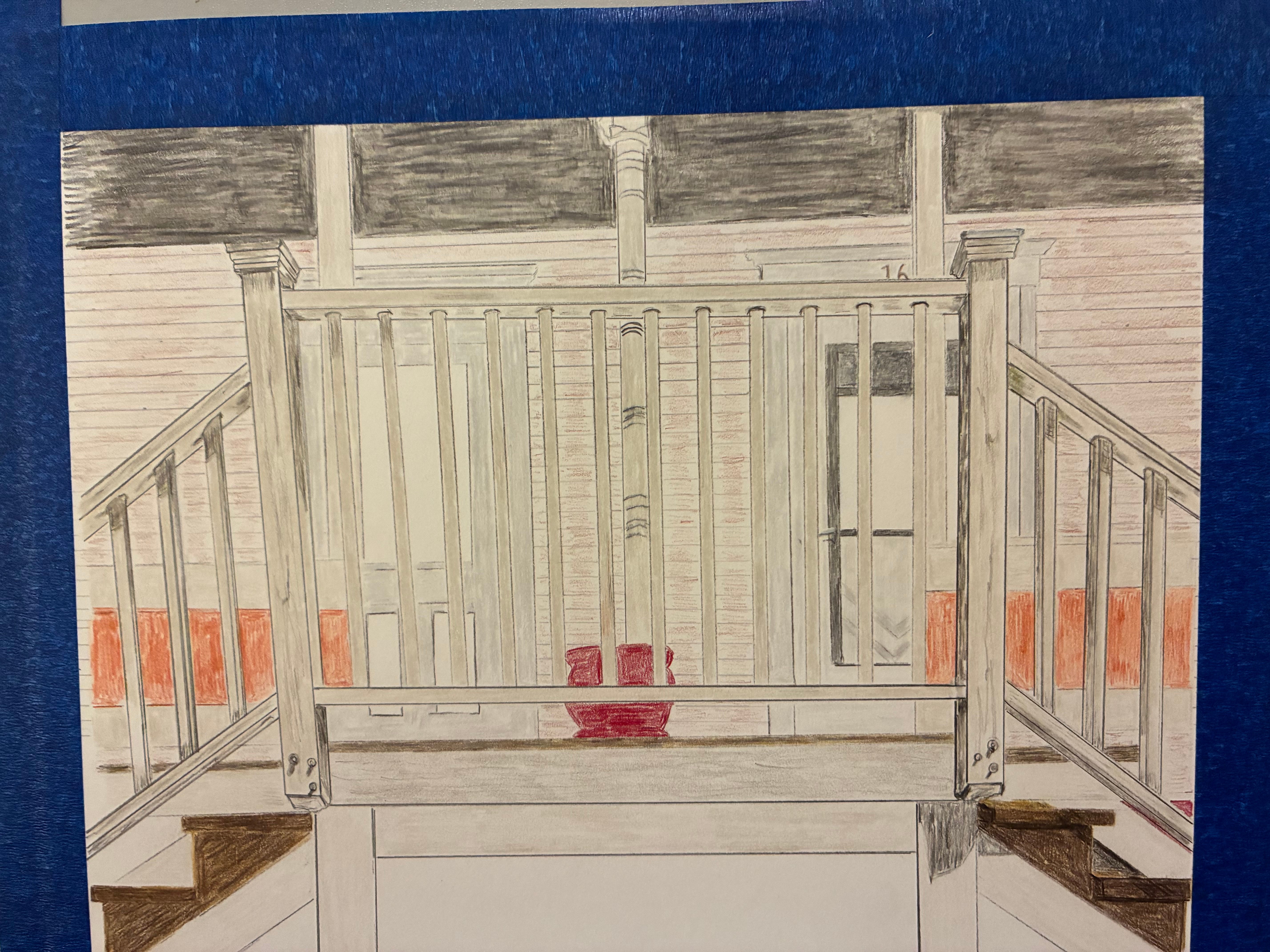
At this point I was confident it would work, and was especially pleased by how well the placement of shadows and cracks in the wood was working.

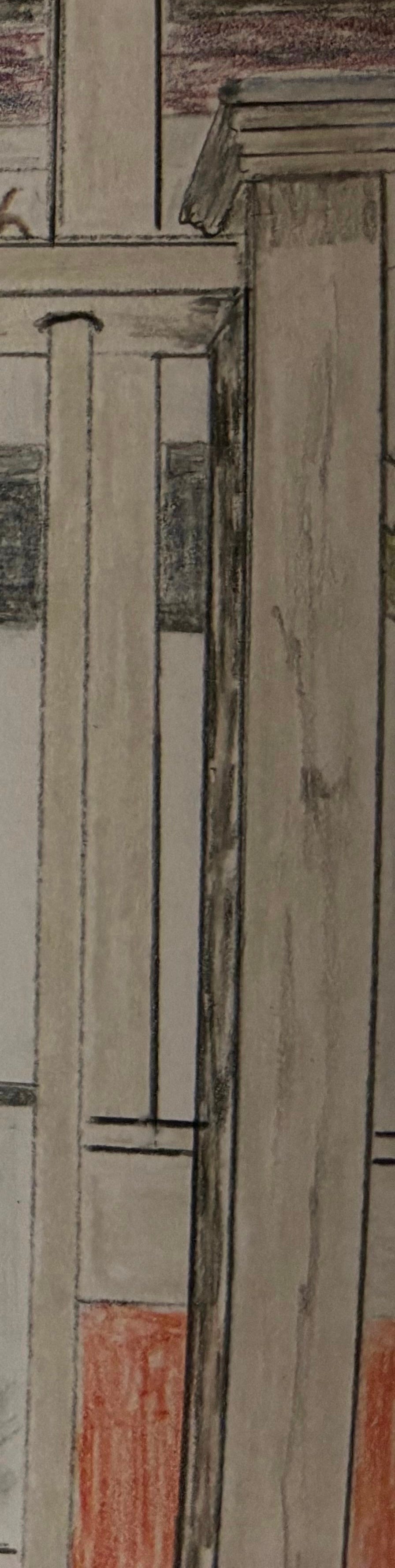
The extreme close-up creates some distortion, but I’m hoping you can really see how the 3D effect works. It’s perspective and then Polychromos Warm Grey I as a base with Warm Grey VI, using a razor-sharp point, used to scratch some cracks into the front plane and then color the shadow on the side plane.
Once I started working on the siding, I realized I wanted more of the red to show than does in the reference photo. In person, it’s obvious that the house is the same burgundy as the front planes of red that show, but the years of disrepair, fading, and the shade of the photo, which I took during a very bright and sunny afternoon, make it look like a faded blue. I wanted to make it more obvious that this is many different states of entropy at work on the same type of paint and siding.
I managed to avoid the mistake I made in the ceiling of filling in gaps with vertical strokes. I kept them all horizontal even though this meant that there’s some white space between the lines of the pole and railing and the color of the siding.
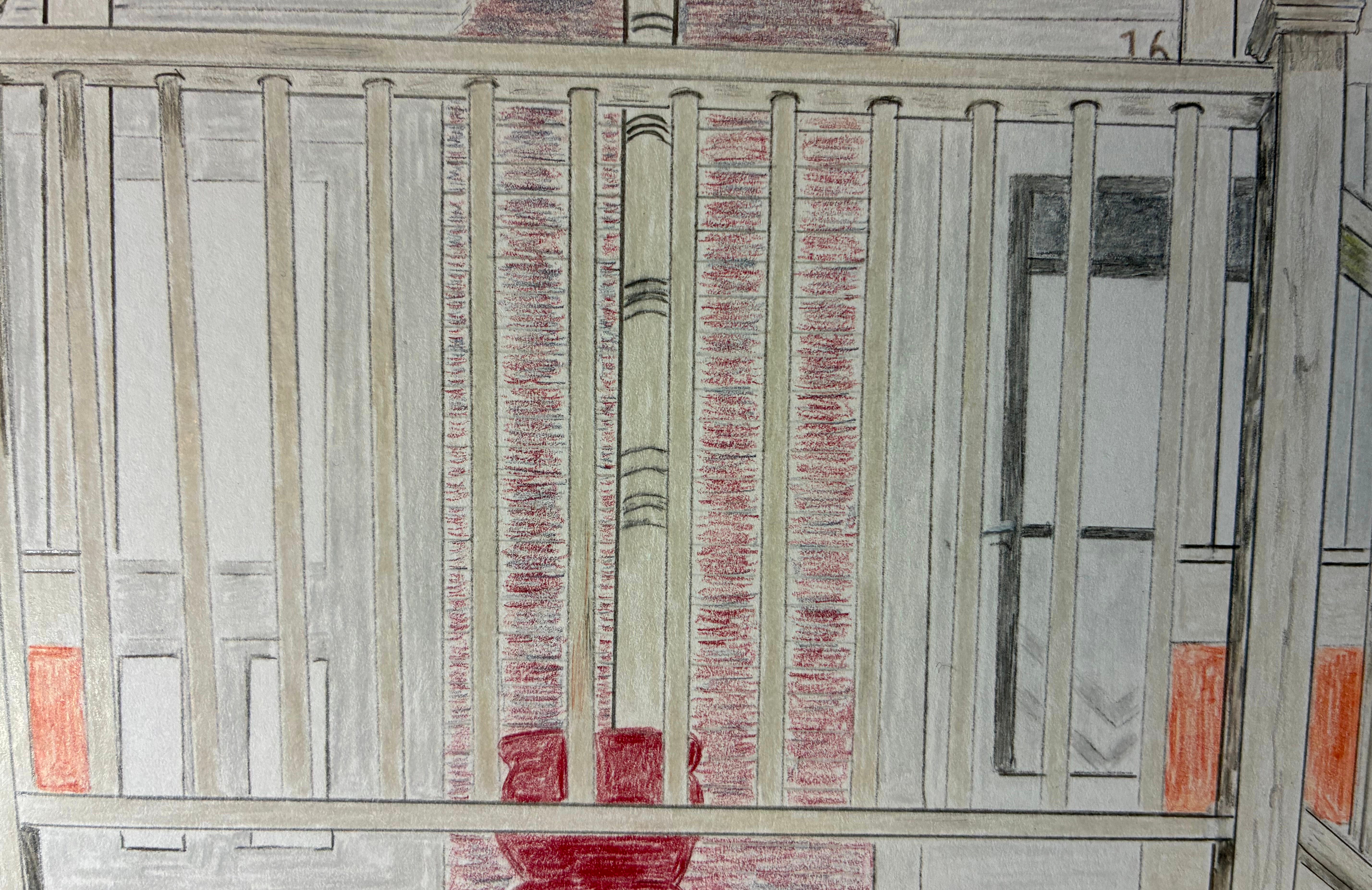
I wanted to stop and throw this one away many times, including when I realized my mistake of not leaving any space for plants other than on top of the middle pole — there were so many shades in the siding that getting even one leaf on top of them was a task. But the determination to keep my promise to myself kept me going.
At this point, I had corrected all the errors I could find, added in detail work including the windows in the doors, the shadows on the bolts holding the front most railing in, and the shadows on the stairs and the undersides of the individual pieces of railing. Then I was ready to start on the bottom half.
That didn’t mean the top half was perfect, but it was definitely at the “ready to wait for the ending polishes” point.
The Power of Art for Presence
It is easy for me to talk myself out of the idea that things I’ve written have any value at all. Candace Owens, Alex Jones, and other outlandish conspiracy theorists have audiences that would’ve made news anchors of the past weep with envy. A recent conspiracy rabbit hole I fell down — the one about how Karmelo Anthony didn’t actually stab anyone — was the basis of a recent episode of Disaffected, and every conspiracy theorist highlighted has a large audience.
The ability to cause humans to react to one’s words, in 2026, means nothing about truth, value, or alignment with reason. Given the horrors of our information landscape, there is even an argument to be made that it suggests something negative about these things.
There are days when even essays that I know have helped people seem like garbage to me.
My therapist says that this is a consequence of disorganized attachment. This is reparable, but it takes enormous energy and constant effort. Without the repair work being done as adults, little kids who have good reason to fear their caregivers grow up to never quite believe they exist, at least not in the same way that other people exist.
And this puts everything else into doubt.
This is likely why art means so much more to me than anything else. It’s tangible and obvious and solid and undeniable.
The value of anything I’ve written is debatable — as my inbox can attest.
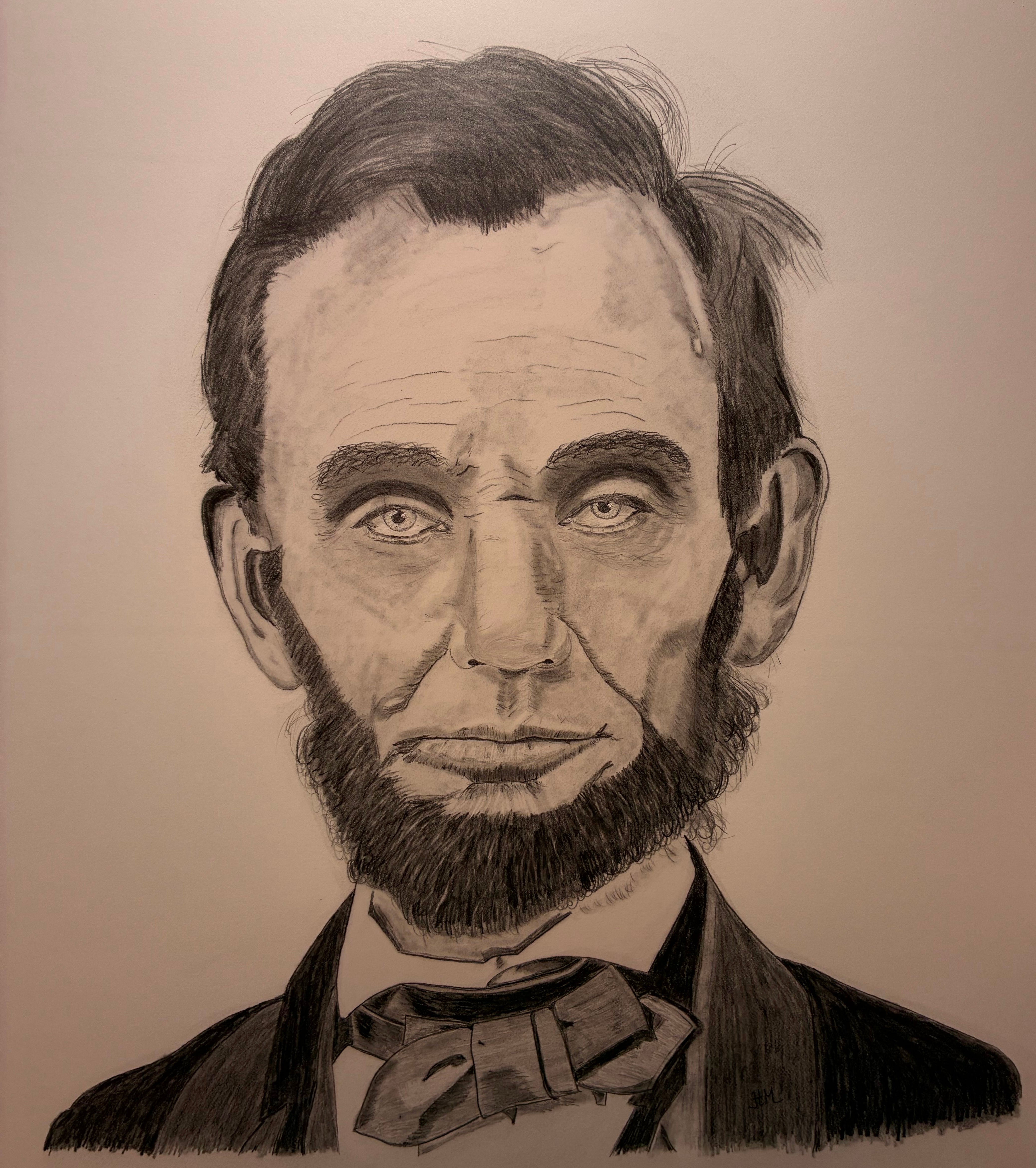
But this? This is Abraham Lincoln, a portrait I drew two weeks ago. I made this. It exists; ergo I exist.
Words can be argued with. Memories can be doubted. Feelings can lie.
But graphite is stubborn. Every line either exists or it doesn’t. Every shadow is either there or it isn’t.
At this point in the drawing and dealing with the triggering incident, my sleep was shot to hell, so I was working on it streaming some of my favorite art YouTubers — SuperRaeDizzle and Sarah Renae Clark — providing a positive mood and atmosphere.
They have both been willing to make art live on the internet and not throw something away because of mistakes, so in addition to their overall excellence, they were great for me to watch while trying to hold some kind of line and to not lose years of progress.
Drawing the Garden
The first step was getting them recognizable as jeans, which meant reasonably uniform stitching and well-varied shades of blue, with visible shadows from plants I will draw later.
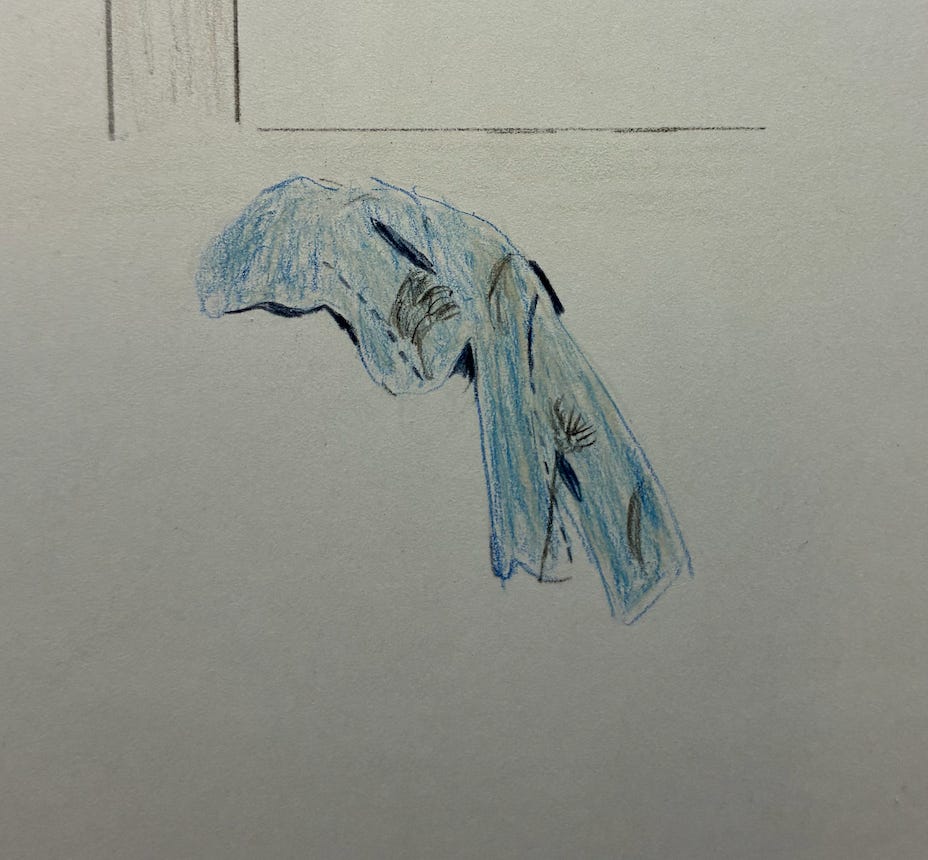
Then, once that’s established, to start working on the garden. Here there are again many choices to be made. I see at least five different shades of green and three of brown, and there are likely many more — I’m still fairly new to color work.
I chose some purples, oranges, and yellows for flowers — when the reference has only white and tiny yellow — because I wanted to add a bit more variation. But I also drew many fewer flowers than are in the reference, since I needed to have the green mass available to me to make the jeans feel like a discovery. Also, there’s so many shades of gray with the weathered white wood that I felt I needed the contrast. I erased part of the bottom of one piece of plank so I could draw a flower there for a nice 3D effect, too:
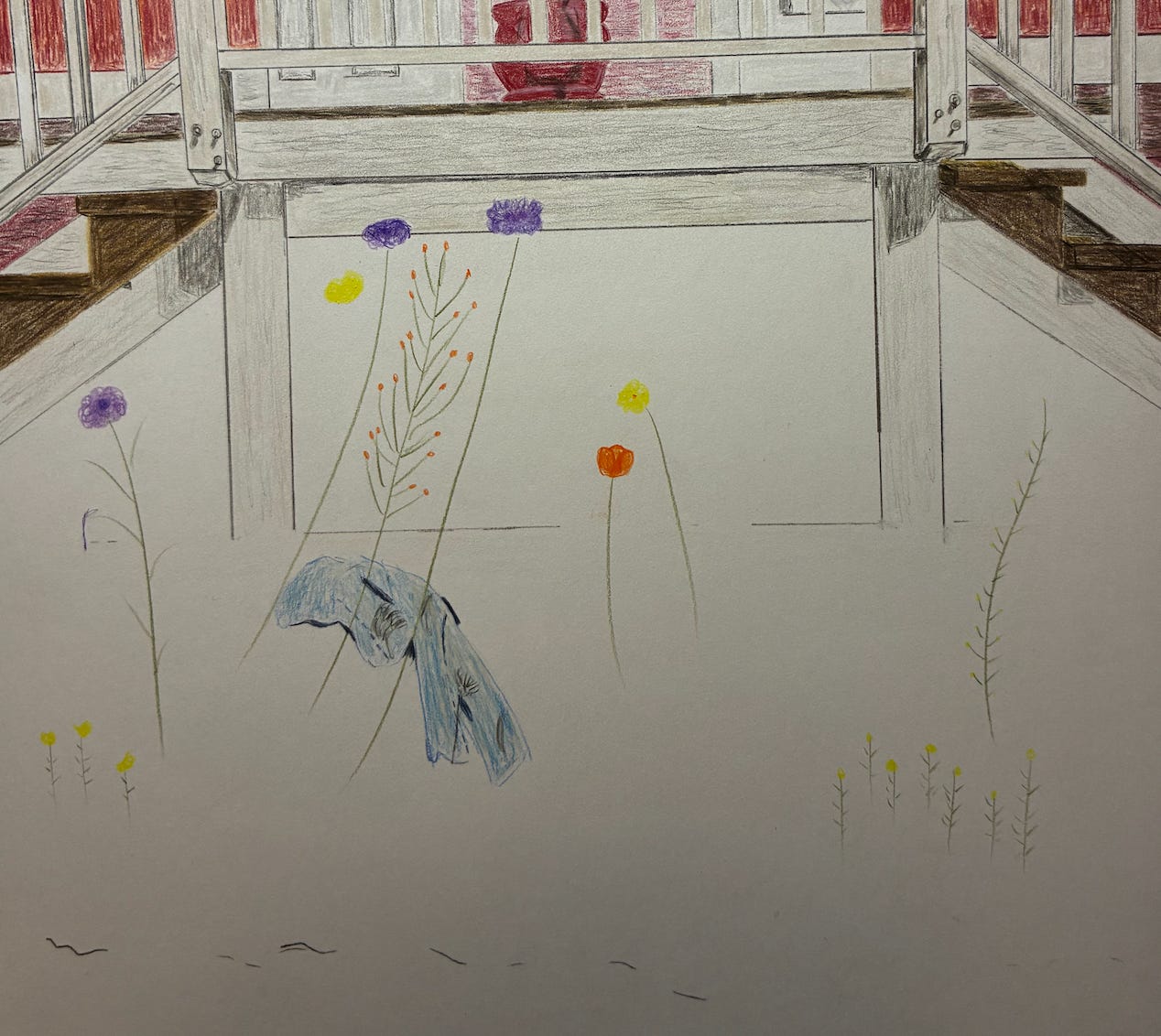
Having made the mistake that limited me to only one green leaf in front of the siding upstairs, I did better on the bottom half by drawing the flowers first, so I could lay the siding in around them. I realized in this process that I don’t have the pencil control to draw around tiny buds of color, so I went over them instead, turning the yellow buds on the right side to orange.
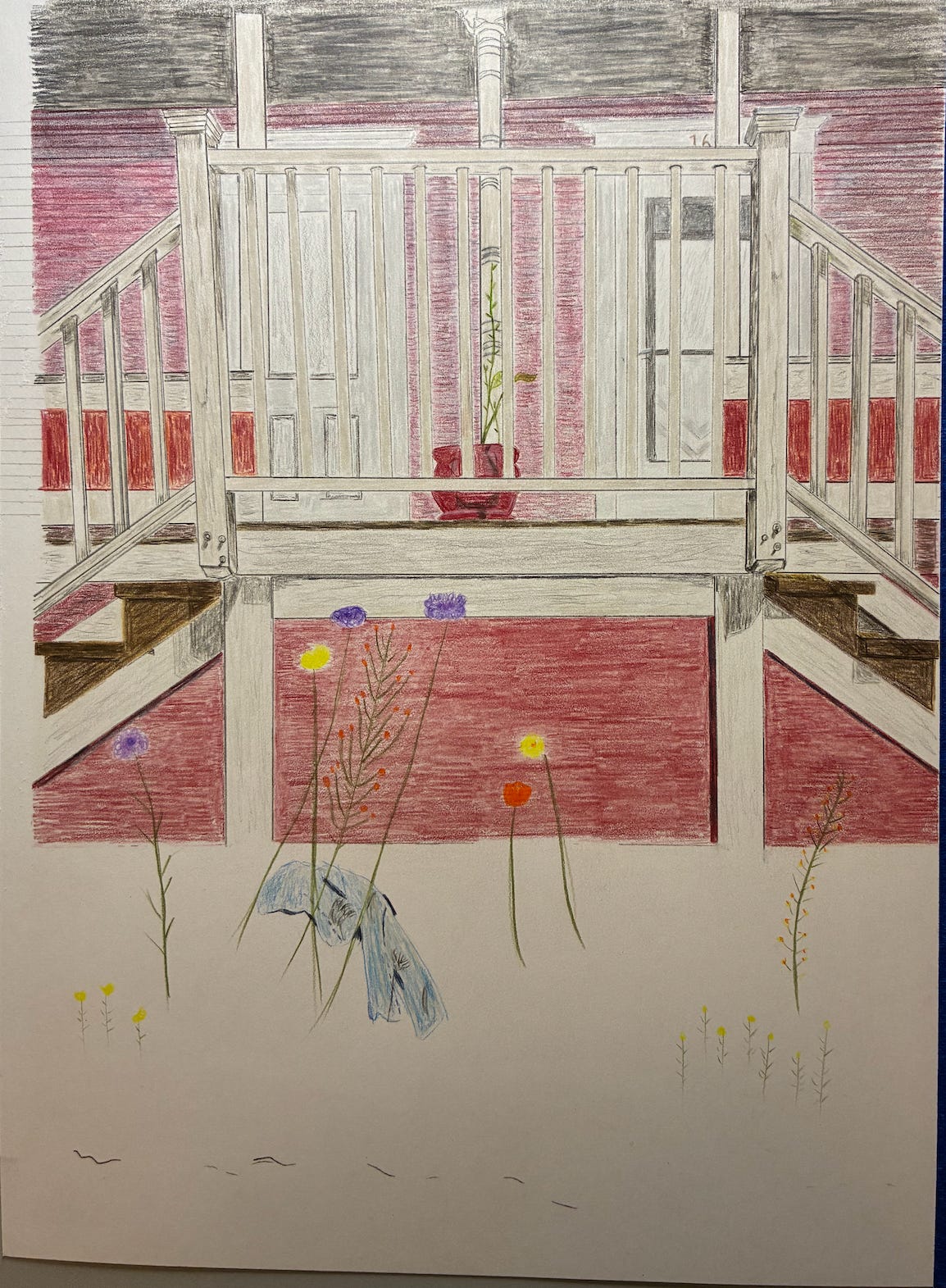
At this point it’s all layers, until the bottom half is done. Starting with some green masses, like a landscape painter. This helps with both speed and every pencil stroke not being super visible.
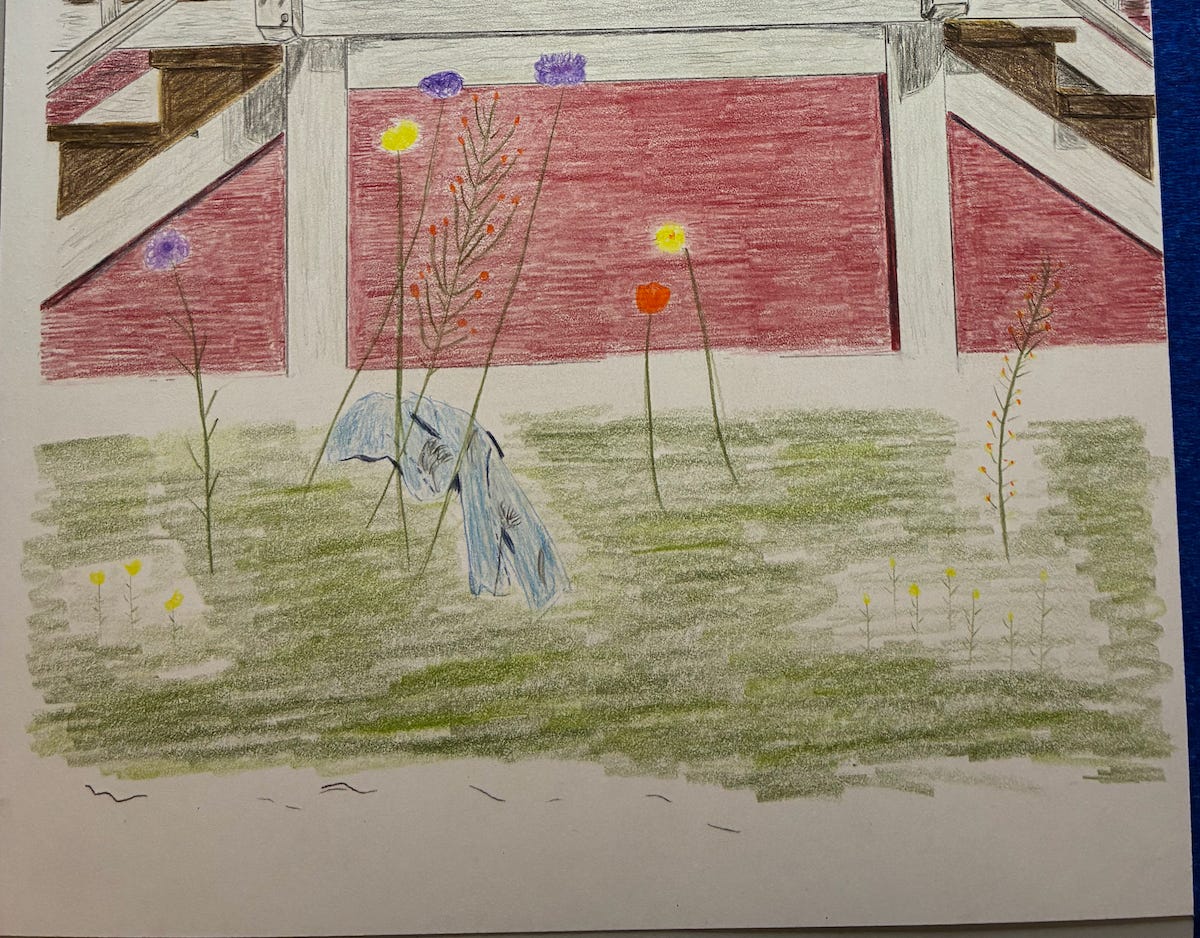
Layer after layer, just adding more and more details.
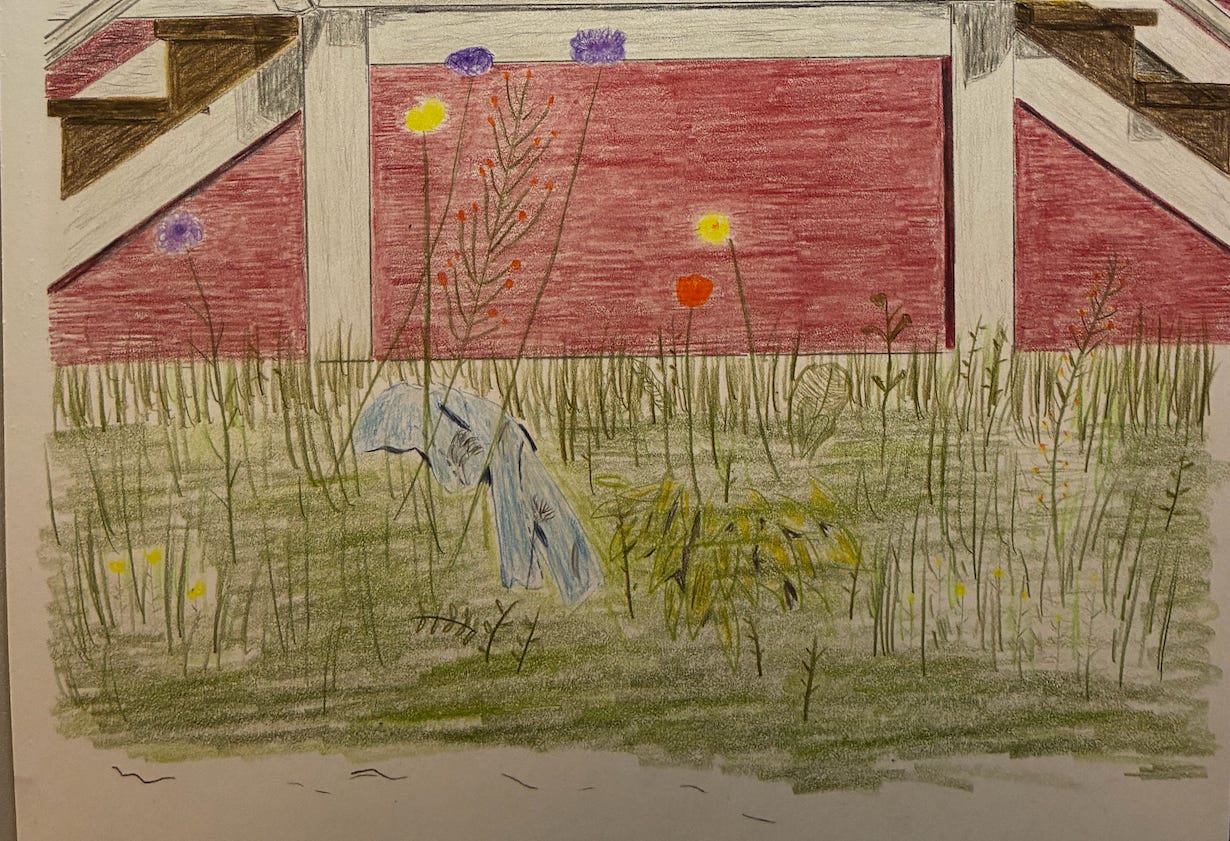
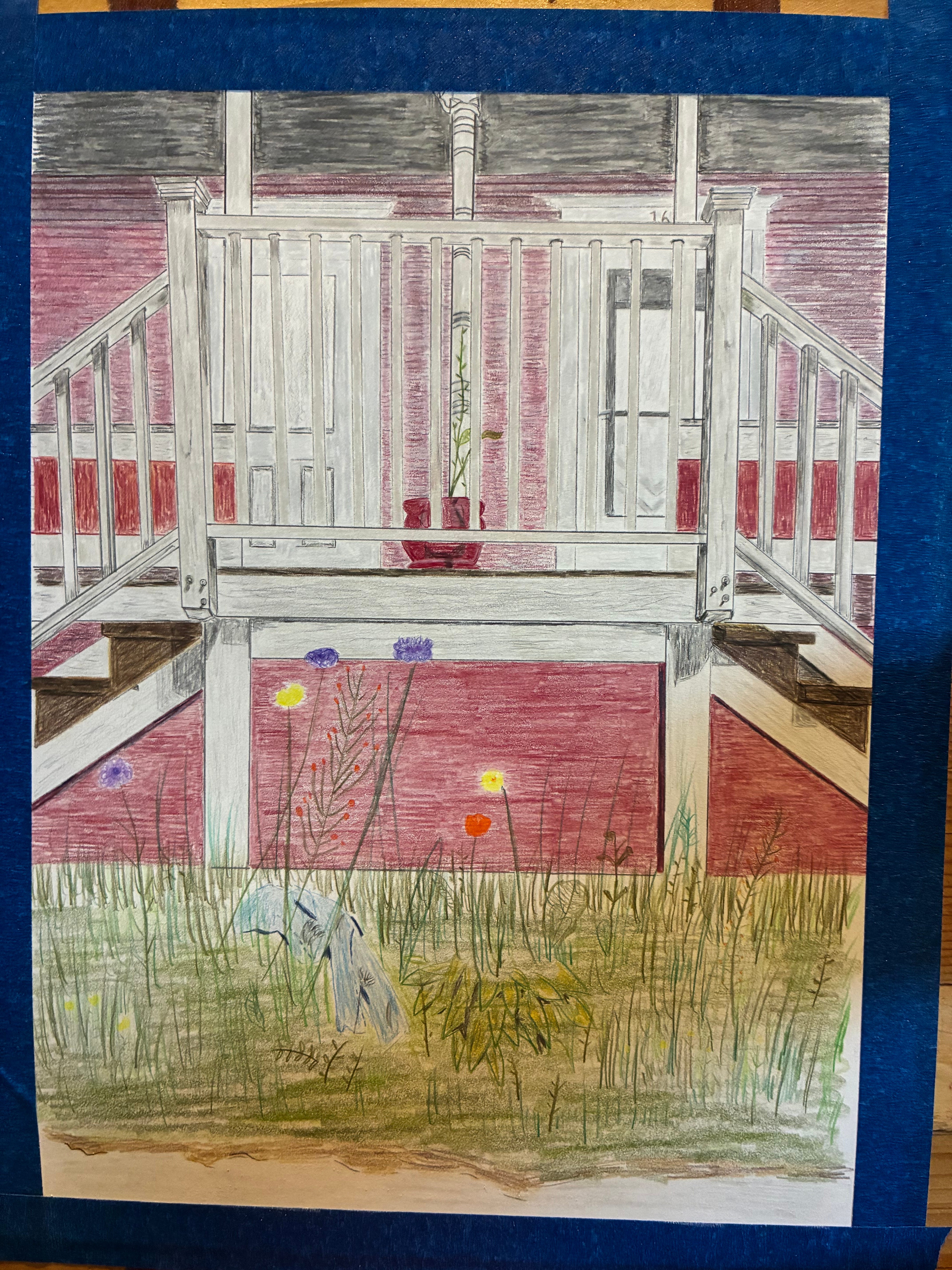
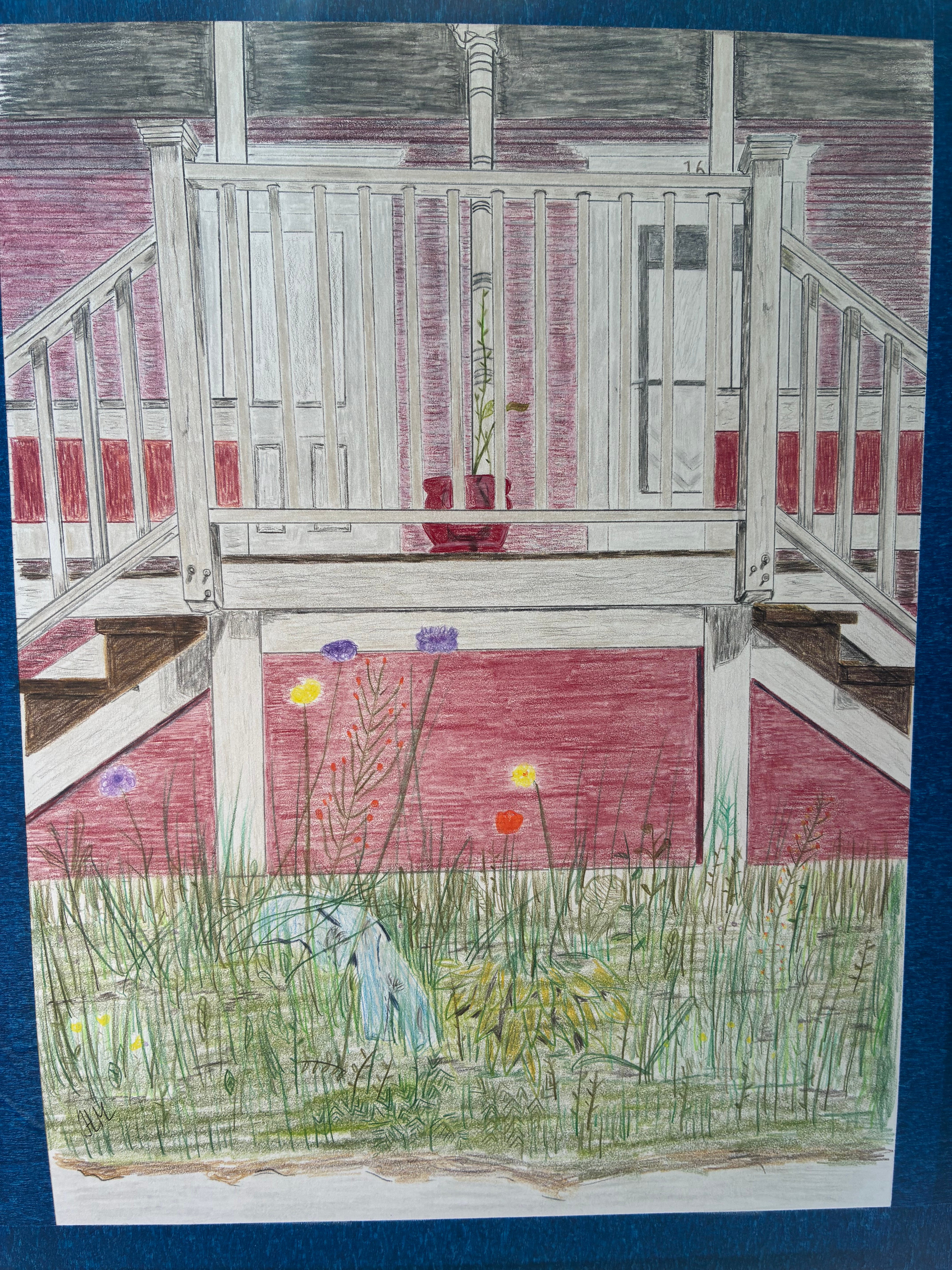
And here, two hours into this part, I had to make a decision, or more accurately, a realization.
I could keep adding plants and leaves and stems in different shades of green all day, but I wasn't going to meet my initial goal.
The jeans were not going to feel like a mysterious surprise. Upon analysis, I see that I’d accidentally made them the star of the drawing instead of something quietly waiting to be discovered.
In the picture I took, they fit much more deeply into the color palette that surrounds them.
I knew that, for realism, it was crucial to have patches of fading and something that resembled stitching. I was too focused on that goal and consequently drew too much of them first. There is also too much contrast; I should’ve been using dark blues and purples underneath the garden instead of greens and browns. I should have drawn just two patches of denim and left the rest suggested.
My initial goal was a failure, but the exercise was not.
I found it enjoyable, stabilizing, and a positive learning experience.
Closing Reflection
It was an incredibly awful couple of days, and it may have cost me ground I spent years gaining, at very high cost. I hope not, but it’ll take time before I will know that for sure.
But the power of art for humans is manifold. It provided me proof that I exist, which it may take another PTSD brain to understand the need for.
When I first saw the photograph, I thought the story was the jeans. They’re what made me stop, check the traffic, step backwards into the road, and take the picture.
Now I think the story was always the garden.
The jeans are still there, still asking their unanswered question, still hinting at some invisible human drama I’ll never know.
But around them, life kept growing anyway. Flowers bloomed. Weeds spread. Paint peeled. Wood weathered. The world continued becoming itself, indifferent to whatever happened on the day those jeans landed there.
Maybe that’s what I needed to remember.
Trauma freezes time. Art unfreezes it.
For a few days, my world became as narrow as the triggering incident, as though everything before it had been erased and everything after it would forever be defined by it.
But every time I picked up a new pencil, I was insisting on a larger truth.
The railing was still worth drawing, even after I colored the ceiling wrong.
The picture was still worth finishing, even after I wanted to throw it away.
And so, perhaps, am I.