
Borrowed Eyes
on borrowing a dead man's gratitude

I lost my shit on Monday.
It was a pop quiz of my therapeutic progress, and I didn’t do very well.
The story is mundane, a boring specimen of post-COVID New Normal: seven months of pharmacy hell, a $75 coupon requiring monthly heroics, and an algorithm I have begun calling Lt. G — short for Lt. Al Gorithm, commanding demon of the seventh circle of hell.
Lt. G is a perfect specimen of Communist central planning, which has a way of generating predictable “unexpected” consequences that somehow never get accounted for.
Nobody local is allowed to update the algorithm.
It takes four months to learn your patterns.
And when it decides, out of nowhere, to restart the whole pre-authorization circus — well, you get 24 hours to sort it out, because Vermont is a nanny state, and Lt. G doesn’t care about snowstorms or insurance snafus or the fact that you’ve successfully completed this exact transaction seven times in a row.
I ended up leaving a work meeting, driving to the pharmacy, and delivering a speech that began, “Do I really have to come down here every month and beg you to take my $75? I will. I’ll plan on it. I’ll block off a whole afternoon for ‘in the United States of America, beg a capitalist institution to take my money’ if I really have to. But is this really where we are?”
And did not improve from there.
I scared my upstairs neighbor with the door slam on the way back in.

I got my meds. I calmed down. I got over it about 50% faster than I used to, which is genuine progress, so I give myself a C-. Next goal: get 50% less upset.
And then I thought about Adam.
My friend Adam died fifteen months ago. He would have turned 41 on March 18.
If you’re new here, the eulogy I wrote for him is one of this Substack’s most-read posts. He also wrote one guest post for me — on American patriotism, from the perspective of a Canadian who loved this country with the particular intensity of someone who chose it rather than inherited it. Read both, if you want to know who he was. I won’t do him the disservice of reducing him to a paragraph.
What I will say is this: Adam, more than anyone I have ever known, loved being alive. Not in the performative, gratitude-journal, taking-advice-from-a-wellness-influencer way. He came very close to losing everything to addiction — the indirect suicide, as I think of it — and he loved life all the more fiercely for nearly forfeiting his own.
I have a gratitude app that reminds me five times a day to stop and count my blessings. I am not proud of needing it. As an adult, I’ve been luckier than almost anyone I know.
The winter after Adam died was the hardest of my adult life.
The grief alone would have been enough. Adam was fit, healthy, and so happy — one of my most reliable anchors through the dark months — and he was ripped away without warning, four days after getting engaged.
The brutal unfairness of it was a fresh wound every morning.
But it was other things, too. I had changed jobs six weeks before he died. The new role wasn’t the right fit, and my working situation ranged from difficult and demoralizing to flatly untenable, but I was so far from my best self that it took me months to be able to see it clearly and longer to find the strength to do something about it.
Combined with the grief and the short days and the cold, it was too much at once.
My therapist — my stoic, plainspoken, not-my-friend-and-never-pretends-to-be therapist — put on a performatively soft voice for the first and only time in ten years and asked whether it wasn’t time for my friend Josh Slocum to come take my gun home with him for a little while…?
He wasn’t wrong.
I am not proud of where I was that winter. I’m also not going to pretend it didn’t happen, because pretending is exactly what I’m writing against.
Here is the contradiction I lived inside, and still live inside sometimes: Adam died wanting more time.
More ordinary Tuesdays. More walks to say hello to the cows. More pie. More Codewars problems at midnight.
More of the life he had spent years building and was just beginning to fully inhabit, the life he was about to expand into marriage.
And I spent that winter — his first winter of not existing — contemplating throwing mine away.
I am, sometimes, exactly that bitch.
I’m working on it.
A year ago, things improved. The snow melted. The clocks sprang forward.
My CEO — the kind of born leader whose people would take a running leap in front of a bullet for him — moved me to the right role, and now I love my job so much that I occasionally giggle that I get paid to do it.
The darkness lifted.
It always does, eventually, which is the thing I can never quite remember when I’m inside it.
But Adam didn’t get eventually.
Memento mori, the Stoics taught us. Remember that you are going to die.
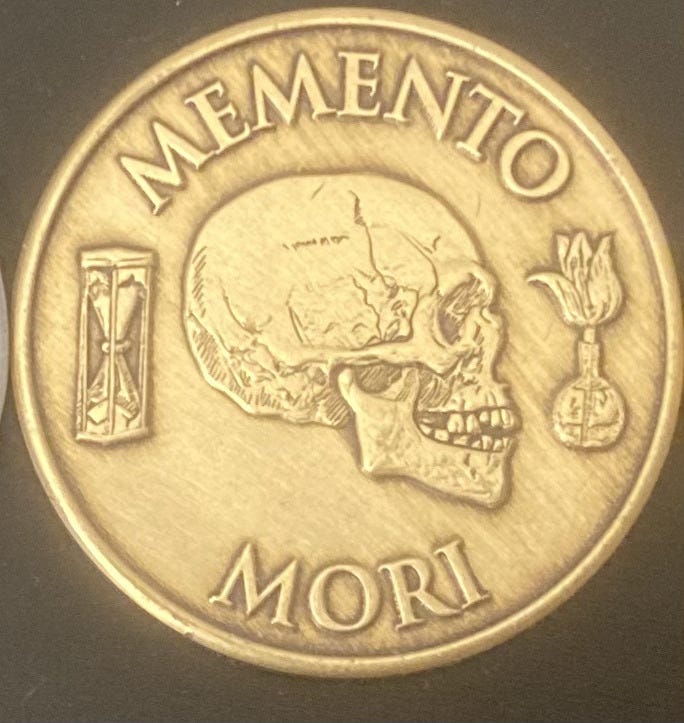
The idea is that keeping death in your peripheral vision — not obsessing over it, just refusing to pretend it isn’t there — the pretense most of us perform constantly and effortlessly — makes you live better.
More deliberately.
With less of your finite time squandered on things that don’t matter.
My version of mortality salience has always been broken. I found a suicide when I was a child, and the image never left. For years, death didn’t feel like a distant horizon to navigate by. It felt like a door I already knew the location of.
That’s not the Stoic ideal. That’s a wound that took a professional to heal, and left a nasty scar that can turn red, swell up, and demand attention without warning.
Adam’s version was different, and better.
He had stared down the same abyss — through addiction, through the slow self-destruction that doesn’t announce itself as suicide but functions the same way — and come out the other side with something I can only describe as luminous gratitude.
He didn’t just know he was going to die someday. He knew he had almost died already, and hadn’t, and that every ordinary Monday after that was a gift he hadn’t earned but intended to use.
That’s what I try to carry now.
When the pharmacy makes me want to put my fist through a wall, I try to see it through his eyes.
The maddening Monday. The algorithm. The door slam.
The C-minus on the pop quiz of my own emotional regulation.
He would have loved this story. He would have called it based that I still showed up and got my meds and calmed down in half the usual time.
He would have asked follow-up questions.
He would have made it funnier than I did.
And he would have given anything — anything — for the chance to have a bad Monday.
I can’t give him that. What I can do is try, imperfectly and inconsistently and with a gratitude app set to five reminders a day, to be worth the Mondays I keep getting.
I wish I could thank him for that.
Happy birthday, Adam. I’m still working on it.